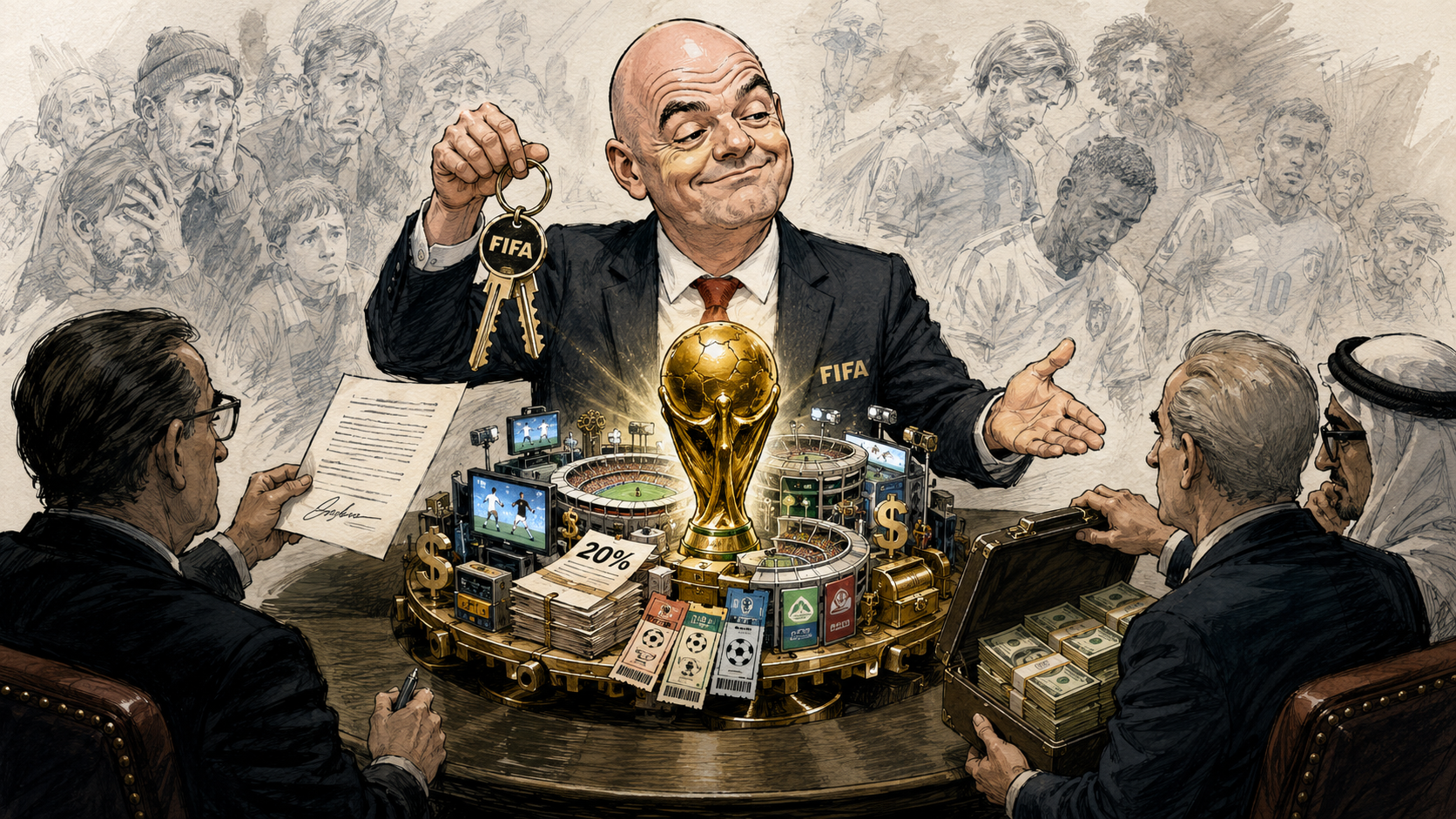
FIFA insists that football is not for sale. It merely wants to place its tournaments, broadcasting rights, sponsorships, ticketing, licensing and event operations inside a company valued at around $20 billion, then sell up to a fifth of that company to private investors for $4.2 billion. The distinction is presumably obvious to people with sufficient legal training and no remaining sense of shame. According to FIFA, this is not privatisation but development, not a sale but investment, and certainly not the surrender of part of the World Cup to financial interests. It is, naturally, the “democratisation of football worldwide”. FIFA has developed a remarkable vocabulary in which every commercial obscenity becomes benevolent once Gianni Infantino has attached the word development to it.
Private investors tend to be disappointingly literal about money. They do not provide billions because they have developed a sudden emotional commitment to coaching facilities in Oceania. They expect returns, and those returns must be produced by the asset they have bought into. In football, the methods are no longer mysterious: more matches, larger tournaments, additional broadcasting windows, higher ticket prices, more sponsorship categories, more hospitality and increasingly inventive ways of charging supporters for the emotional attachment they already provide free of charge. FIFA has already demonstrated the principle through its ticketing operation. As I wrote in FIFA Did Not Fight the Black Market. It Became the Dealer, it did not eliminate the ugliest excesses of the resale market. It absorbed them, controlled the platform and took its percentage. The proposed company would apply the same instinct on a grander scale. FIFA would no longer merely sell the product with the enthusiasm of a dealer. It would sell investors a share in the dealership itself.
FIFA says that private investors would hold minority, non-controlling stakes, that they would have no authority over sporting decisions and that the organisation would retain permanent control. This is meant to be reassuring, although FIFA remaining in control is precisely what has brought us here. Investors would not need to select referees, write the Laws of the Game or decide who plays whom. Their expectations would be present whenever FIFA discussed how often its competitions could be staged, how far they could be expanded and how much more revenue might be extracted from them. Once part of the World Cup appears on an investor’s balance sheet, commercial growth ceases to be merely Infantino’s favourite obsession and becomes the economic logic of the structure.
The tournament would remain recognisable, because even private capital understands that the packaging must not be damaged. There would still be flags, anthems, tears, children in replica shirts and carefully edited films about unity. The football would simply become more bloated, more expensive and more exhausting, while every degradation was presented as an improvement in access, inclusion or global reach. Supporters supply the atmosphere and the emotion. FIFA reserves the right to determine how much of either they can still afford.
The manner in which the proposal emerged makes the commercial plan impossible to separate from the man behind it. Confederations complained that they had not been properly consulted. Carlos Cordeiro, appointed by Infantino in 2021 as a senior adviser to help shape FIFA’s future, resigned with immediate effect, stating that he had no involvement in the proposal, that he opposed it unequivocally and that FIFA was mortgaging football’s future without compelling justification. A former banker declining to be associated with a financing structure is not the usual direction of travel.
Then FIFA’s own chief operating officer, Kevin Lamour, said that staff had been deceived and described the proposal as the project of one person. This is the sentence that matters. Not a rival confederation, not a European president with his own interests, not a columnist: the executive responsible for running the organisation, publicly stating that the largest commercial decision in FIFA’s history belongs to an individual rather than to the institution. FIFA’s response was to blame incorrect media reports for disrupting its intended consultation and to announce that it would continue presenting the plan to the 211 member associations. Apparently the absence of consultation was not the problem. The problem was that the public discovered the arrangement before Infantino had finished presenting it as democracy.
None of this requires a forensic reconstruction of meetings that certain people did not attend. It simply confirms how FIFA now operates. The Council exists, the committees exist, the advisers exist and the Congress exists, but important decisions increasingly emerge from a narrow presidential circle before the institution is invited to admire them. Infantino does not behave like the temporary custodian of a sporting federation. He behaves like the proprietor of a business whose governing bodies remain useful mainly because even autocracy looks better with minutes.

That is what makes FIFA Forward Enterprise more than another greedy commercial initiative. It would create a powerful new company around FIFA’s most valuable assets, establish permanent relationships with private investors and, by design, outlast the presidency that produced it. Infantino faces re-election in 2027, and FIFA’s rules on how many terms he may serve have already proved flexible enough to reward careful reading. No future role for him in the proposed company has been confirmed, and there is no evidence that one has been arranged. Yet only the incurably innocent would fail to ask whether the man constructing a new commercial empire has considered where he might sit once the presidential office is no longer available to him.
The expected lead investor supplies an almost unnecessarily elegant detail. The group is to be fronted by Thrive Eternal, a fund run by Thrive Capital, the firm founded by Joshua Kushner, brother of Jared Kushner, Donald Trump’s son-in-law. Jared himself is not reported to be investing, which is an important factual distinction and a rather limited improvement to the overall appearance. Infantino has displayed his proximity to Trump with the restraint of a tourist determined to appear in every photograph. At the 2026 World Cup draw, as I wrote in The Day FIFA Finally Stopped Pretending, football became background scenery for political flattery and a spectacle increasingly organised around Infantino himself. Now an investment vehicle founded within the wider Kushner family is expected to lead the group acquiring part of FIFA’s commercial future. Perhaps everything is entirely proper. It merely has the visual elegance of a private entrance being opened for people who already know the building.
Infantino appears to have absorbed the essential lesson of the political figure he so admires: holding office is useful, but building a structure that preserves money, loyalty and influence beyond the office is better. Leave the institution formally intact. Weaken its internal restraints. Personalise authority. Reward dependable supporters. Construct a system in which the distinction between the organisation and the man controlling it becomes increasingly theoretical.
The reward mechanism is not a matter of interpretation, because FIFA has published the numbers. Member associations are currently promised around $8 million each in development funding for the 2027–30 cycle. Under the proposed structure, that becomes $20 million, then $22 million, then $24 million, with a further one-off capital programme on top. And associations that oppose the plan have been warned that they would be excluded from the new funding model if it passes without them. So the offer to the electorate that decides Infantino’s future is roughly this: vote for the sale of football’s commercial heart and receive several times your current income, or decline and watch your neighbours receive it instead. Infantino calls this democracy. It is the oldest political instrument in existence, distributed by bank transfer and defended with the vocabulary of solidarity.
This is the fraud concealed inside FIFA’s version of one association, one vote. The principle gives smaller countries a voice, which is entirely defensible. It also allows the president to distribute money generated largely by the tournaments of the biggest football nations to an electorate that then decides whether he should continue controlling the distribution. The system does not merely tolerate patronage. It is patronage, with a constitution.
Which is why UEFA’s reaction matters, not because European football has suddenly discovered moral purity, but because it has finally discovered leverage. All 55 European associations voted unanimously to boycott FIFA competitions while the proposal remains alive. Concacaf and the Asian Football Confederation have rejected the plan, though both stopped short of a boycott. Between them, those three confederations contain 143 of FIFA’s 211 members. The proposal requires a majority of that membership. On the current arithmetic it is not a controversial plan awaiting consultation. It is a dead plan awaiting an obituary that Infantino has not yet agreed to write.
For once, FIFA is not facing another carefully drafted expression of concern that can be acknowledged, filed and forgotten. It is facing the possible withdrawal of the teams, players, audiences and football cultures without which the World Cup becomes a well-sponsored administrative conference with an opening ceremony.
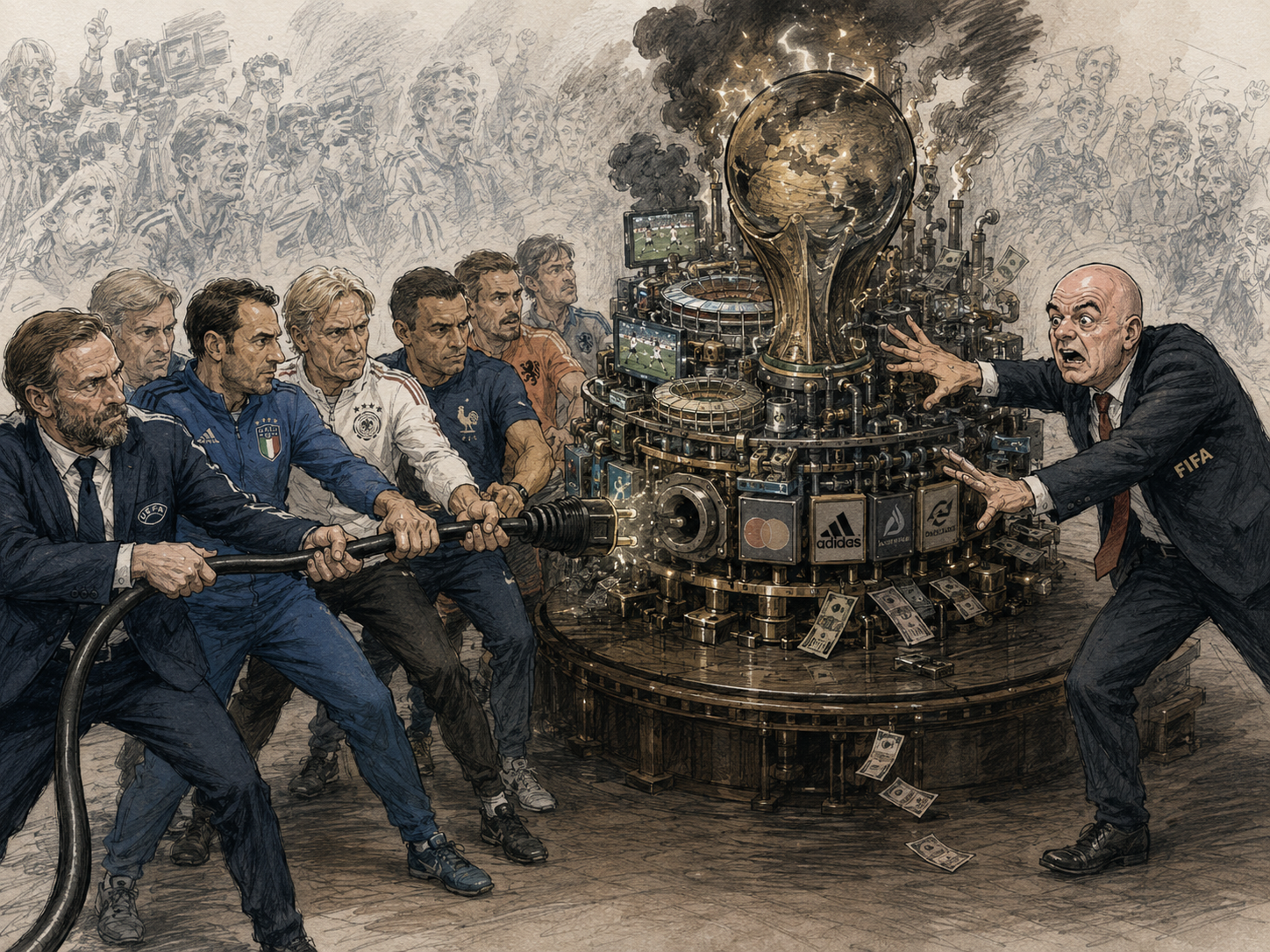
Europe tolerated the arrangement for far too long. Most of the great football nations are European, with Brazil and Argentina the obvious exceptions, yet UEFA behaved for years as though FIFA were a natural authority from which withdrawal was unimaginable. The result was an absurd combination of sporting importance and political impotence. Europe complained, national associations muttered, journalists published outraged columns, and everybody attended the next tournament. Infantino understands the routine, because it has protected him throughout his presidency.
I argued after the ticketing affair that FIFA could no longer be reformed from within, and that meaningful resistance would begin only when the major football nations acted together. At the time that read like a fantasy. It is now the unanimous position of an entire confederation, which tells you less about my foresight than about how far FIFA has been permitted to go.
UEFA must now avoid its habitual mistake of accepting a tactical retreat as a strategic victory. If FIFA withdraws this proposal while Infantino remains in office, nothing has been solved. He will simply have learned that the plan was introduced too openly, that the resistance was unexpectedly coordinated, and that the payments should have been discussed before the investors. The next attempt will arrive with more consultation theatre, softer terminology and an even larger development fund.
The demand must therefore go beyond the abandonment of FIFA Forward Enterprise. Infantino must leave, and FIFA’s governance must be reformed so that his successor cannot reproduce the same system with better manners and a less irritating smile. Major commercial decisions require independent supervision. Presidential power requires genuine limits. Europe requires political influence proportionate to the responsibility it carries for world football. Smaller nations must retain a meaningful voice, but equality cannot mean that the countries sustaining the World Cup have no effective means of preventing its commercial dismemberment. A credible challenger in 2027 would help. A rule preventing the next president from ever attempting this again would help considerably more.
If FIFA refuses, UEFA should leave. That sounds extreme only because football administrators have spent decades presenting submission as responsibility and cowardice as diplomacy. FIFA’s authority derives entirely from the willingness of the football world to participate. Remove the great nations and it still owns the trademark, the headquarters and presumably several thousand pages of regulations. What it no longer owns is a World Cup worth watching.
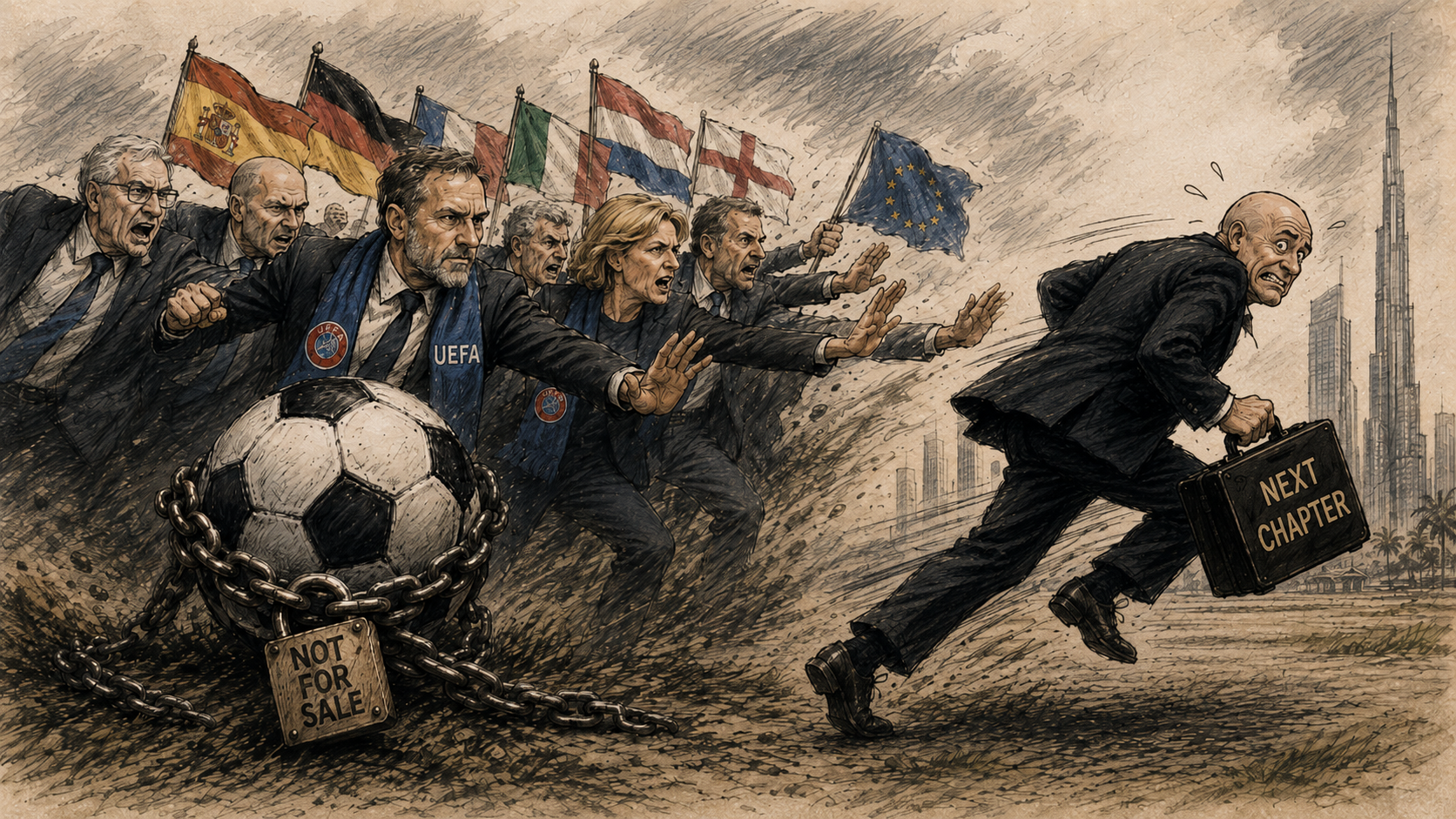
FIFA is right that football is not for sale, although not for the reason it imagines. Football cannot be sold by FIFA because it does not belong to FIFA. It does not belong to private investors, and it certainly does not belong to Gianni Infantino. UEFA has finally threatened to remind him. This time it must not settle for the withdrawal of the plan. It must insist on the departure of the man who believed he had the right to propose it.
Like always, just my five cents.
//Alex


1 comment