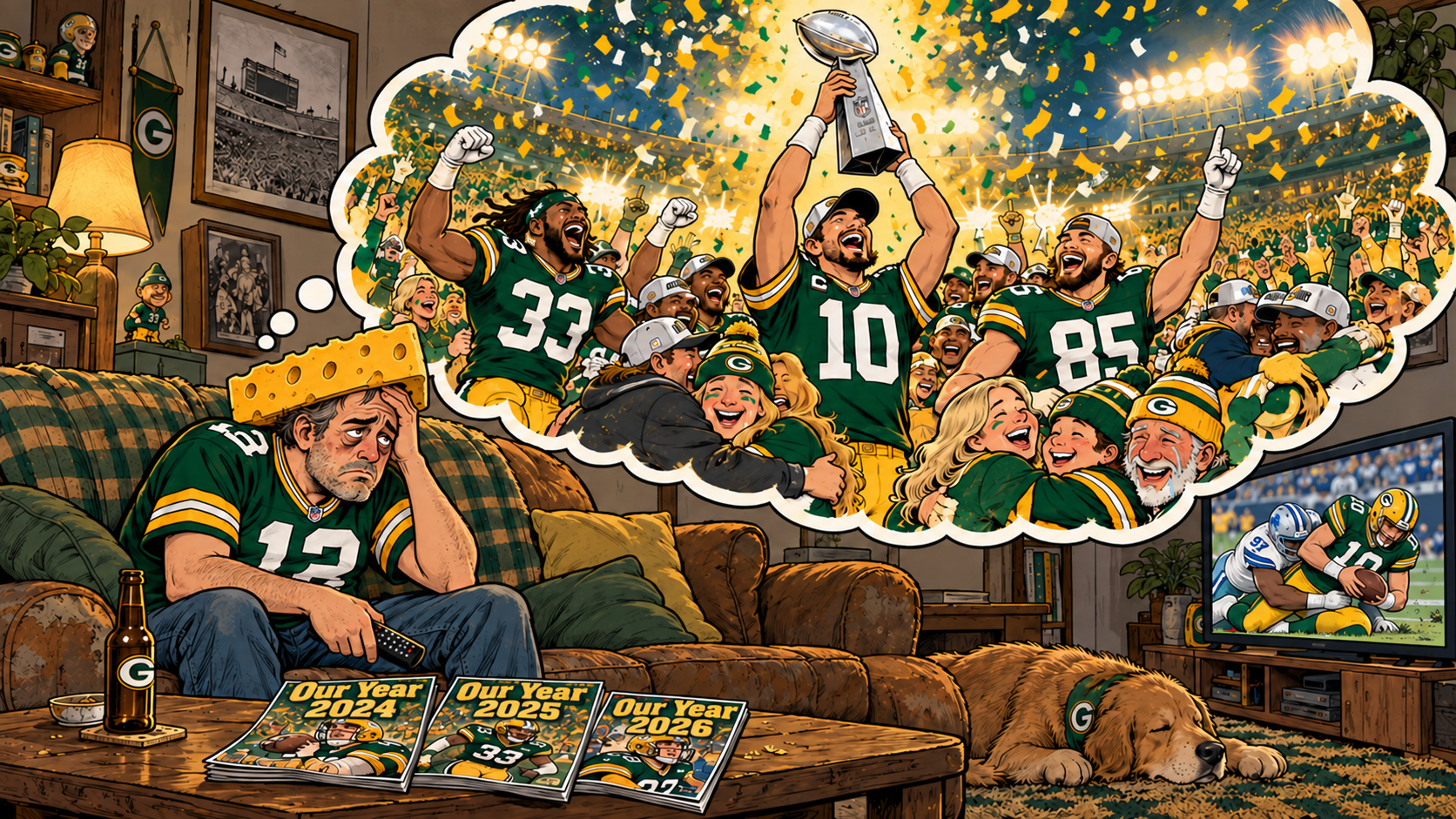
There is a particular indignity in spending the summer wondering whether your team can win the Super Bowl and reaching September grateful for a first down. I had allowed myself rather more ambitious thoughts about the Green Bay Packers. There was talent, there was investment, and there was the unmistakable suggestion that the people in charge believed the time had come. Three games into the season, I would settle for an offensive line that treats the arrival of a defender as something it had been expecting.
The 35–14 defeat to Atlanta at Lambeau was an efficient correction of my expectations. The Packers managed 17 rushing yards. Jordan Love threw 53 passes. Atlanta ran for 242 yards and kept the ball for more than 37 minutes. There are defeats in which a promising team falls short, and defeats in which you begin checking whether the promising team was ever more than a collection of names. This was firmly in the second category.
Love was inaccurate at times, receivers dropped passes, and the defense offered plenty of independent reasons for concern. But the offensive line sits beneath almost everything that went wrong. If you cannot run, the opposition has less reason to respect the possibility. If you cannot protect, the passing game becomes an increasingly urgent exercise in getting rid of the ball. When possessions end quickly, the defense goes back out. None of this absolves defenders who miss tackles or lose receivers. It does explain how weakness in one part of a team can steadily make the rest of it worse.
What makes the line so infuriating is that Green Bay has spent money and draft capital on it. Jordan Morgan was a first-round pick. Anthony Belton was a second-round pick. Aaron Banks arrived on a four-year, $77 million contract. Sean Rhyan received a new deal this spring. The question for Brian Gutekunst is therefore more uncomfortable than why he neglected the position: why have these investments produced something so fragile? Listing the resources committed to a problem is a poor answer when the problem is currently running unblocked toward your quarterback.
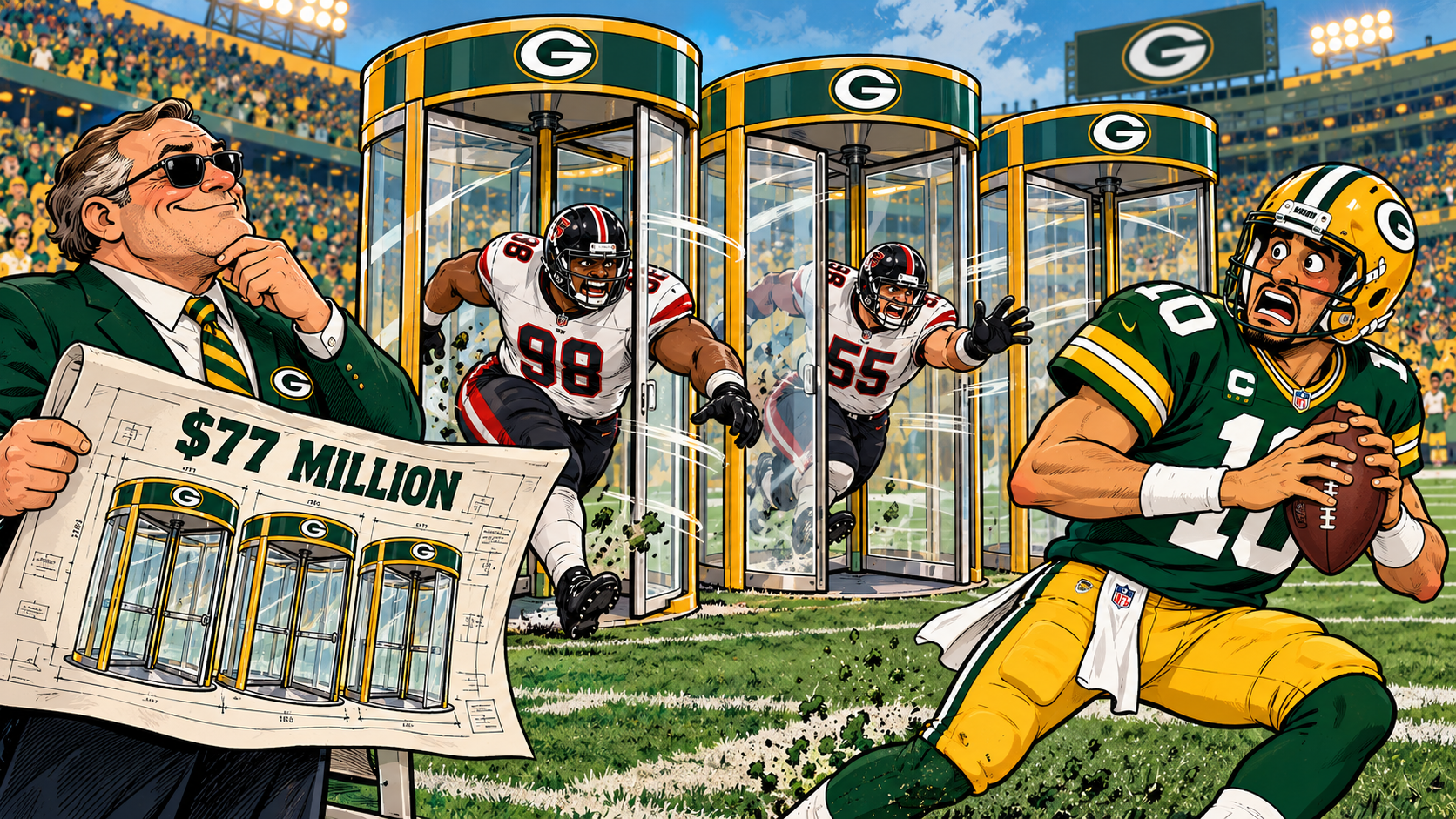
The dependence on Zach Bako-Bewele, formerly Zach Tom, was hardly a recent discovery. The Packers won only one of the six games they played without him in 2025. He entered this season after surgery on a partially torn patellar tendon, then suffered a complete tear of the same tendon against the Jets. That is dreadful for the player, and the outcome alone tells us nothing about whether his medical clearance was wrong. It does, however, leave a legitimate question for the organization: how much of the plan depended on a recovering cornerstone remaining available, and how convincing was the alternative?
The injury history makes that question harder to dismiss. The 2024 season ended with Christian Watson unavailable after a torn ACL and more players going down during the playoff loss in Philadelphia. In 2025, Tucker Kraft and Micah Parsons suffered season-ending knee injuries, while other important pieces disappeared for substantial stretches. Now Bako-Bewele is out for 2026, Jayden Reed has suffered a frightening neck injury, and Parsons is still working his way back. No sensible person expects an NFL roster to contain spare All-Pros at every position. I would nevertheless like the distance between “our preferred starters” and “we appear unable to operate” to be slightly greater.
We even know what a successful contingency plan looks like. Malik Willis won both starts while Love was unavailable early in 2024. Unfortunately, that reassuring example now plays for Miami. Keeping him at the price the Dolphins paid would have been an expensive luxury, so his departure is not, by itself, evidence of incompetence. It does mean we cannot keep citing him as proof that the current Packers are well insured. Watching Love absorb pressure behind this line is considerably less relaxing when the familiar emergency solution has moved to Florida.
Then there is Josh Jacobs, whose absence belongs in an entirely different category. He remains on the commissioner’s exempt list after pleading no contest to misdemeanor battery and criminal damage to property charges. The human implications deserve more seriousness than treating the case as an inconvenience to the running game. But professional responsibility and availability matter too, and once a possible absence became a known risk, the football operation needed a credible response. A team cannot control every action of every player. It can be judged on how it prepares when relying on one of them becomes uncertain.
Meanwhile, Green Bay has been remarkably decisive about extending contracts. Love received his $220 million extension after one season as the full-time starter. Reed and Watson received new deals this year. Kraft signed his substantial extension immediately before his first competitive game back from a torn ACL. There are defensible reasons for all these decisions: talent, previous production, expiring contracts and the risk of paying more later. Still, it is reasonable to ask how confidently the Packers are pricing sustained performance and availability. The organization seems rather better at securing the future of its preferred players than at making the present work when some of them are missing.
Matt LaFleur’s extension deserves the same scrutiny. It was agreed in January, after the Packers surrendered a 21–3 halftime lead to Chicago and left the playoffs with a 31–27 defeat. Gutekunst and Russ Ball were extended too. The leadership had reviewed the leadership and concluded that continuity was essential. Perhaps it was.
LaFleur’s regular-season record gives the decision a serious defense. His 3–6 playoff record at the time supplies an equally serious objection. In that Chicago defeat, the Packers struggled to pick up additional pressure, the offense stalled, and the defense was left carrying an increasing burden. Months later, we are discussing protection failures, offensive paralysis and a team unable to stop its difficulties spreading. Nobody expects a coach to prevent every injury. Adapting when conditions become less convenient is, however, a fairly substantial part of the job.
Contracts do not make anyone impossible to remove, but they make reversals expensive, and admitting an expensive mistake rarely gets easier for people who have just been extended themselves. I am pleased the organization believes in its people. I would be more pleased if those people could provide fresh evidence that the belief remains justified.
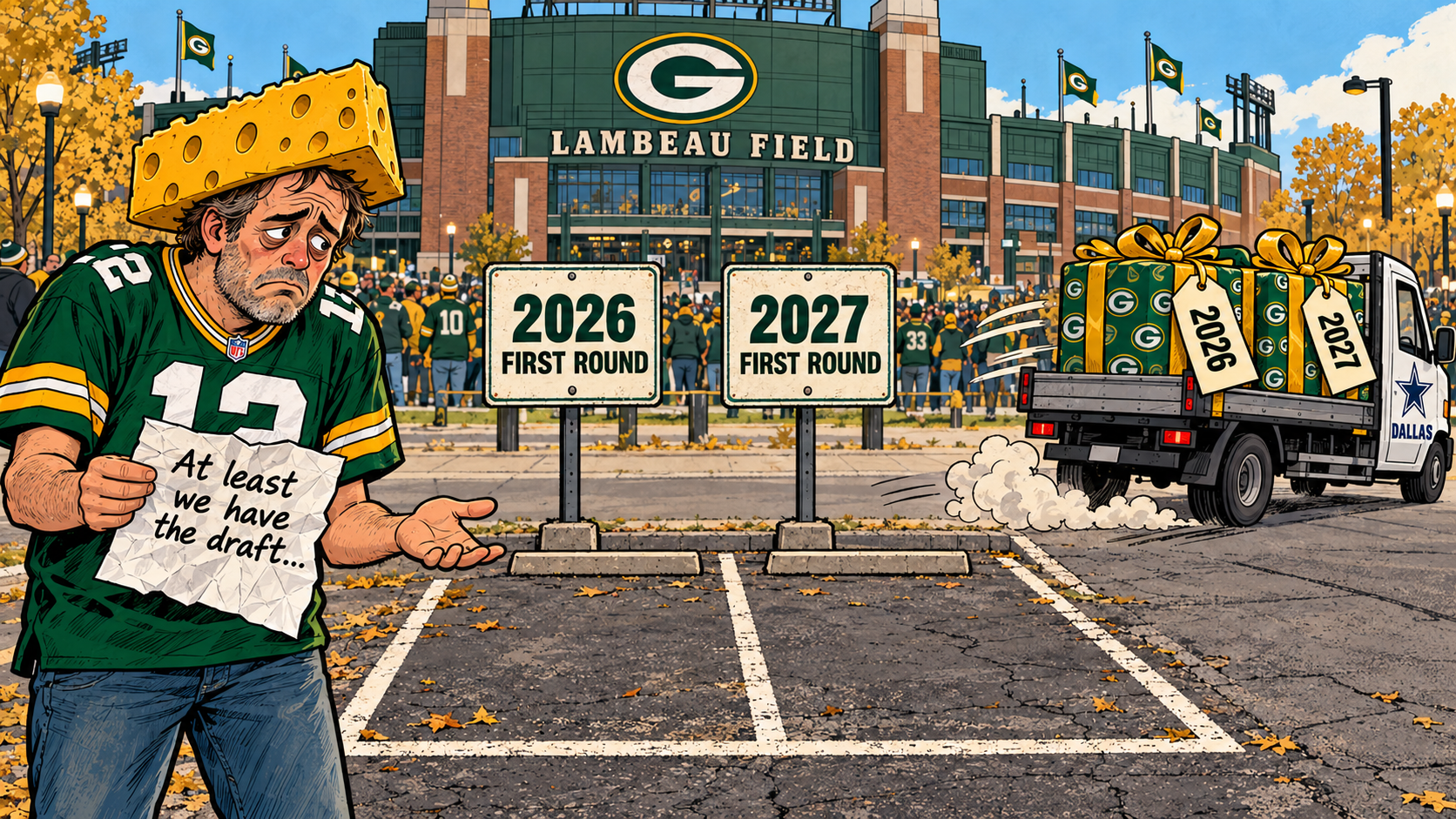
The Parsons trade is what gives all of this its particular urgency. Green Bay sent Kenny Clark and its first-round picks in 2026 and 2027 to Dallas, then committed to a reported four-year, $188 million extension for Parsons. That was a declaration of intent. I welcomed the ambition. I still understand the appeal of acquiring a player that good. But you cannot spend that much of tomorrow to strengthen today and then ask everyone to regard today as another developmental exercise.
Usually, a miserable season comes with one small consolation: at least the draft position improves. The Packers have already transferred the most valuable part of that consolation elsewhere. The 2026 first-rounder is gone, and a disastrous 2026 season would make the surrendered 2027 first-rounder more attractive to somebody else. There is something exquisitely unpleasant about watching your own team struggle while knowing that another franchise stands to receive the most obvious draft benefit. Even our consolation prize has been traded.
Green Bay will still have other picks, and the salary cap is not permanently unmanageable. But there is no effortless reset: cuts can leave dead money, restructures can move costs into later years, and money committed to keeping this core together cannot simultaneously buy every solution around it. Love’s scheduled cap charge alone rises from roughly $36 million in 2026 to $44 million in 2027 under the current structure. The team has choices; it has already made some substantial ones.
That is why this feels more alarming than an ordinary poor September. My fear is that we are watching the expensive version of the team fail before it has delivered the success that was supposed to justify the expense. If the line remains a fundamental weakness, fixing it next spring will require more than announcing that another year of experience should help. If the coaching cannot adapt, a new contract will not supply the missing answers. Losing now could leave 2027 occupied with repairs when it was meant to be part of the championship run.
At some point, Titletown has to be an expectation as well as an address. I do not demand a Lombardi Trophy every February, although I would be willing to endure the inconvenience. I do expect a team making these commitments to look as though it is moving toward one. Another respectable record followed by a familiar postseason collapse would be disappointing enough. Watching the whole project become precarious before October, with next April’s first-round pick already gone, is rather more difficult to file under patience.
And yet I know exactly how this will end for me. Parsons will return, somebody on the line will improve, a receiver will make an outrageous catch, and I will begin assembling the evidence for renewed confidence. By next summer, the injuries will have become unfortunate interruptions, the weaknesses will have become lessons learned, and I will explain, with embarrassing conviction, why the roster is finally ready. We are going to the Super Bowl next season, obviously. I have identified several serious flaws in the Packers’ planning. None of them appears to have improved my own.
As always, just my five cents.
//Alex

