
Changing radio stations around Zürich is an activity that promises considerably more choice than it delivers. Radio 24, Energy, SRF 3, Radio Top and the other familiar names may have different presenters, jingles and opinions about how urgently I need another traffic update, but musically they tend to inhabit much the same universe. Switzerland has its official singles chart, SRF 3 still devotes its weekly Hitparade to the current Top 30, and much of commercial pop radio naturally gravitates towards the same successful songs. Press a preset because you have heard enough of one particular hit and there is a respectable chance that another station will greet you with either the same song or one of its immediate neighbours.
This has annoyed me for years. It is not necessarily because the music is bad. Some of it is very good. The problem is the relentless repetition. A song appears, becomes successful and is subsequently played with such enthusiasm that within a few weeks it has travelled the full emotional distance from “Oh, I like this” to “For God’s sake, not again.” Modern radio can achieve this transformation with impressive efficiency. The same handful of successful records follows you to work, accompanies you home again and occasionally catches up with you at the weekend, presumably just to make sure there are no remaining pockets of affection.
There is, however, one redeeming feature to the whole system: the charts move.
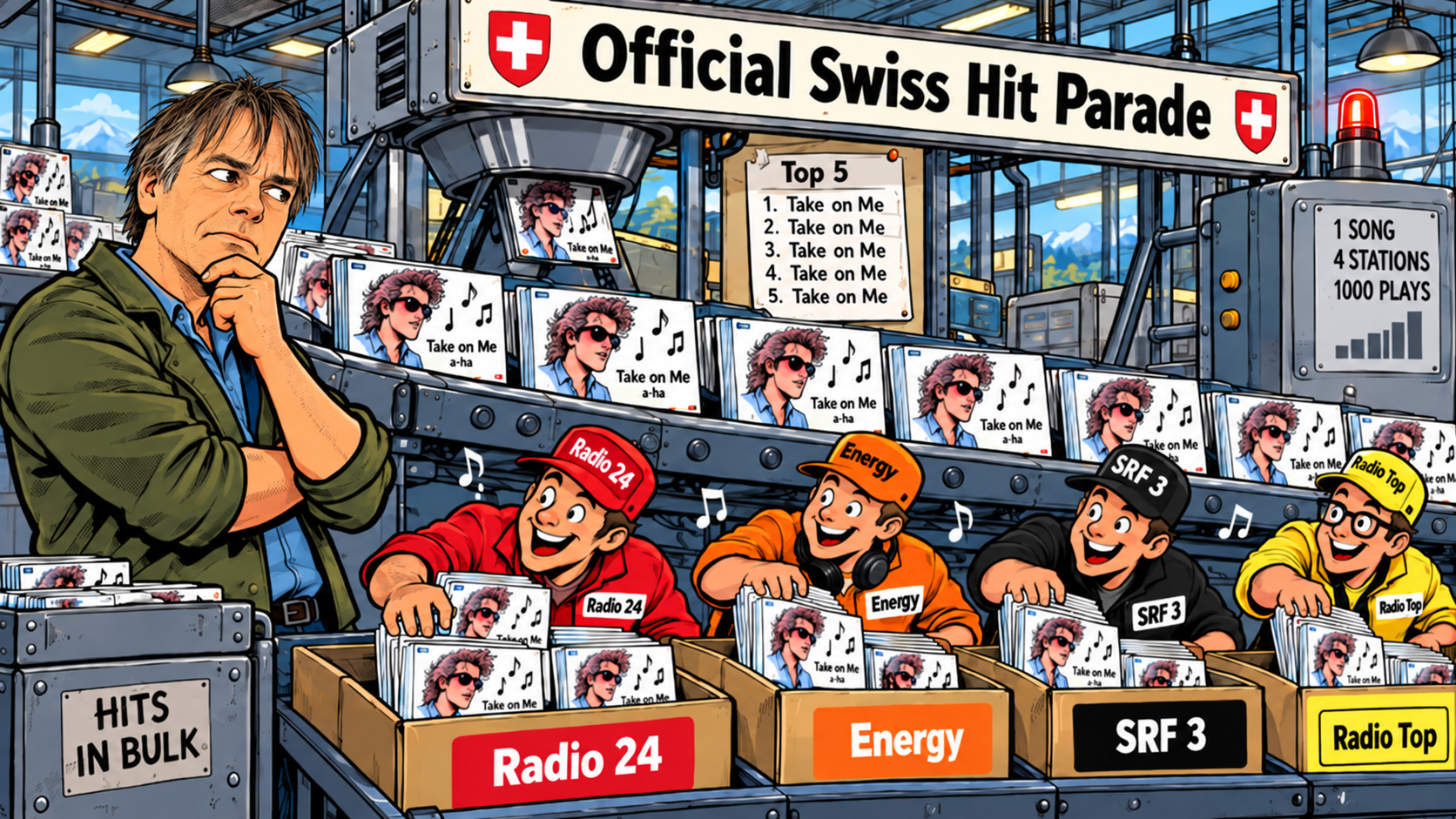
Not quickly, admittedly. A sufficiently successful song can hang around with the determination of somebody who has not noticed that the party ended an hour ago. But new records do enter, others climb, some gradually fall back and eventually even the most persistent hit disappears from heavy rotation. Only a few titles may change at a time, so the overall impression remains reassuringly repetitive, but there is at least movement. Today’s musical wallpaper is slowly replaced by tomorrow’s musical wallpaper, and after a year or two the song you once could not bear to hear again may even become pleasant.
Radio Zürisee has discovered a way to remove this last remaining element of uncertainty.
The station used to occupy broadly the same mainstream territory, but at some point it did what companies do when they decide they need a sharper profile: it researched its audience. Music testing and listener surveys apparently produced the insight that people in its target group rather liked music from the 1980s and 1990s. This is not entirely astonishing. A considerable part of that audience actually grew up with it. If you are now old enough to have strong opinions about mortgage rates, wine storage and whether a restaurant is too loud, there is a reasonable chance that the soundtrack to your youth involved synthesizers, enormous hair or both.
As someone who belongs rather comfortably to this demographic, I approve of the basic idea. I like the 80s enormously, and there was plenty of excellent music in the 90s too. More importantly, both decades offer an almost ridiculous amount of material. Twenty years of popular music should be enough to operate a radio station without creating the impression that somebody has left a playlist on repeat. And yet, after spending some time with Radio Zürisee, that impression slowly begins to form.
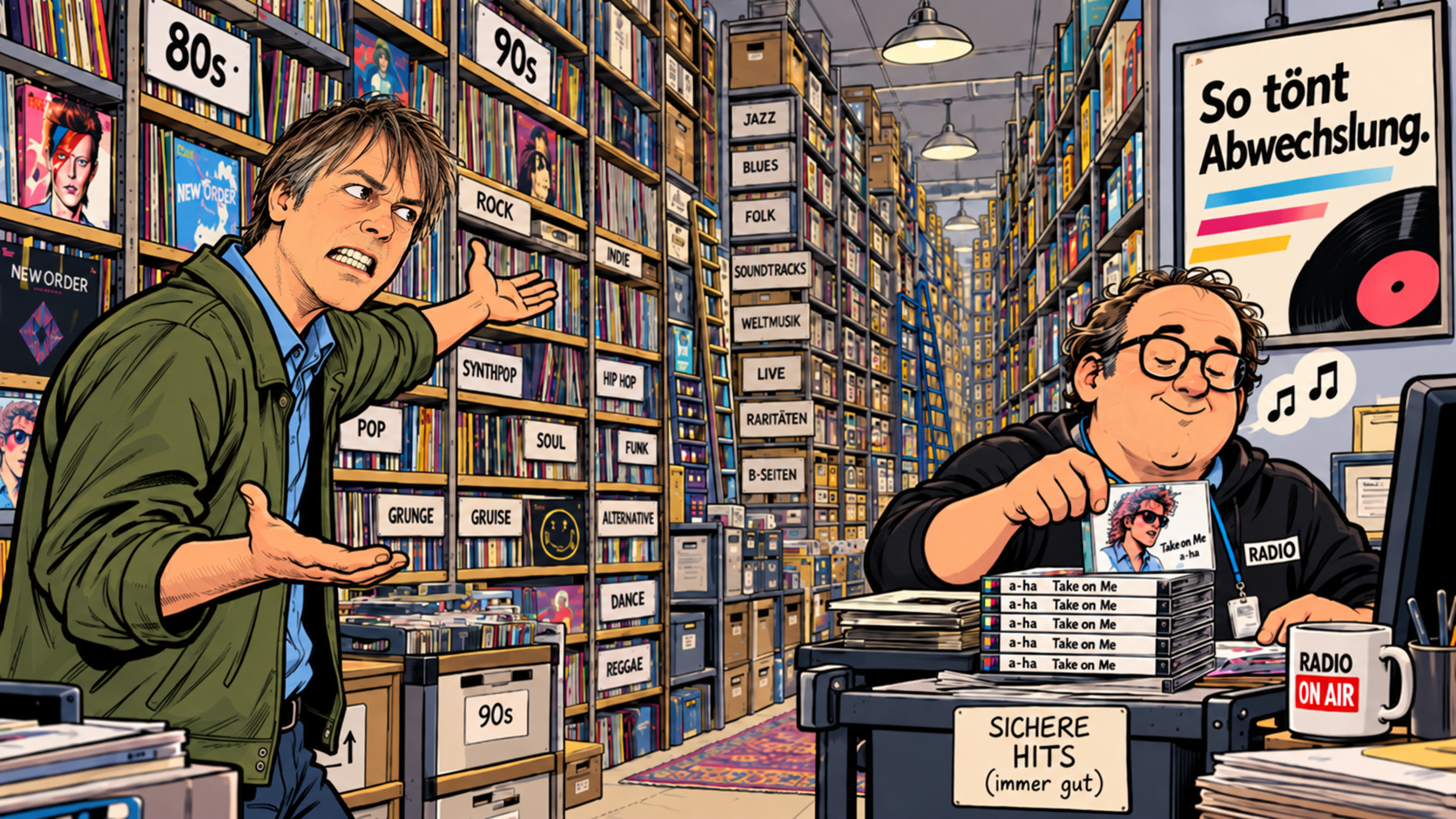
I have no idea how many songs are actually in its core rotation. Perhaps it is a hundred. Perhaps it is 150. Perhaps considerably more. The number itself does not matter, because the sensation is unmistakable. Listen often enough, particularly during regular commuting hours, and you begin to recognise the furniture. The same artists return, the same obvious hits come round again, and songs that initially produced a pleasant little burst of nostalgia gradually start eliciting exactly the same reaction as the current chart hits I was trying to escape.
Oh, not this one again.
This is rather an achievement, because the 1980s alone contained enough musical variety to keep a mildly curious person occupied for years. There was new wave, synth-pop, post-punk, rock, metal, funk, soul, electro, new romanticism, early house and all manner of other things produced during an era in which musicians appeared to have been given unlimited access to synthesizers, hairspray and questionable clothing without adequate adult supervision. The 1990s added grunge, Britpop, trip-hop, techno, house, Eurodance, alternative rock and another enormous catalogue of pop music that ranged from excellent to magnificently regrettable.
You do not even have to venture into obscure B-sides recorded in somebody’s basement in Düsseldorf. There are thousands of perfectly accessible songs from those decades, including major hits that have largely vanished from radio, smaller hits that instantly return you to a particular summer, and artists whose entire careers appear to have been quietly compressed into the one song everybody already knows.
That last part is where nostalgia radio becomes strangely conservative. Play an artist with ten successful singles and somehow the same one tends to win. There is apparently an officially approved Phil Collins, an officially approved Roxette and an officially approved Bon Jovi. Entire catalogues are reduced to the titles least likely to make anybody reach for the button. Which is, of course, exactly how we arrived at mainstream hit radio in the first place.
The irony is rather elegant. Radio Zürisee has escaped the repetitive world of current chart music by reproducing its operating model with older records. The pool may be larger, but it has one fundamental disadvantage compared with the current Hitparade: nobody is making any new songs for it. The 1980s are finished.
This may come as disappointing news to parts of the fashion industry, but musically the decade is complete. There will be no promising newcomer entering the 1986 charts next Friday. Nobody is about to release a surprising new single in 1992. The inventory is fixed, and unless somebody expands the part of it being played, the rotation does not merely become repetitive. It becomes permanently repetitive.
That makes Radio Zürisee’s problem subtly different from the one suffered by the mainstream stations. Radio 24 or Energy may hammer the current hits into your skull until you begin to consider driving in silence, but at least the offenders are mortal. Six months later some of them will be gone. A year later the musical landscape will have changed again. Radio Zürisee, by contrast, can continue serving the same nostalgic favourites until the people who bought the originals on vinyl are comparing assisted-living facilities.
This is particularly unfortunate because nostalgia is at its best when it arrives unexpectedly. Hearing a song you have not encountered in thirty years can be astonishing. Within a few seconds you remember a place, a car, a holiday, a nightclub, perhaps even somebody you had successfully forgotten. Music has an extraordinary ability to reopen rooms in your memory that you did not know were still there.
But the effect depends rather heavily on surprise. If the song comes back next Tuesday, it is still nice. If it appears again on Friday, you may begin to notice. If it follows you around for the next eighteen months, it is no longer an unexpected visitor from your youth. It has moved in.

This is also where audience research can become unintentionally self-defeating. Ask people which songs from the 80s and 90s they like and the familiar classics will naturally perform brilliantly. Everybody knows them. Everybody remembers them. They have survived precisely because they have been played for decades. The forgotten song somebody adored in 1987 faces a slight methodological disadvantage in a survey asking people what they remember enjoying.
Yet that forgotten song is exactly what I would like a station devoted to those decades to find for me. That should be the pleasure of the format. By all means play the obvious classic, but then wander a little further into the catalogue. Give me another song from the same artist. Play something that was huge in 1984 and has somehow disappeared. Remind me of a record I have not thought about since school. Surprise me with something that makes me wonder how I could possibly have forgotten it.
My own 80s playlists manage this rather better, which is not an especially impressive boast. I do not have a music department, market research or professional audience testing at my disposal. I have merely accumulated enough music over the years to discover that an entire decade contains more than its greatest hits compilation.
Radio Zürisee even advertises its musical proposition with “Die grössten Hits der 80er, 90er und mehr”, which is perfectly fair. More entertaining is the slogan attached to it: “So tönt Abwechslung.”
There is something wonderfully Swiss about conducting extensive audience research, carefully identifying what everybody already knows they like, removing as much uncertainty as possible and then calling the result variety. The annoying part is that I still like Radio Zürisee’s basic idea. Given the choice between yet another station following the current chart mainstream and one drawing on twenty years of music I grew up with, I will happily take the latter. The raw material is vastly better and almost inexhaustible. Almost. You do, occasionally, have to take another record off the shelf.
The modern Hitparade may be repetitive, narrow and capable of destroying a perfectly good song through overexposure. Radio Zürisee has simply demonstrated that nostalgia can achieve exactly the same thing if applied with sufficient discipline.
There is only one important difference: eventually, the Hitparade changes.
As always, just my five cents.
//Alex


1 comment