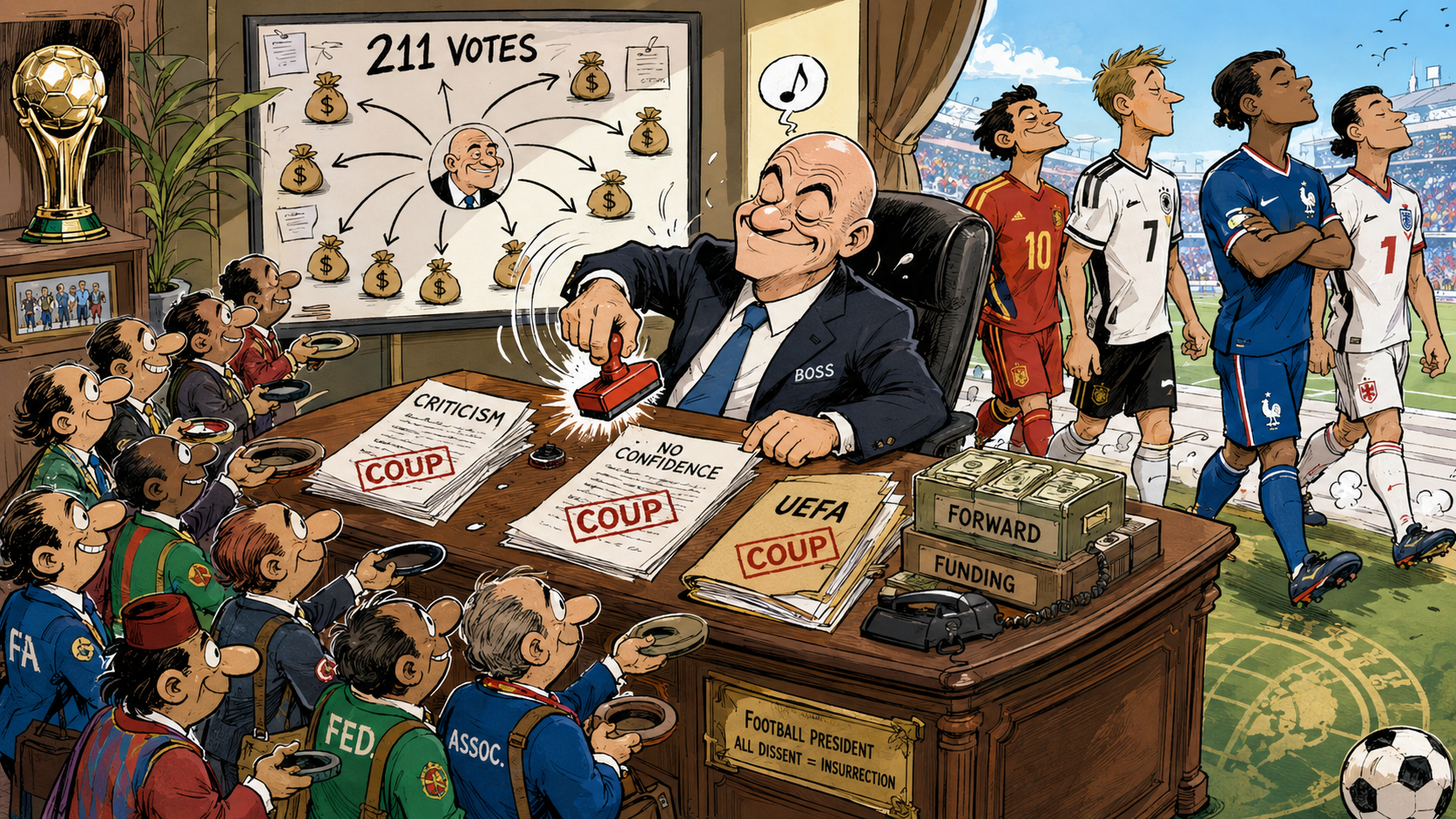
Nine days ago I wrote that under Gianni Infantino the distinction between FIFA the institution and Infantino the man was becoming theoretical. FIFA has now kindly removed the remaining doubt. In a statement issued on Saturday, world football’s governing body announced that it had detected a “concerted and ongoing effort by some to undermine FIFA and its president”. One phrase, two subjects, welded together. The welding is the entire message.
Read the rest of the statement slowly, because it is a small masterpiece of institutional self-defence. Those who lack the support of the member associations, it says, should not attempt through allegation, insinuation or misinformation what they cannot achieve through FIFA’s established democratic processes. It complains of unsubstantiated assertions and promises to challenge inaccurate reporting vigorously. Then, almost as an afterthought, it adds that FIFA will not support, facilitate or tolerate any process concerning the election of its president that is inconsistent with its statutes and governance framework. Consider what that sentence actually does. An organisation whose president intends to stand again in Morocco next March has pre-announced which attempts to replace him it is willing to recognise. Elsewhere this is called a conflict of interest. At FIFA it is called a governance framework.
It is worth being precise about what provoked this, because the timing is more revealing than the language. The statement did not follow a coup. It followed a report in the Daily Telegraph about a payment made by UEFA to a former employee during Infantino’s time as its general secretary, involving allegations concerning his private life which he strongly denies and which FIFA has dismissed as untrue. One may find that story flimsy, tawdry, or nobody’s business. That is not the interesting part. The interesting part is that FIFA folded a tabloid story about a man’s private life and the wider institutional revolt over the attempted sale of the World Cup into the same narrative, with the same enemy and the same defence. Everything is now filed under one heading. Whether you object to his conduct, his commercial schemes or his understanding of the office, you are engaged in a concerted effort to undermine FIFA.
Because look at what these putschists have actually done. A confederation representing fifty-five associations concluded that it had lost confidence in the leadership. The president of the Norwegian federation said publicly that he should resign. The global players’ union accused him of an abuse of power. Nobody stormed the Home of FIFA. Nobody suspended the statutes. Nobody did anything that would raise an eyebrow at a mid-sized insurance company, where members losing confidence in a chief executive is not an insurrection but the working of the constitution. FIFA has managed to describe the ordinary machinery of accountability as a threat to its existence, which is only possible if you have quietly redefined your existence as the continued employment of one man.
And this is where the grip becomes visible, because the coup narrative only functions if enough people are willing to nod along to it, and Infantino has spent a decade making certain that they are. FIFA’s Congress consists of 211 associations, one vote each. Germany has one. Brazil has one. So does every federation whose annual budget would not cover the wage bill of a mid-table Bundesliga squad and for whom FIFA is not merely a governing body, but an economic lifeline: development grants, competitions, travel, infrastructure, staff, relevance. Infantino did not build this dependency from nothing, but he has expanded its financial reach spectacularly and understood better than any of his predecessors that a body which funds much of the electorate enters every count with a considerable advantage.
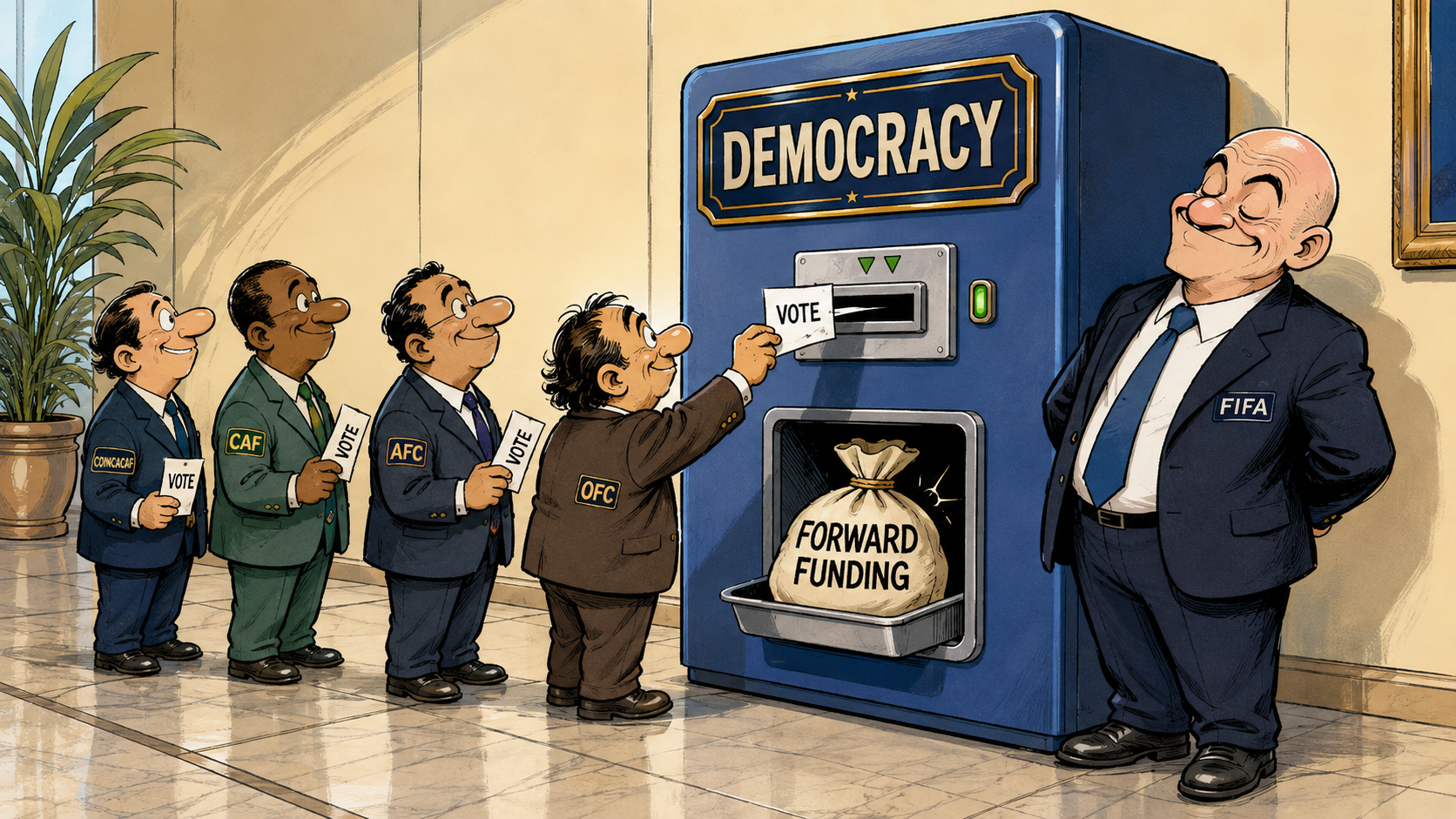
The abandoned sell-off illustrated the mechanism with a candour that was almost admirable. In late July, Infantino wrote to all 211 member associations to present what he called a singular and unique funding opportunity. Approve the new subsidiary, valued at twenty billion dollars with up to a fifth sold to private investors, by 19 September, and a ten-billion-dollar funding package would become available from 1 January 2027, with each association able to access up to forty million dollars across the 2027-30 cycle. Reject it, and the overall package would fall back to the previously announced $2.7 billion. Fifty-three days to decide. The presidential election takes place in Morocco in March 2027. I allege nothing; I merely note the calendar, and observe that whoever built that timetable understood both finance and gratitude. There is no need for anything as vulgar as buying votes when you can hand the electorate a number, a deadline and a countdown, and then describe the resulting enthusiasm as a mandate. The offer is dead. The number is not. Every one of the 211 now knows precisely what its agreement was worth, and who would have been signing.
That, in the end, is the trick that holds the structure upright. The organisation Infantino leads distributes substantial resources to the members; those members decide whether he remains at its head; and their entirely rational loyalty is then produced as evidence of his democratic legitimacy. Formally this is impeccable. Politically it is a closed loop with a man standing in the middle of it. When FIFA invokes the will of the associations against its critics, it is appealing to an electorate whose financial relationship with FIFA is part of the very system being defended.
The choreography that followed the collapse was equally instructive. FIFA convened a crisis meeting in Morocco, apologised to the 211 for mistakes in the handling of the proposal, the handling, note, not the proposal, and its leadership reaffirmed its full support for the president. An organisation reassuring itself of its confidence in itself, and mistaking the sound for absolution. CAF, CONMEBOL and the Mexican federation duly rallied behind him. The grip holds.
Except that it did not hold entirely, and this is the one genuinely new fact of the past ten days. The scheme died because Asia and CONCACAF joined Europe in refusing it, and because UEFA’s members voted to boycott FIFA competitions unless it was withdrawn. Infantino capitulated within a day. For a decade the received wisdom was that Europe would complain and then sign; instead Europe threatened the only thing FIFA cannot manufacture: the football that people actually want to watch. The president folded before the weekend. The weapon works. What remains untested is whether it works on a man rather than a document. A proposal can be withdrawn while everyone keeps their dignity. A president cannot be partially withdrawn.
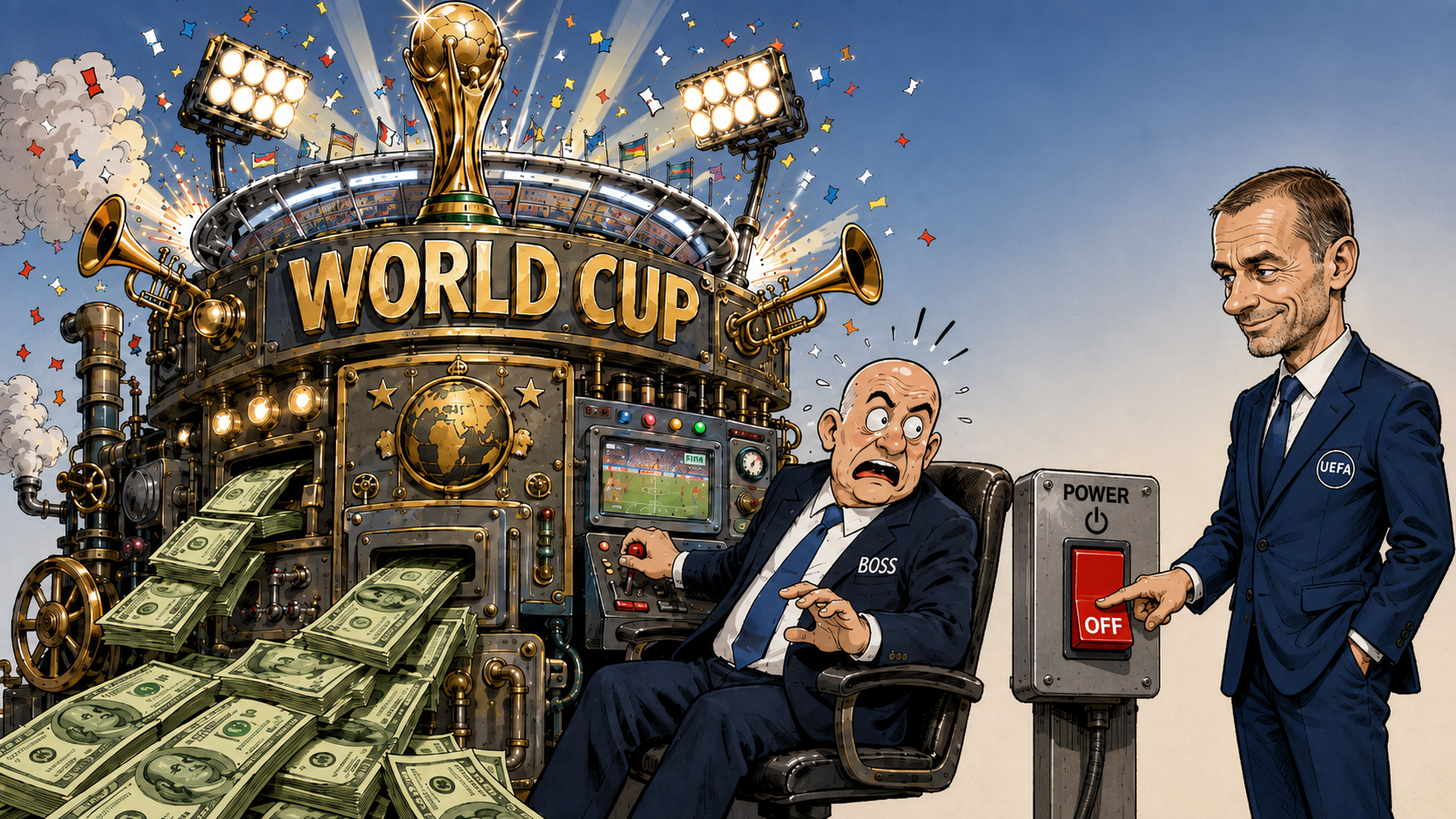
So the position, eight days on, is this. The challengers have discovered that FIFA’s authority is more fragile than it looks. FIFA has demonstrated that it can no longer distinguish between an attack on its president and an attack on the institution, and has decided that this confusion is a feature. Meanwhile, 211 associations are being invited to understand that defending Gianni Infantino and defending FIFA are essentially the same civic duty.
That is his real achievement. Not the expanded World Cup, not the record revenues, not the tournaments nobody asked for. It is that he has made opposition to himself increasingly indistinguishable from opposition to the institution he runs. Every autocrat’s favourite sentence is that the institution and its enemies are easily identified, and FIFA has now written it down on official letterhead.
The coup, if anyone is still looking for one, was completed years ago. It simply had the good manners to be constitutional.
Like always, just my five cents.
//Alex

