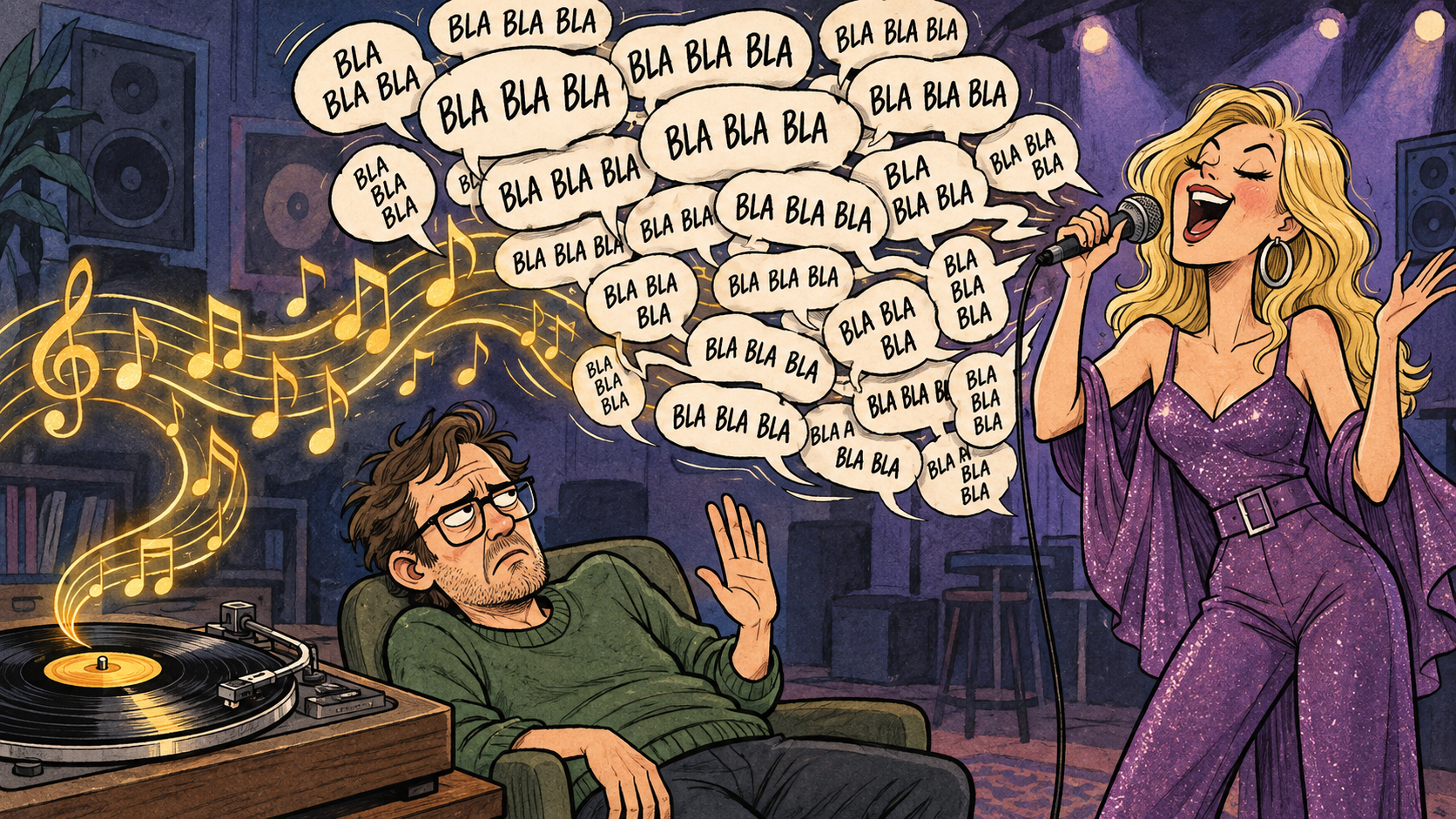
There are songs I would enjoy considerably more if the singer would let me hear them. Somewhere beneath the uninterrupted vocal is a melody I have loved for years, but every time I settle into it, another sentence arrives. The artist has expressed themselves at length. My main feeling is relief that they have finished.
I keep encountering this in contemporary pop: a famous melody, borrowed for the hook, with a new vocal talking over it from start to finish. Every feeling is elaborated until there is nothing left to discover, and a modest thought gets an entire song in which to repeat itself. Songwriting has acquired the habits of the explainer video, including its estimate of the audience’s intelligence. Apparently, even pleasure now requires a voice-over.
For a particularly depressing example, listen to “New Religion” by Bebe Rexha & Faithless, which builds a new pop song around the riff of Faithless’s “Insomnia”. For me, the original is one of the greatest records ever played in a club. Maxi Jazz talks us through a sleepless night, uneasy and unresolved, and then gets out of the way: when the riff arrives, it has the room to itself. The record understands exactly what deserves our attention, and when.
“New Religion” has other ideas. Rexha coats the riff in words until its character disappears beneath the delivery. I recognise the tune and want to follow it; what I get is something approaching a children’s singalong. The lyric celebrates losing yourself in music. Unfortunately, she keeps singing about it over the part in which I was hoping to get lost.
Rexha has form here: in 2022, she and David Guetta did much the same to Eiffel 65’s “Blue” with “I’m Good (Blue)”. Borrowing a classic is a convenient way to arrive with a strong musical idea: somebody else has already had it. Recognition supplies the attention; old affection does much of the emotional work. A worthwhile reinterpretation should offer more than the opportunity to hear you sing over it. If you take on a masterpiece, have enough self-awareness to notice when your contribution makes it worse. Calling it a tribute does not oblige anyone to be grateful for musical vandalism.
The rights holders deserve the same scrutiny. Faithless are credited on the release, but a credit is not a signature: permission to use the melody, and with it the responsibility, rests with whoever holds the rights. Why approve a version that cheapens the work you control? Whether the attraction is royalties, exposure or sincere enthusiasm, someone should still ask whether the result is any good. Permission establishes that a record may be released; it does remarkably little to establish that it should be.
Plenty of songs talk themselves to death using entirely their own material. Doing it over somebody else’s masterpiece is harder to forgive. Give me a few words worth remembering and the restraint to let the melody do the rest. If your song improves every time you stop singing, somebody should have noticed before releasing it.
But again, what do I know about music?
//Alex

