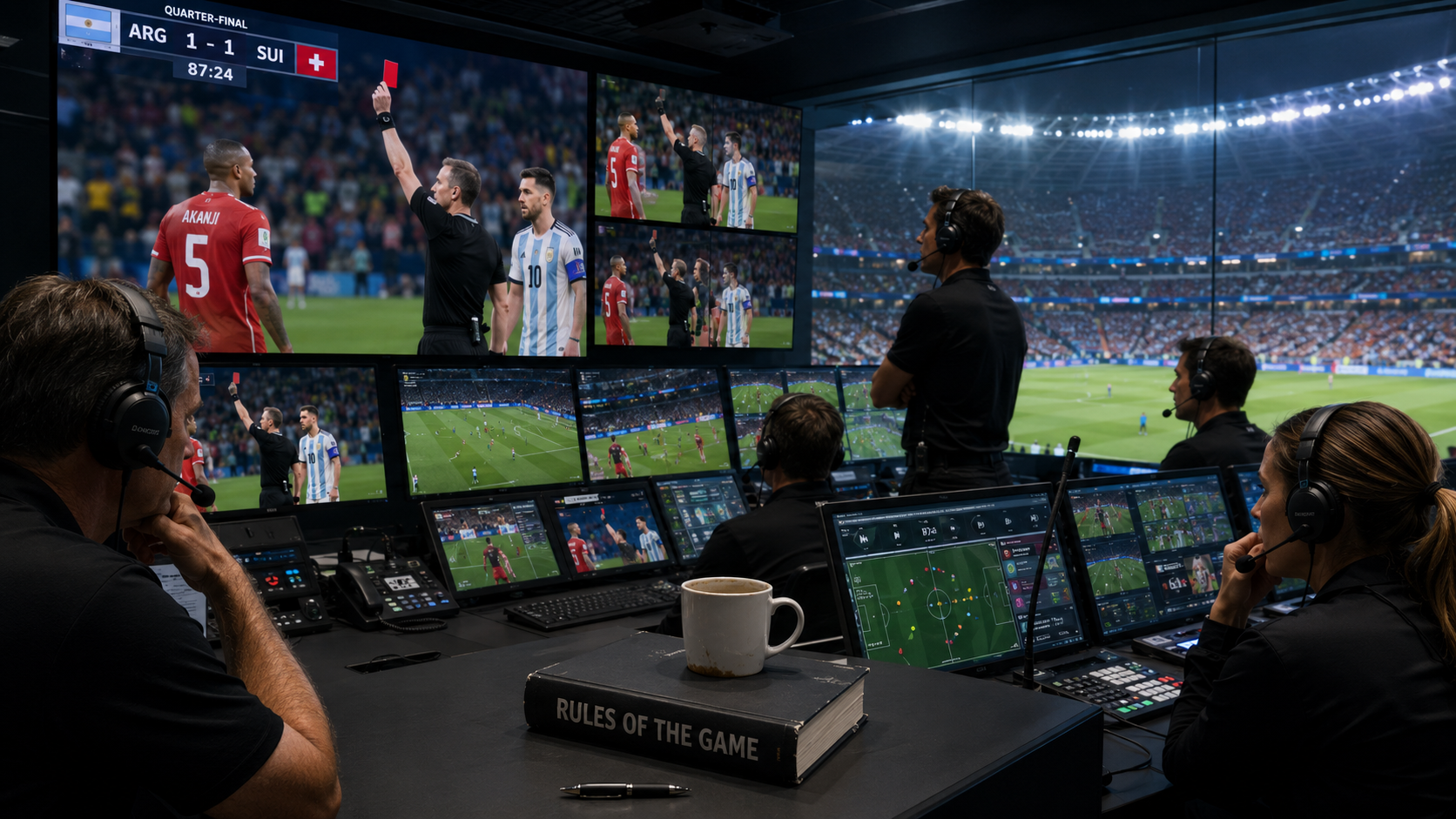
Billions watch the World Cup, billions are earned from it, and few things matter more to a country’s sporting pride than the fate of its national team. Football has analysts for throw-ins, consultants for sleep patterns and enough data to calculate whether a substitute warmed up with the correct emotional intensity.
What it apparently lacks are people who know the rules.
Breel Embolo was sent off against Argentina after VAR reviewed a decision it was not allowed to review. Paredes had received his first yellow card. First yellow cards are not reviewable. That should have been the end of it. Instead, VAR reopened the scene, reinvented the offence and misused the “mistaken identity” provision to produce a second yellow card for Embolo. It was less a review than a small piece of experimental theatre.
I explained this on 12 July and sent the article to Blick. No reaction. Admittedly, Blick is not where one normally looks for the intellectual reconstruction of Western civilisation, but its sports department has a decent reputation. One might therefore have expected somebody to read the relevant rules before the tournament had finished.
Apparently not.
Two weeks later, The Athletic reported that IFAB considered the decision wrong. Blick then discovered the story as well. The facts had not changed. They had merely arrived from a publication important enough to be read.
This is modern sports journalism at its most efficient. Ignore information sent directly to the newsroom, wait until somebody else researches it, translate the conclusion and present it as news. One begins to wonder why a newspaper is required at all. A browser can copy foreign articles too, and usually without looking so pleased with itself.
The associations performed no better. Switzerland lost a World Cup quarter-final after an illegal intervention, yet the decisive clarification arrived when the tournament was already history. A protest that establishes the truth two weeks later has roughly the same sporting value as arriving at the stadium with the correct team sheet the following morning.
National teams should learn from this. At the next World Cup, they should place a lawyer and an AI specialist on the bench. When the referee begins inventing rules, the lawyer can object immediately while the AI retrieves the relevant paragraph. This would probably be more useful than the third masseur, particularly since a massage has rarely restored a player wrongly sent off an hour earlier.

The whole affair would be amusing if it had happened at an amateur tournament, where the referee is somebody’s uncle and the rulebook has been missing since 1998. On football’s grandest stage, surrounded by money, technology and self-declared expertise, it is simply embarrassing.
Still, there is a useful lesson. When officials are confused, associations are asleep and journalists are waiting for The Athletic to do their reading, difficult questions need not remain unanswered.
Just ask Alex.
He probably knows. Not because he invents anything, but because he has mastered the dark art of reading and, unlike much of football, is not afraid to use it. 😉

