“Tesla makes the safest car in the world.” Say that, and the conversation almost immediately turns to crash tests, crumple zones and airbags. All important. But there is another question I want answered before entrusting myself to a connected car: how well is it protected against someone who would prefer to operate it without my permission?
Cybersecurity belongs at the centre of that conversation. Yet in the car and technology reviews I watch, it barely gets a seat.
YouTube offers exhaustive demonstrations of new interfaces, parking features and animations. Reviewers will spend several minutes explaining a rearranged menu. How frequently a manufacturer delivers security patches, whether they arrive over the air, and how clearly those corrections are documented receive considerably less attention. A screen that looks more modern is easy to film. Software that remains properly maintained requires a different set of questions.
I work in cybersecurity, which probably explains why I read the release notes whenever my Model 3 offers an update. By late October, I had installed more than twenty this year. New functions are welcome, but the entry I keep noticing is “Security Improvements.” It appears so regularly that it has become one of the reasons I trust the car.
A connected vehicle is part of a much larger software system. Mobile apps, cloud services, wireless connections and onboard computers allow owners to locate it, unlock it and adjust settings from a distance. Where Tesla offers Summon, the car will even leave its parking space on its own and drive across the car park to collect an owner waiting at the other end. A two-tonne vehicle answering a tap on a phone is a remarkable convenience, and it rests entirely on authentication, permissions and carefully controlled access. Selling that connectivity creates an obligation to maintain it throughout the vehicle’s supported life.

And the environment in which that obligation must be fulfilled is changing rapidly. Frontier AI, meaning the most capable models now being built, is becoming a serious tool for finding software weaknesses. Microsoft’s security team describes models that can discover vulnerabilities, combine weaknesses into working attacks and generate proof-of-concept code. Anthropic’s Project Glasswing brings major technology companies and open-source organisations together to apply these capabilities defensively. This is already engineering work, with real software and real flaws.
There is no reason to assume the advantage belongs exclusively to the defenders. In October, Microsoft reported that a China-aligned threat actor had used AI agents to automate parts of a campaign targeting hundreds of organisations. In some cases, privileged access was obtained in under three hours. The list of targeted industries included automotive. That is not evidence of cars being remotely hijacked, but it shows that organised attackers are building AI into their operations, and that the car industry is firmly on their map. Their tools do not stop improving because a vehicle manufacturer has a long product cycle.
Even Linus Torvalds, the creator of Linux, recently credited an AI with much of the grunt work behind a stubborn kernel graphics-driver fix. He also noted that it declared the problem unsolvable several times, and suspected it had been trained by people less stubborn than himself. It was debugging, not exploit hunting, but it shows how far these tools have moved into serious software maintenance.
That makes the old reassurance of “we hardly ever need updates” increasingly unconvincing. Software can contain flaws for years before somebody finds them. Better analysis changes what becomes discoverable. In my professional experience, the organisation acknowledging and fixing vulnerabilities may be demonstrating precisely the process I want to see. A quiet release history does not establish that the underlying code is exceptionally secure.
Tesla even invites that scrutiny. It brings its cars to Pwn2Own, a competition where researchers are paid to break them. In 2023, a French team compromised a Model 3’s gateway in under two minutes and won the car. That is not an embarrassment. It is the process working: flaws found by people paid to report them rather than sell them.
Tesla’s record is unusually visible. Reviewing public release histories, I counted at least 68 OTA versions for the Model 3 Highland, the generation I drive, between January and late October 2026, spread across regional software branches. Nineteen of them explicitly list security improvements. No single car receives every regional version, and a release is not the same as a vulnerability. Across those regional branches, that averages roughly one security-labelled release every two weeks, running quietly alongside the headline features.
My previous BMW ownership left a different impression: I remember receiving roughly one vehicle software update in two and a half years. That is my experience with one car, not a fleet-wide measurement. It still leaves me asking what security maintenance reached it during all that time.
BMW does have an automotive bug-bounty programme, Mercedes-Benz runs a vulnerability disclosure programme, and other manufacturers have security teams and processes. Mercedes has also patched more than a dozen flaws that researchers found in its first-generation MBUX infotainment system. Some corrections can be made in cloud services without updating the vehicle. But when I examined the documentation for selected models from BMW, Mercedes-Benz, Volvo, BYD, Volkswagen and Audi, I could not reconstruct an equally clear, comparable annual history of security-related OTA releases. The presence of a security organisation is useful information. Evidence of what reaches the customer’s car is useful information too.
Are traditional manufacturers adapting their engineering and maintenance processes to this new pace? Are they using advanced tools to find weaknesses, validating the results and distributing corrections promptly? Or has their public demonstration of software competence become disproportionately concerned with what moves around on the screen? From the customer’s side, too much of the important work remains difficult to assess.
Tesla is hardly innocent of dashboard theatre; my car can now dress itself for Halloween. I have no objection. The difference is that its release notes also keep showing me the less photogenic work. An animation is entertainment. Keeping a connected product secure is a continuing responsibility.
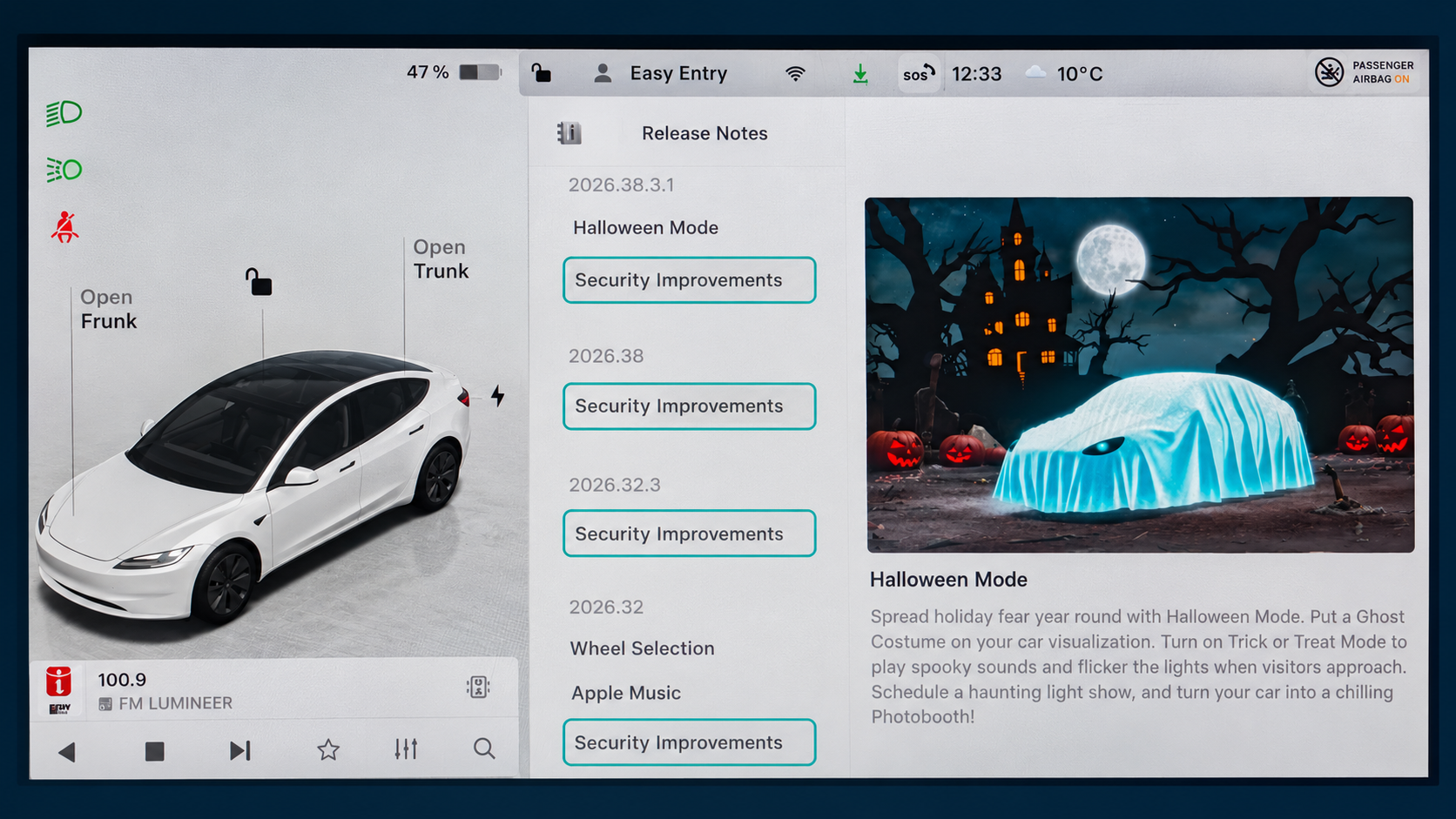
I would welcome more detail than “Security Improvements,” but transparency needs judgment. Publishing a vulnerability’s technical explanation before enough vehicles have been patched can help attackers target the remainder. Comparing old and new software can also expose what changed. Coordinated disclosure gives manufacturers and researchers time to distribute a correction before revealing the deeper details. Tesla explicitly asks researchers to allow reasonable time for remediation before publication.
Owners can still be told which component was affected, how urgently to install an update and which version contains the correction. Useful communication does not require an instruction manual for exploiting the flaw. Nor should withholding technical details become an excuse for making security maintenance invisible.
Above all, the correction has to reach the car. A workshop appointment is a poor default mechanism for routine cybersecurity maintenance, especially when attackers are accelerating their own work. Vulnerabilities are unlikely to respect the service interval.
So, the safest car in the world? No honest global ranking can be extracted from release notes alone. But Tesla gives me tangible reasons to trust how it maintains the connected car I own. I want that standard of visible, ongoing security work to become an ordinary expectation across the industry.
Reviewers could help by asking about it. Manufacturers could help by showing it. Another animated welcome screen can wait.
As always, just my five cents.
//Alex

