Every World Cup produces refereeing controversies. A missed penalty, a dubious offside, a challenge that looks worse with every replay. Usually the outrage lasts until the next match supplies a new grievance. Football survives because everyone accepts that referees are human and supporters are rarely neutral. That explanation becomes less convincing when the same team repeatedly emerges from the decisive controversies unharmed.
Argentina have reached the semi-finals of the 2026 World Cup, but their progress has acquired an increasingly visible asterisk. This does not prove that the tournament has been arranged for them, nor that instructions have travelled from FIFA headquarters to the referees. It means something simpler and more damaging: too many important decisions have fallen in Argentina’s favour, too many opponents have left with similar complaints, and too many journalists and former players have begun asking the same question.
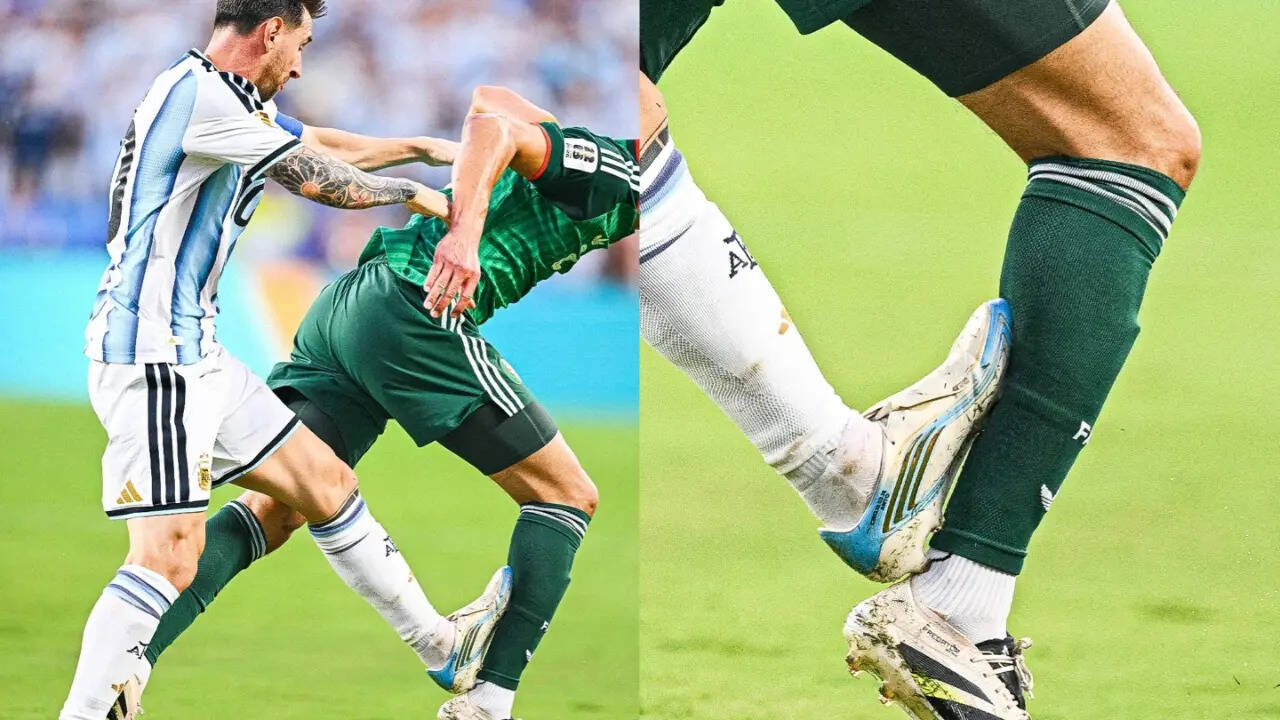
The argument began in Argentina’s opening match against Algeria. Lionel Messi caught Aïssa Mandi with an open sole on the lower leg in a challenge that several analysts considered worthy of a straight red card. Alejandro Moreno called it “100% a red card” and argued that Messi had received special treatment. Algeria later complained to FIFA about the officiating.
The referee allowed Messi to continue. He scored, remained available for the next match and avoided the suspension that would ordinarily follow a dismissal. Had an Algerian player made the same challenge on Messi, one suspects the discussion would have been considerably shorter.
This is where the Messi bonus becomes difficult to ignore. Great players have always received a degree of protection, partly because defenders target them and partly because football prefers its stars available. Messi is more than another star. He is the commercial centre of the tournament, the reigning champion on one final attempt at immortality. FIFA, broadcasters and sponsors have all built a large part of the spectacle around his presence.
That does not prove the referee consciously protected him. It does explain why the absence of a red card was so convenient for almost everyone except Algeria and the principle of equal treatment.
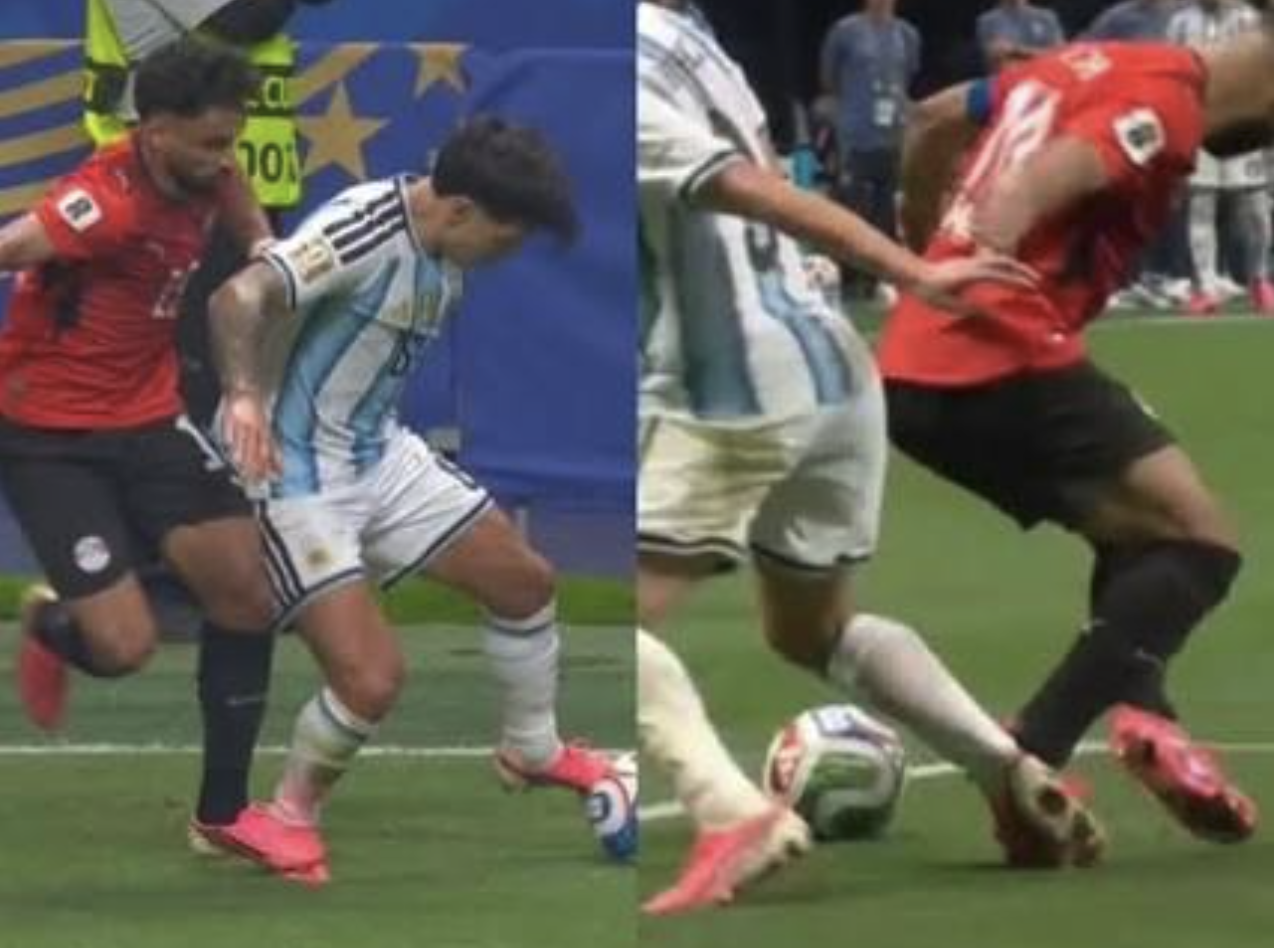
The controversy intensified against Egypt. Egypt believed they had extended their lead through Mostafa Ziko, only for VAR to identify a foul earlier in the move and cancel the goal. Later, they appealed unsuccessfully for a penalty before Argentina attacked at the other end and scored the winner in stoppage time. The Egyptian Football Association publicly questioned the consistency of the decisions, while coach Hossam Hassan said his side had suffered an injustice.
This was no longer merely a defeated coach performing the traditional post-match search for external causes. International media examined the sequence in detail. Analysts and journalists began asking whether the tournament’s largest grey areas were being judged with unusual generosity whenever Argentina were involved.
FIFA’s defence is to separate every incident. The Egyptian goal can be explained through the foul in the build-up. The penalty appeal can be dismissed as insufficient contact. Messi’s challenge can be reclassified as careless rather than dangerous. Each episode receives its own technical explanation until the sequence disappears beneath procedure.
It is an efficient bureaucratic method. Divide the pattern into sufficiently small pieces and officially there is no pattern at all.
VAR was supposed to reduce this kind of suspicion by correcting clear and obvious errors. Instead, it has introduced selective certainty. One incident is examined from every available angle until an infringement is discovered. Another receives a brief glance before play resumes. The technology is consistent. The appetite to use it is not.
The quarter-final against Switzerland turned that inconsistency into the defining issue of the match. There is little point pretending that Breel Embolo did not dive. He did. It was unnecessary, foolish and entirely avoidable, but it was also a piece of simulation near the halfway line, not an attempt to win a penalty or manufacture a goal.
Embolo should not even have entered that scene one caution away from dismissal. His first yellow card had been unjustified. Earlier, inside Argentina’s penalty area, an Argentine defender had pushed him into Emiliano Martínez. Instead of a penalty for Switzerland, the referee awarded a goal kick. Argentine physicality was repeatedly granted generous latitude; Embolo was already carrying the consequences of decisions that had gone the other way.
The irony is hard to miss. After repeatedly overlooking Argentina’s hard challenges and tactical fouls, the officials suddenly discovered perfect eyesight. Had the referee not rushed to book Paredes for the supposed foul, VAR would never have become involved and the match would simply have continued eleven against eleven.
More importantly, the VAR had no authority to intervene.
There were two possible legal routes for a VAR intervention, and they must not be confused. Under the official IFAB Laws of the Game 2026/27, page 153, VAR may intervene in relation to a “red card, including a clearly incorrect second caution”. If such a review is lawfully opened, the referee may then, as stated on page 159, “take/change/rescind any disciplinary action” where appropriate. Had Paredes received a direct red card or a second yellow resulting in his dismissal, the referee could therefore have reviewed the incident itself, cancelled the decision and cautioned Embolo for simulation.
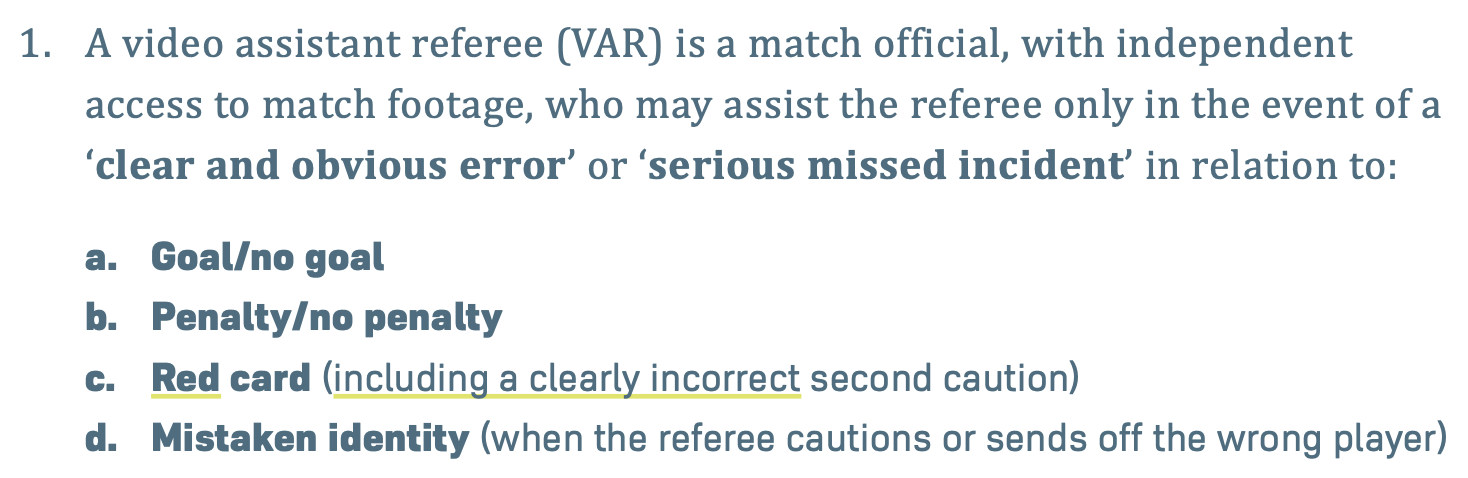
But Paredes received only his first yellow card. There was no direct red card and no second caution resulting in dismissal. The incident was therefore not reviewable under that provision, and the referee had no legal basis for reassessing the scene as a whole.
FIFA instead relied on mistaken identity. That is a separate and explicitly narrower provision. The official protocol states on page 155 that “only the identity of the offender can be reviewed”. The offence itself has already been established. For example: if the referee cautions number 10 for a foul actually committed by number 11, VAR may correct the identity of the player responsible for that same foul. It may not decide that no foul occurred, switch to the opposing team and replace the original offence with simulation.

The referee’s general authority to impose, change or rescind disciplinary action after a review does not remove this specific restriction. That authority applies only after a review has been lawfully opened and within the permitted scope of that review. In a mistaken-identity case, the written rule is explicit: only the identity may be corrected.
That is why Embolo could not lawfully be cautioned through this intervention. VAR did not correct the identity of the player who had committed Paredes’s alleged foul. It abolished the foul, introduced a different offence and created a dismissal that the referee had never awarded.
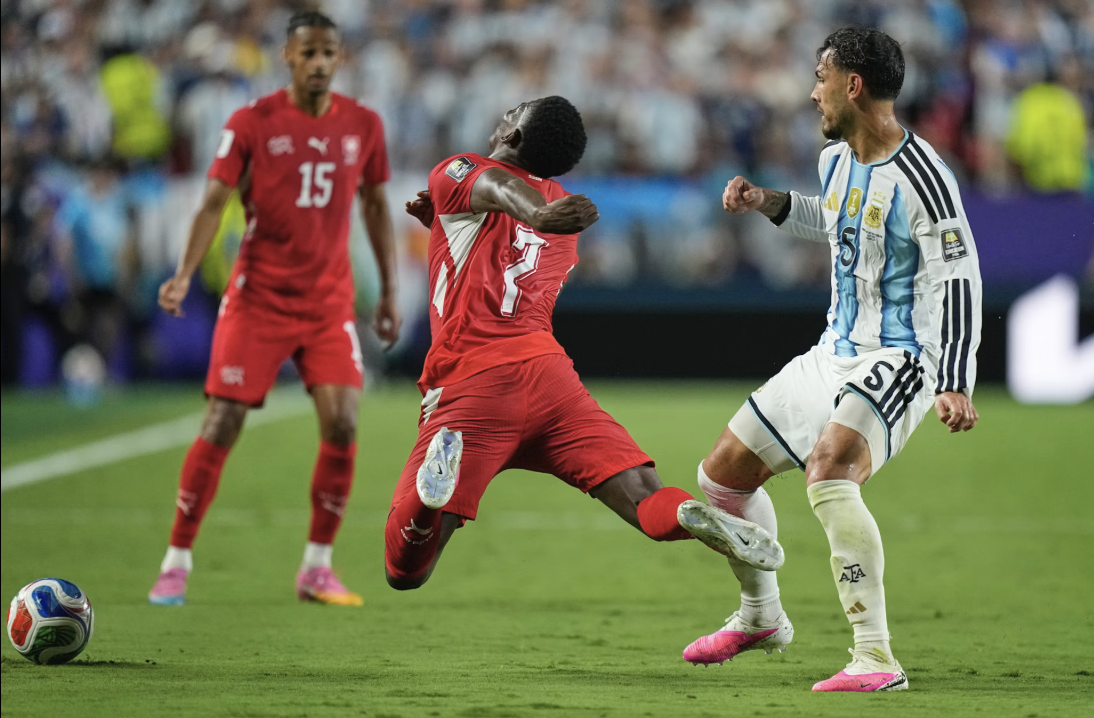
Simulation has been common throughout the tournament, particularly inside penalty areas where the potential reward is a goal. Yet Embolo’s pointless dive near midfield became important enough for VAR to determine how almost an hour of a World Cup quarter-final would be played. At elite level, ten against eleven for that length of time does not merely disadvantage a team. It usually destroys the contest. The issue is not whether Embolo deserved criticism. He did. The issue is whether that punishment, and especially the VAR intervention that created it, was permitted under the Laws of the Game. It was not.
Switzerland had equalised shortly before the dismissal and were competing on level terms. Argentina looked vulnerable, the Swiss had momentum and the match remained open. Nobody can know whether Switzerland would have reached the semi-final with eleven players. The officials removed the possibility of finding out. VAR was introduced to correct clear and decisive errors, not to give officials outside the field the power to reshape a match in one team’s favour. By intervening without authority and manufacturing a dismissal, VAR did not protect the integrity of this quarter-final. It directly compromised it.
Argentina did not write the protocol and cannot be blamed for accepting the advantages it produced. The responsibility belongs to FIFA, which has created a system capable of being intensely intrusive in one moment and conspicuously passive in the next.
The organisation weakened the authority of its own disciplinary system elsewhere in the tournament when Folarin Balogun’s suspension following a red card for the United States was overturned before the match against Belgium. Whatever the administrative reasoning, the episode demonstrated that even the ordinary consequences of a dismissal can become surprisingly flexible. Had Messi been sent off against Algeria, would the suspension have survived untouched? Perhaps. After the Balogun precedent, certainty would be optimistic.
This is the atmosphere surrounding Argentina’s run. Messi escaped a challenge widely described as red-card worthy. Egypt saw a goal removed, a penalty appeal rejected and the winner scored at the other end. Switzerland lost Embolo after an extraordinary VAR intervention that altered the balance of a quarter-final. Each incident can be defended individually. Together, they have created a problem FIFA can no longer dismiss as the noise of disappointed supporters.
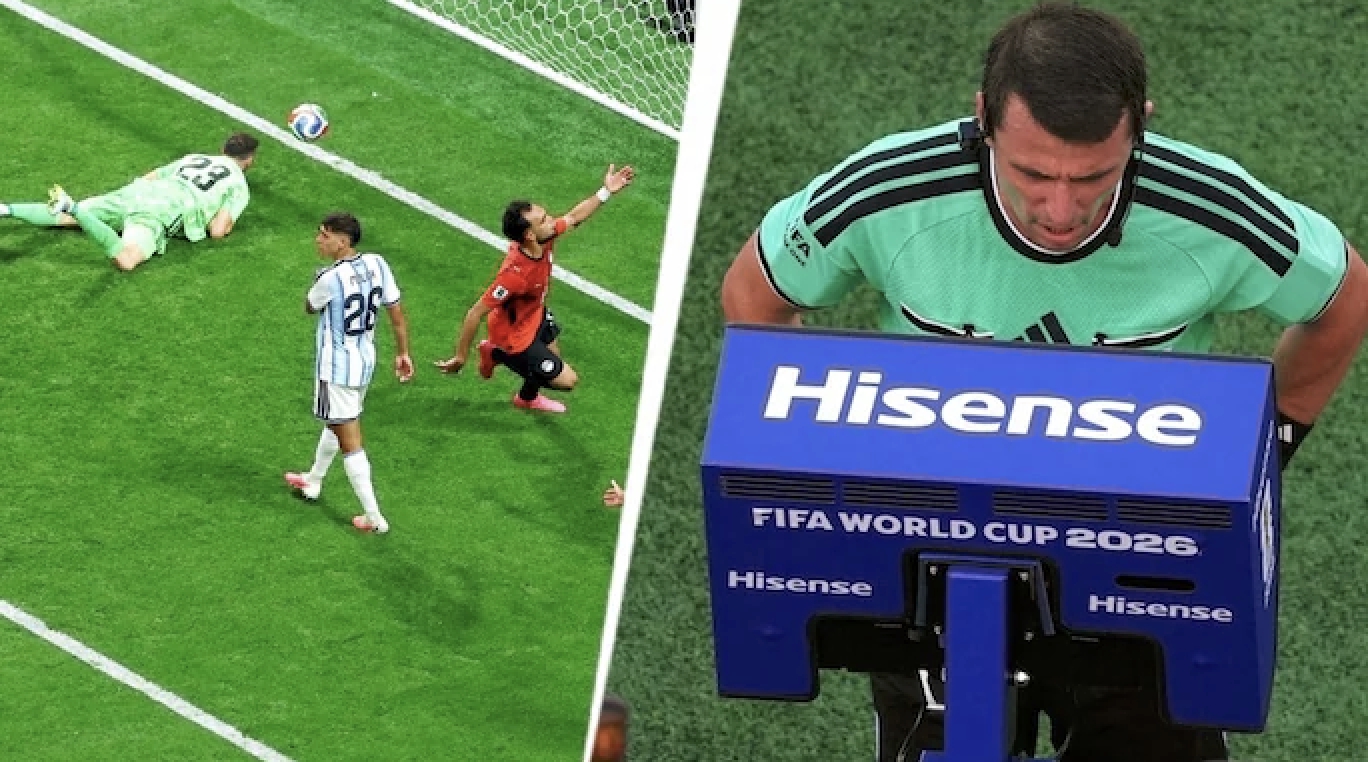
Argentina themselves have not looked irresistible. Cape Verde pushed them into a chaotic 3-2 match. Egypt led them and came close to eliminating them. Switzerland caused them serious problems before the red card changed the contest. This is not the Argentina that grew in authority through Qatar. It is an ageing champion surviving through experience, competitive aggression, Messi’s remaining quality and a remarkable ability to emerge favourably from the moments that define matches.
That does not make Argentina unworthy of the semi-final. It makes the officiating around them more consequential. A dominant team can absorb a fortunate decision without allowing it to define the result. A vulnerable team repeatedly surviving decisive moments cannot expect the same generosity from public perception.
FIFA may insist that no preference exists. It may quote protocols, defend individual referees and remind everyone that football contains subjective decisions. What it cannot do is prevent people from noticing the direction in which that subjectivity keeps travelling.
The deeper scandal is not that anyone has proved this World Cup was fixed for Argentina. No such proof exists. The scandal is that FIFA has allowed the tournament to look as though keeping Messi and Argentina alive matters more than preserving a recognisable and proportionate standard of officiating.
Argentina may still beat England, reach the final and produce a performance worthy of champions. FIFA will then celebrate Messi, destiny and another triumph for football. Institutions are exceptionally good at congratulating themselves.
Others will remember Algeria asking why Messi remained on the pitch, Egypt asking why the decisive interpretations ran against them and Switzerland asking why VAR suddenly developed an urgent objection to simulation in the middle of the field.
A World Cup should produce arguments about greatness. This one has produced an argument about credibility, and Argentina happen to be standing at the centre of it.
As always… just my five cents.
//Alex


2 comments