One of the more pleasant discoveries of owning an electric car is that, in everyday life, charging is barely a subject at all. At least it is not if you can charge at home. I plug the car into an 11 kW wallbox in the evening and start the next morning with more than enough energy for the day. Well over 90 per cent of my charging happens this way. The Supercharger network, excellent though it is, spends most of its time being reassuringly irrelevant. Its importance becomes rather more apparent when ordinary life ends and there are 700 kilometres between you and where you want to be.
This is where Tesla deserves considerable credit. The network is extensive, dependable and tightly integrated into the car. Enter a distant destination and the Trip Planner calculates the charging stops, predicts battery levels, preconditions the battery and tells you how long to stay. What once made electric long-distance travel feel slightly adventurous has become almost boring. Tesla understands charging remarkably well. What it understands less well is what makes a good journey.
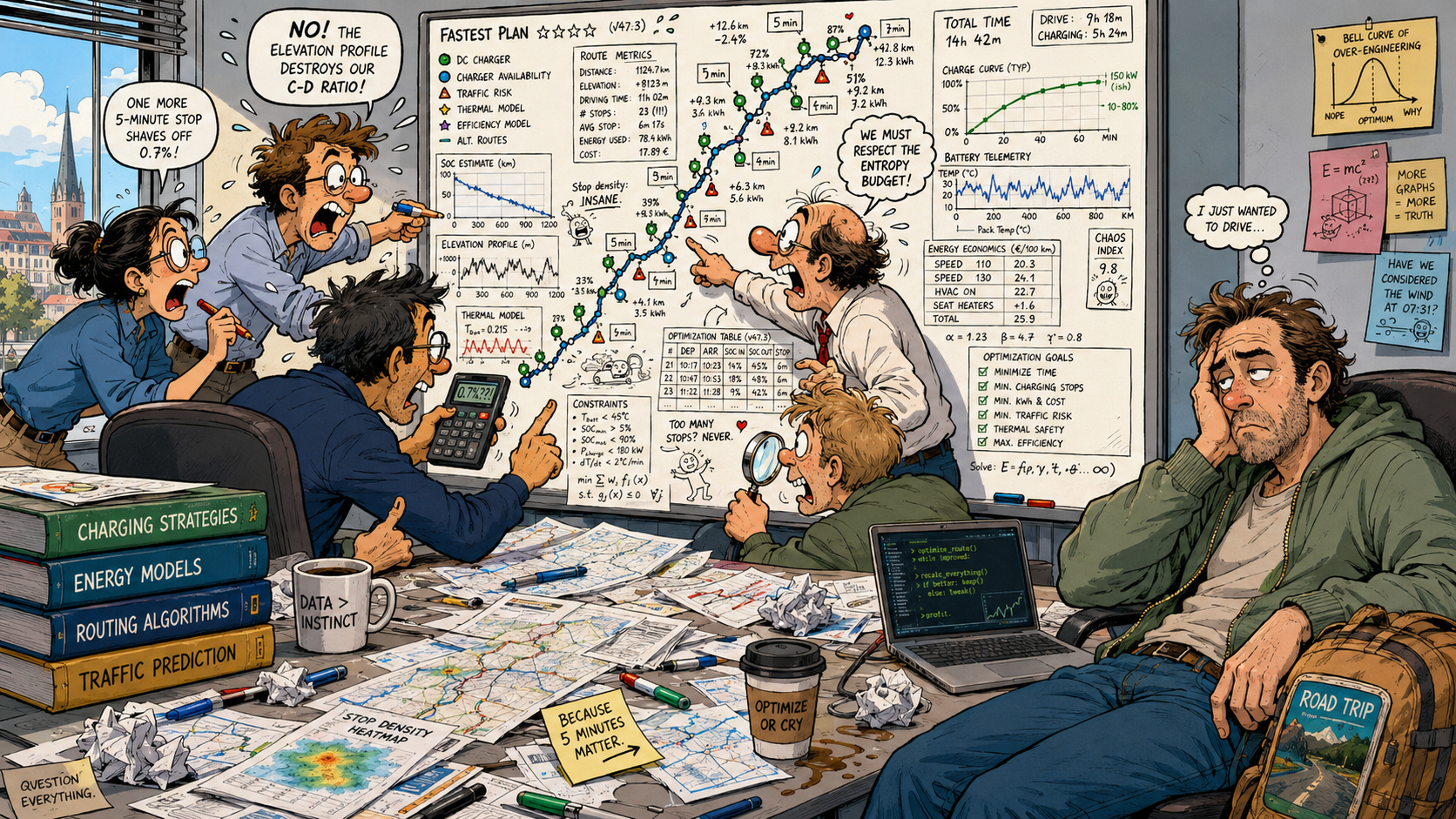
On a long drive, the navigation can propose a succession of very short charging stops. Five minutes here, six minutes there, perhaps eight minutes further along. Technically, there is sound logic behind this. A battery charges fastest at a relatively low state of charge, so taking just enough energy for the next leg can minimise total travel time. That may be an excellent way for a battery to travel, but it is not necessarily an excellent way for a person to travel.
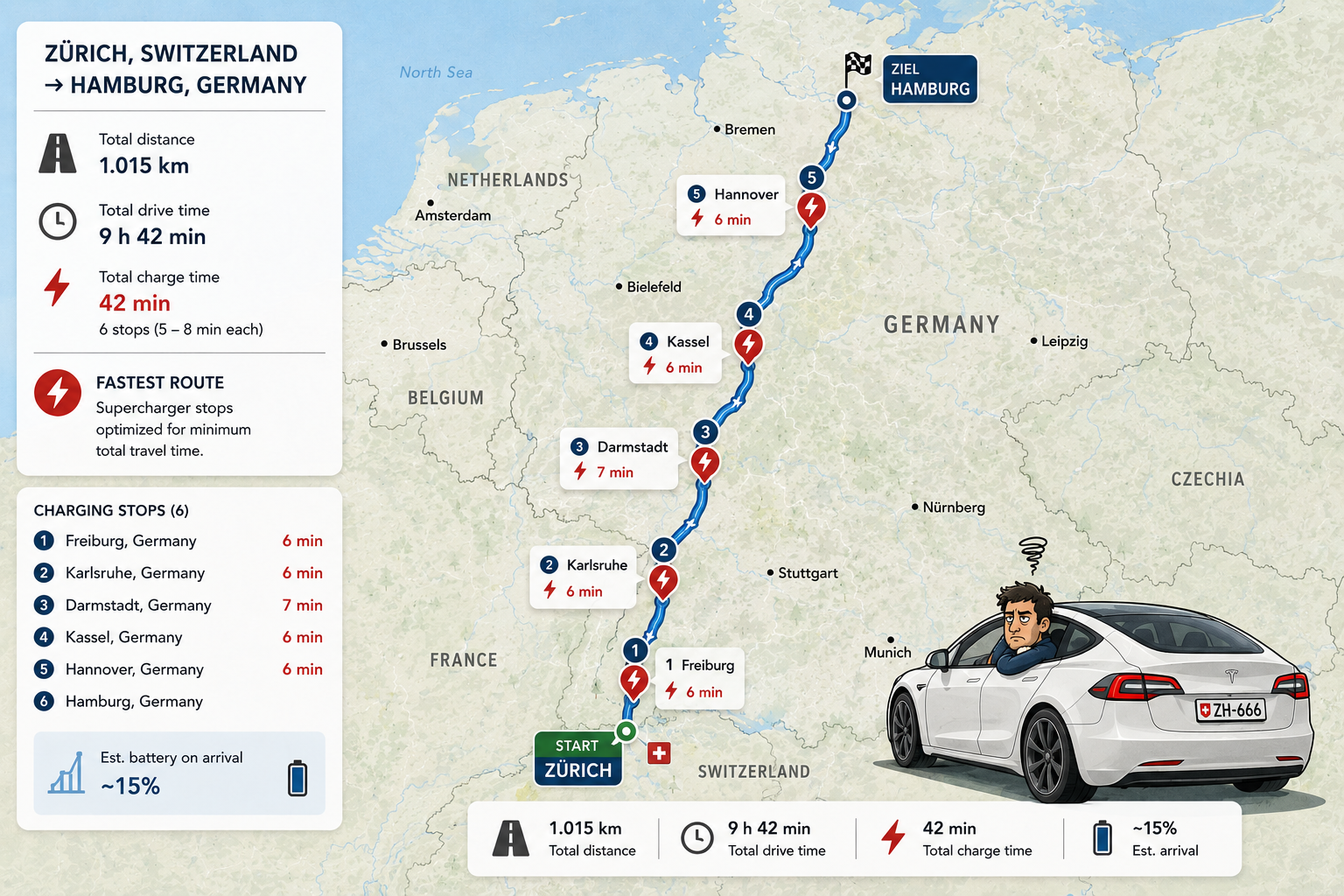
A five-minute charge may well be the fastest option on paper. It is not a five-minute interruption. You leave the motorway, negotiate the access roads, find the charger, park, connect the car, and then perform the entire procedure again in reverse. Do that four or five times and the minutes so carefully saved on the charging curve look considerably less impressive from behind the steering wheel. After two and a half or three hours on the road, I would much rather stop once for twenty or thirty minutes, stretch my legs, use a toilet, eat something and then continue for another substantial stretch. It may cost a few minutes overall. It makes for a far better journey.
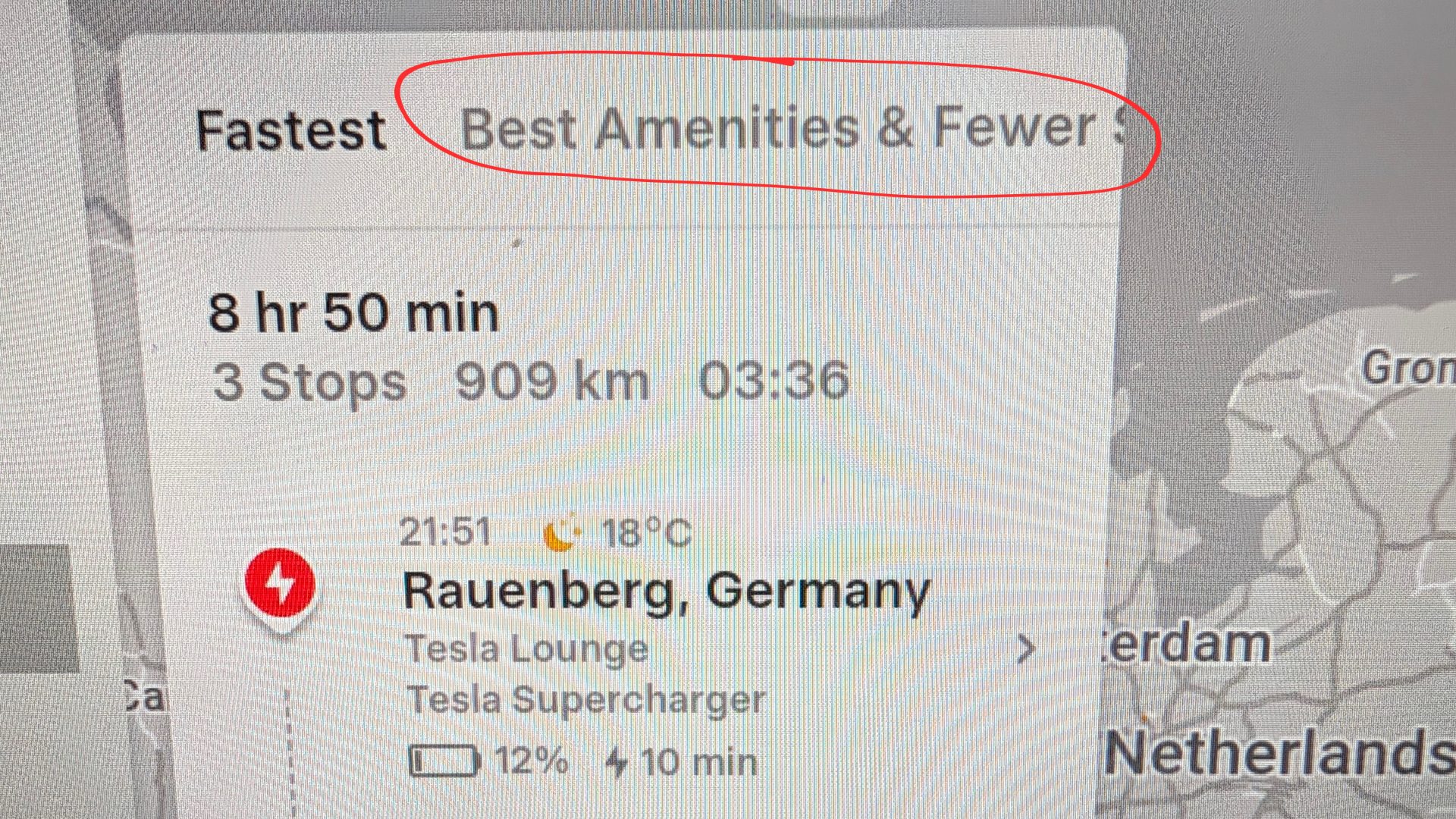
Tesla has, to its credit, already recognised that the fastest charging plan is not necessarily the most desirable one. Alongside Fastest, my route-selection screen offers Best Amenities & Fewer Stops. I discovered this only after becoming sufficiently irritated with the proposed charging stops to cancel the navigation and enter the destination again. Even then, the option hardly announces itself. On my display, the label is truncated to “Best Amenities & Fewer S…”, which is a surprisingly discreet way of presenting a feature capable of changing the character of an entire long-distance journey.
More oddly, the choice is available only when the route is first presented. Once navigation has started, it disappears from the normal workflow. If I decide two hours later that the succession of short charging stops is becoming tiresome, I cannot simply change the trip strategy. I have to end the navigation, enter the destination again and select the alternative before starting over. A preference that may affect the next several hundred kilometres should be considerably easier to find, and considerably easier to change.
But the larger problem is not where Tesla has put the option. It is what the option actually combines. Best Amenities & Fewer Stops treats two entirely separate preferences as though they naturally belonged together. They do not. I may want fewer stops simply because I prefer driving for two or three hours and then taking one proper break instead of repeatedly leaving the motorway for five or six minutes. I may not care about amenities at all.
Tesla is effectively mixing two separate questions: How do I want to travel? And what do I need when I stop?
Combining them can produce precisely the wrong kind of assistance. Choosing Best Amenities & Fewer Stops may send me to different Superchargers, or even alter the route, in search of facilities I never asked for. Yet if facilities are important, Tesla gives me no meaningful way to specify which ones. A toilet, a vending machine, a fast-food outlet and a proper restaurant are all reduced to the wonderfully vague concept of “amenities”.
The solution is not another layer of settings. It is a clearer distinction. Tesla really needs only two basic travel modes, and both should remain switchable at any point during the journey rather than only at route selection.
Fastest should mean exactly that. Get me there in the shortest possible time, whatever the charging plan looks like. If I select Fastest, the algorithm has my full permission to treat me as cargo. Healthy Breaks should favour fewer, more substantial stops, with perhaps twenty minutes as a sensible minimum.
If I want to make practical use of those longer pauses, Tesla would then need only two additional choices:
- Toilet: Yes / No
- Food: None / Snack / Fast Food / Proper Restaurant
That keeps the logic simple. Healthy Breaks determines how I want to travel. Toilet and food determine what I need when I stop. Tesla can take care of the charging curve, battery level, charger selection and everything else in the background.
The two choices, however, are only useful if the car takes them literally. A toilet inside a supermarket that closed two hours earlier is technically nearby and practically useless. And “food” should not mean that a vending machine, a McDonald’s and a proper restaurant are treated as interchangeable simply because all three technically contain calories. If the supposedly optimised charging stop leaves me searching for another service station fifteen minutes later, the optimisation has missed the point.
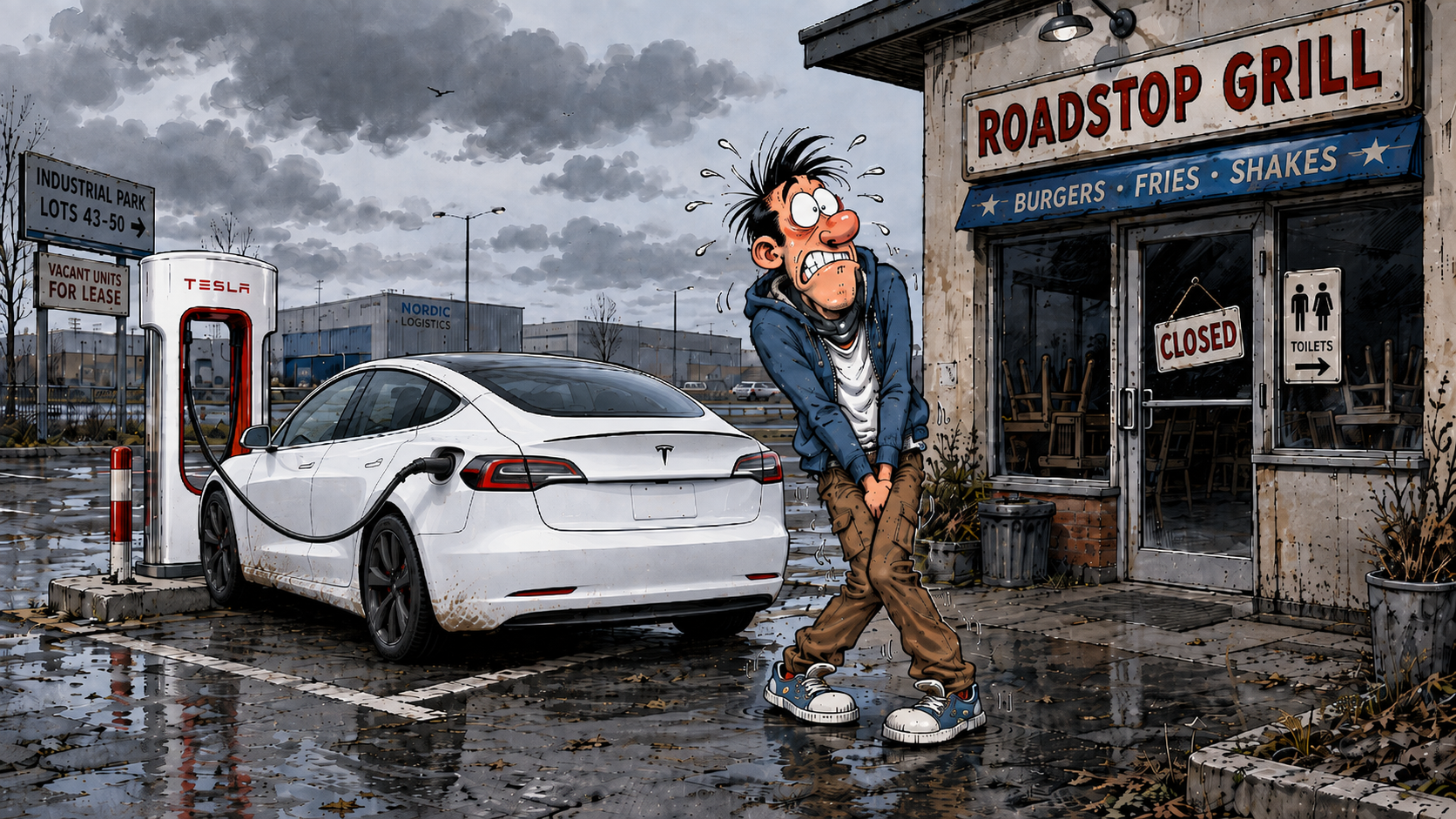
None of this requires a complicated settings page. Quite the opposite. Good software should hide technical complexity rather than hand it back to the user in the form of more controls. I should tell the car how I want to travel; the car should work out how to charge. Tesla already has the network, the data and the algorithms. What is missing is simply a more human definition of efficiency.
Sometimes efficiency means arriving five minutes earlier. Sometimes it means driving for three hours, stopping once somewhere useful, eating while the car charges and then continuing without another pointless interruption. Tesla already knows how to optimise the battery. It should learn to optimise the journey.
As always, just my five cents.
//Alex

