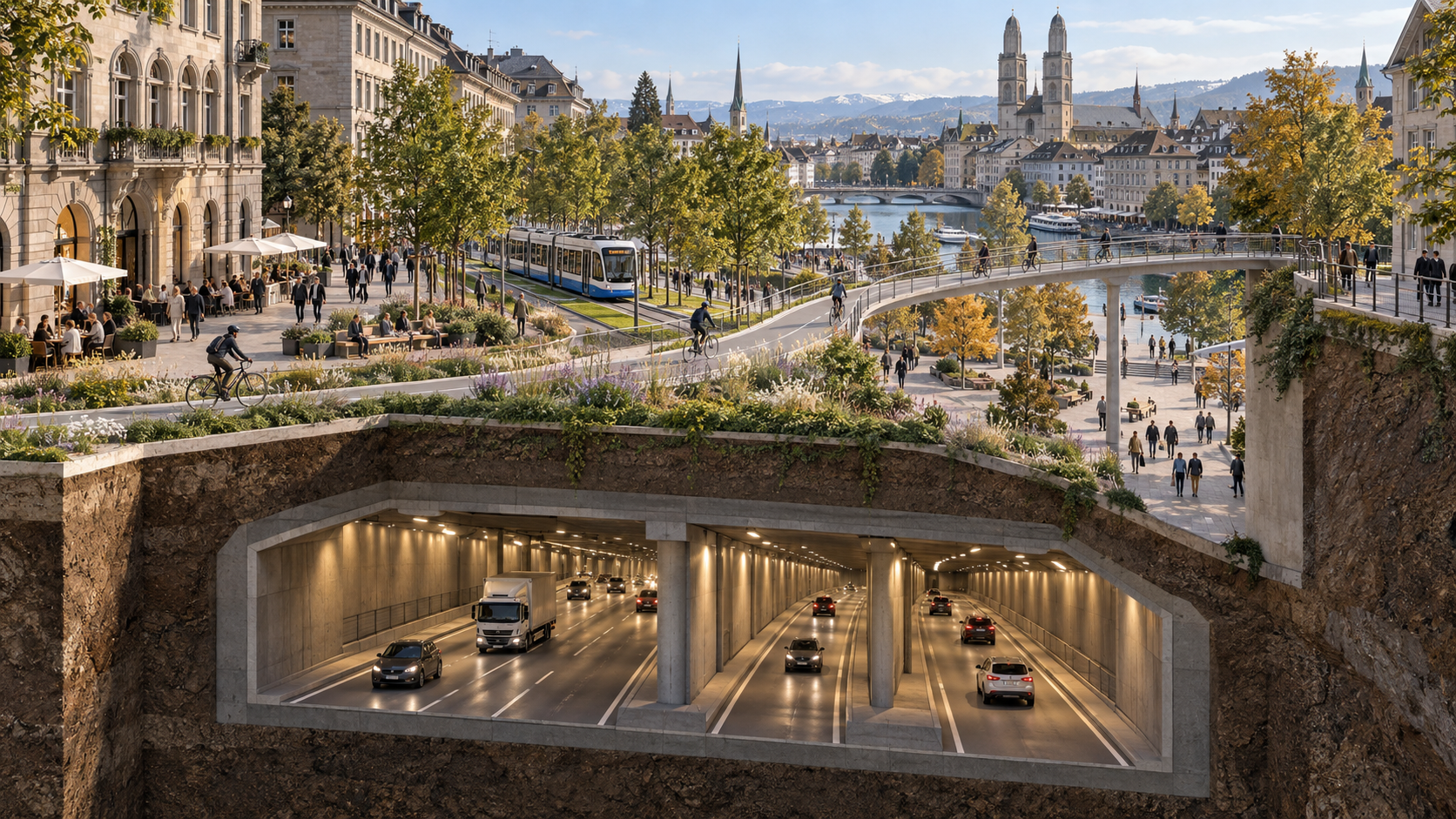
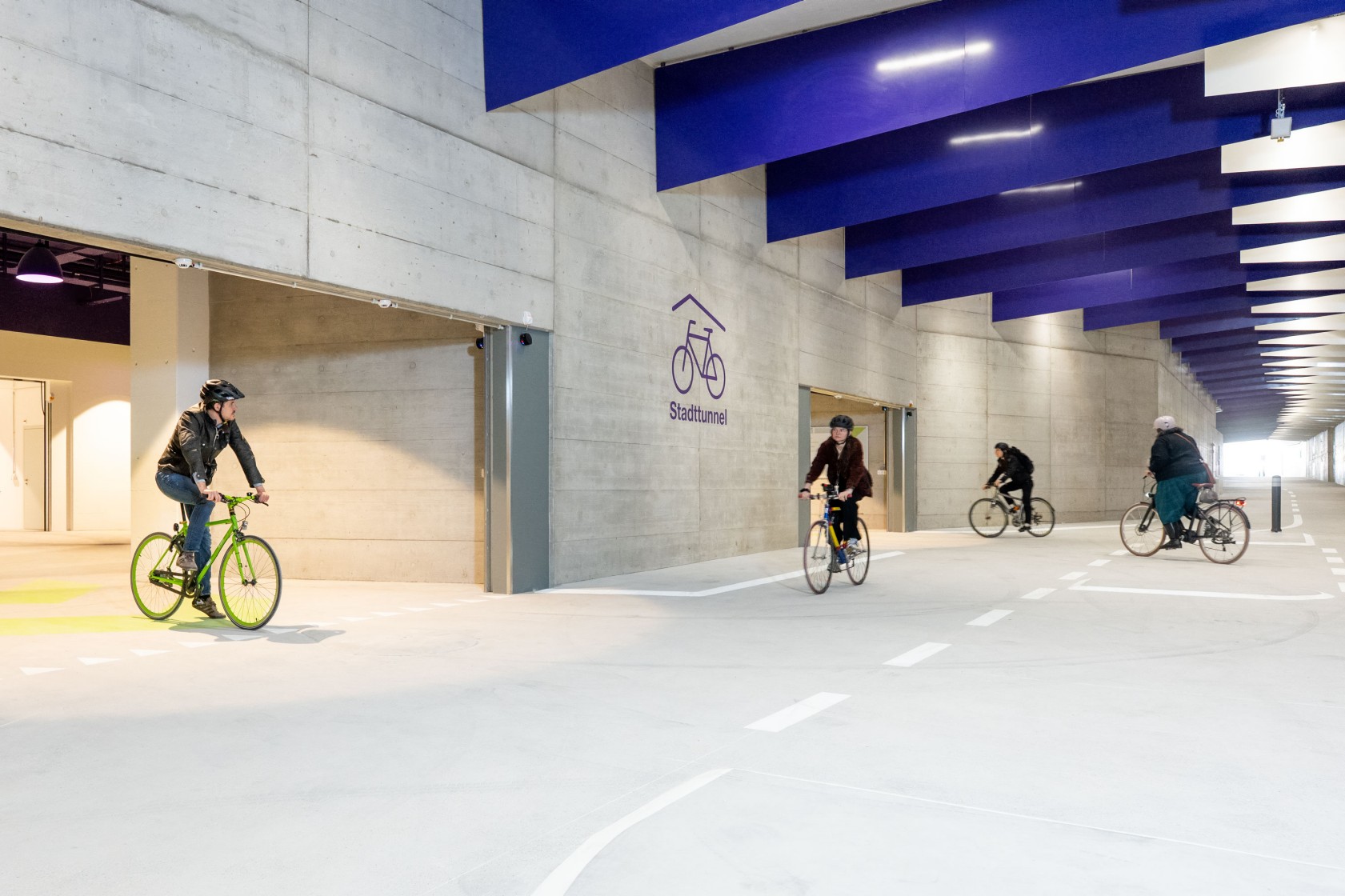
Under Zürich’s main railway station, cyclists can ride through a dedicated tunnel, park their bicycles and continue their journey by train. I think it is excellent. Elsewhere in the same city, they negotiate tram tracks, pedestrians, narrow traffic lanes and whatever the planning department has recently decided to communicate through coloured asphalt. The tunnel suggests that Zürich knows how to solve a transport problem. The streets above suggest that it sometimes prefers to illustrate one.
A new study gives that contrast a more serious context. Researchers from the University of Twente and ETH Zürich examined more than 86,000 police-recorded cycling crashes in Switzerland and the Netherlands between 2019 and 2022. The reported rate per 100,000 kilometres cycled was 0.19 in Switzerland and 0.09 in the Netherlands: roughly twice as high. Public transport stops, junctions and tram tracks emerged as particular Swiss trouble spots, with differences in infrastructure offered as a possible explanation. These are recorded crashes, not a complete count of every fall or collision, but the findings deserve considerably more attention than another campaign encouraging everyone to get on a bicycle. Study coverage and findings
The locations sound familiar. In an earlier article, I described the arrangement at Bürkliplatz, where a cycle lane passes through the movements of people approaching the boat landing, buying tickets, visiting the kiosk and generally behaving as people do beside a lake. Along Seestrasse, I questioned the wisdom of mixing fast-moving bicycles and e-bikes with people out for a walk. The complaint was not that cyclists had been given space. It was that providing that space appeared to count as an achievement regardless of the conflicts created around it.
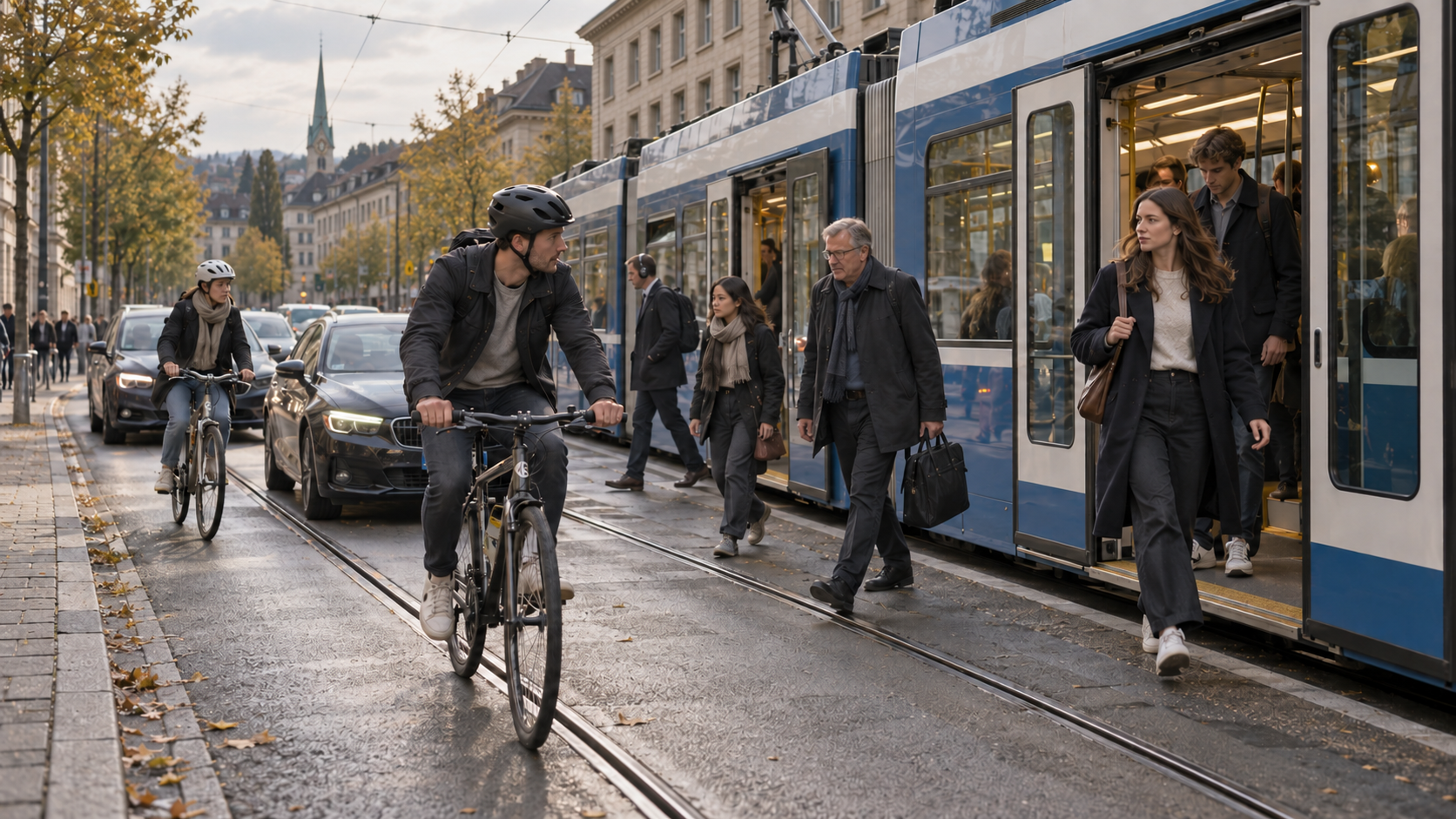
More recently, I wrote about Rämistrasse and Universitätstrasse: tram passengers, closely spaced pedestrian crossings, narrow lanes and cyclists moving between stationary traffic and the tracks. These are my observations, not an independent validation of the study. Nevertheless, when researchers identify tram tracks and public transport stops as problematic, I do not need a diagram to imagine the combination. I have driven through it.
A bicycle is a vehicle, not an exemption
Before the familiar argument begins, I am not against cycling. I support infrastructure that makes it safer, more practical and more attractive. I would support giving selected streets over to bicycles and removing parking spaces where a coherent alternative exists. The tunnel beneath the station earns my approval for precisely the same reason that some surface arrangements earn my contempt: I judge them by how they work, not by which mode of transport receives the ribbon-cutting ceremony.
That also means taking cyclists seriously enough to discuss their behaviour. On the streets I use, I see riders pass stopped traffic along the tram tracks, rejoin the lane without an evident check behind them and continue through red signals as though stopping were a matter of personal temperament. Not every cyclist does this. Enough do it to make their next movement something other road users have to guess.
The study does not establish that Swiss cyclists are less law-abiding than Dutch cyclists, nor does it tell us how much of the difference in crash rates could be attributed to enforcement. I am not suggesting that it does. My point is simpler: better infrastructure and responsible behaviour are complementary requirements. A badly arranged junction does not excuse riding recklessly through it, any more than a reckless rider excuses the junction’s design.
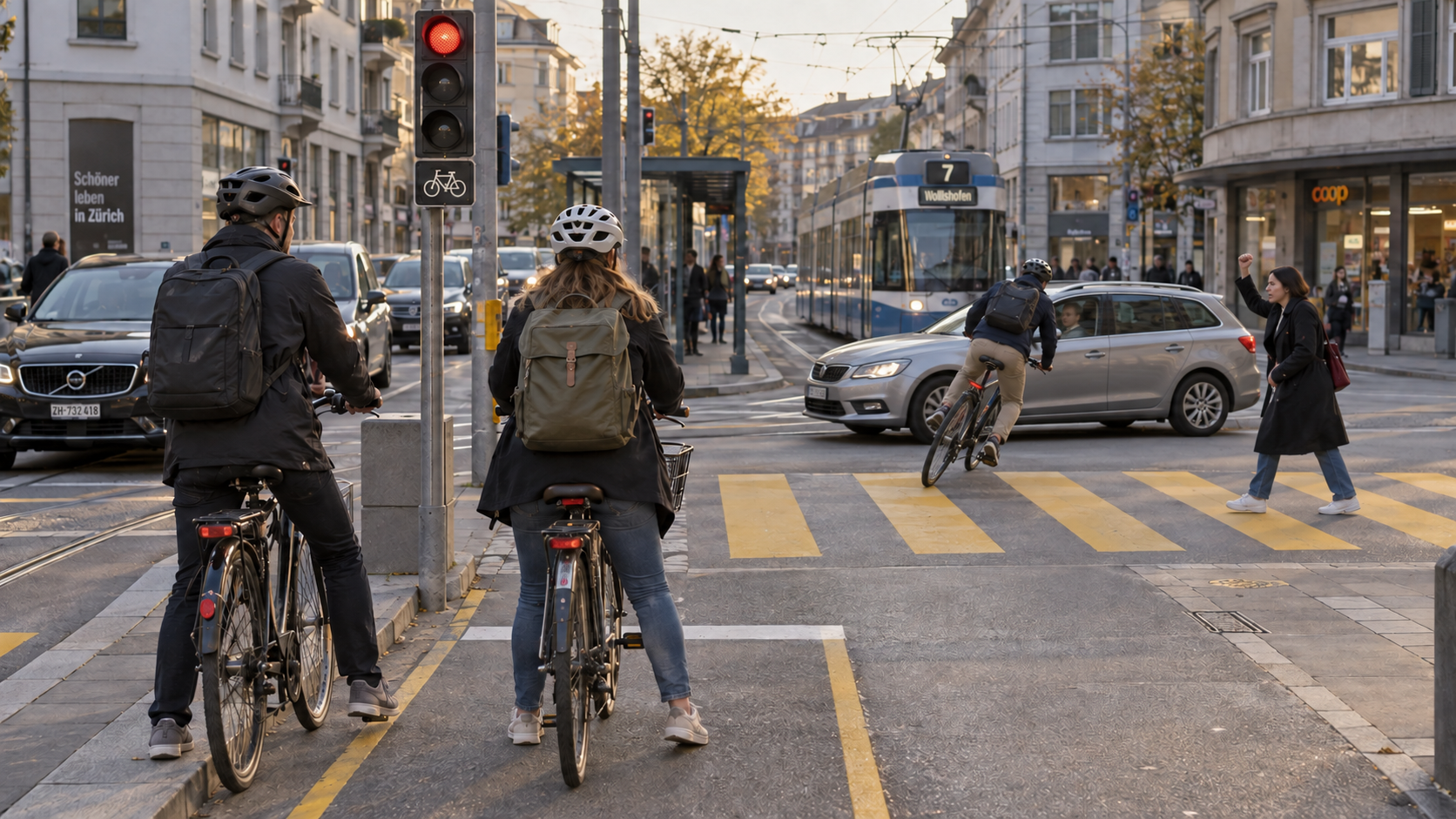
Nor should the discussion stop at the vulnerability of the person on the bicycle. Beside a lorry, the cyclist is the vulnerable party. Beside an elderly pedestrian or a small child, a fast e-bike is the danger. Concern for the weaker road user should survive the moment that person steps off the pedals. Rules and enforcement need to follow the risk, not our affection for the vehicle involved.
What frustrates me is the apparent tolerance for unpredictability. Whatever controls are taking place, the behaviour I regularly encounter does not suggest that compliance is being treated as an essential part of the cycling project. Promoting a means of transport and expecting its users to behave responsibly ought to be entirely compatible ambitions.
Give the traffic somewhere sensible to go
The answer cannot be to demand perfect behaviour while leaving everyone to compete for the same awkward strip of road. Good planning should reduce the number of occasions on which safety depends on several strangers making the right decision at precisely the same moment. That is what I like about the HB tunnel: it provides a route instead of asking another group of road users to negotiate its way through an existing conflict.
Where surface space is genuinely insufficient, why should every solution remain on the surface? Selected elevated cycle routes could carry riders across the worst intersections and pedestrian bottlenecks, forming useful connections rather than isolated architectural attractions. Copenhagen’s 230-metre Bicycle Snake demonstrates the principle: cyclists travel above an area where pedestrians can use the waterfront below without crossing their path. It is not a ready-made blueprint for Zürich, but it is a built answer to a problem we too often seem content to repaint. Bicycle Snake project
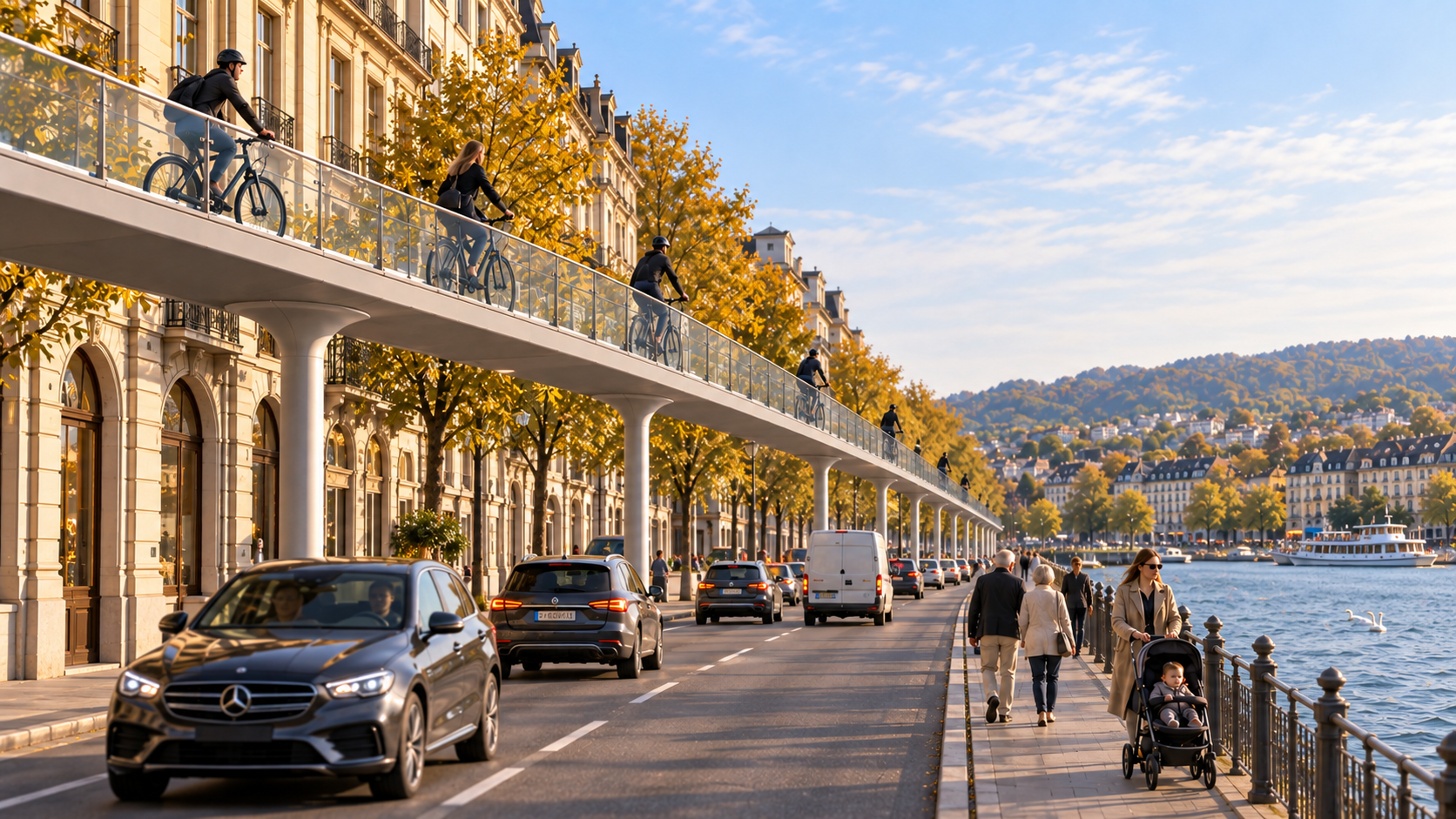
A whole elevated network would require careful choices about routes, gradients, access and its effect on the streets beneath it. Some sections would make sense; others would not. At ground level, a simpler answer may be to close a street to through motor traffic and give cyclists a continuous route, while protecting pedestrian space and providing the necessary access for residents, deliveries and emergency services. If suitable alternative routes exist, do it properly. A clearly assigned street is more honest than one that remains nominally open to everyone while working satisfactorily for nobody.
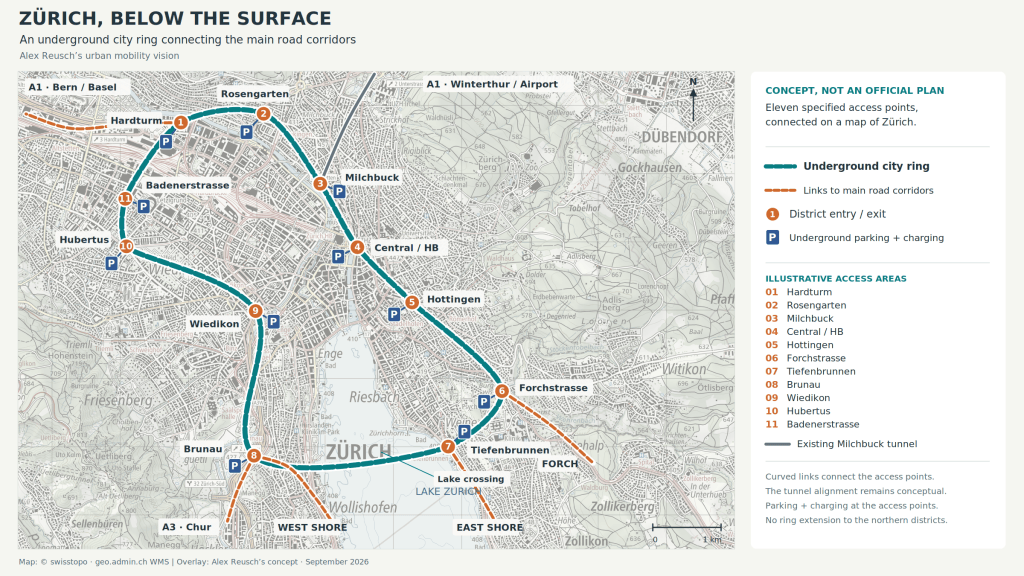
I would go further. Zürich should be willing to investigate a long-term underground road network linking the major approaches: the A1, the A3, the Forch corridor and the roads along both shores of the lake. Through traffic could pass beneath the city, with carefully located connections allowing traffic destined for particular districts to reach them. Underground parking and charging facilities could complement that network, designed to accommodate both conventional cars and future autonomous services. The proposal should still make sense if people continue driving their own cars.
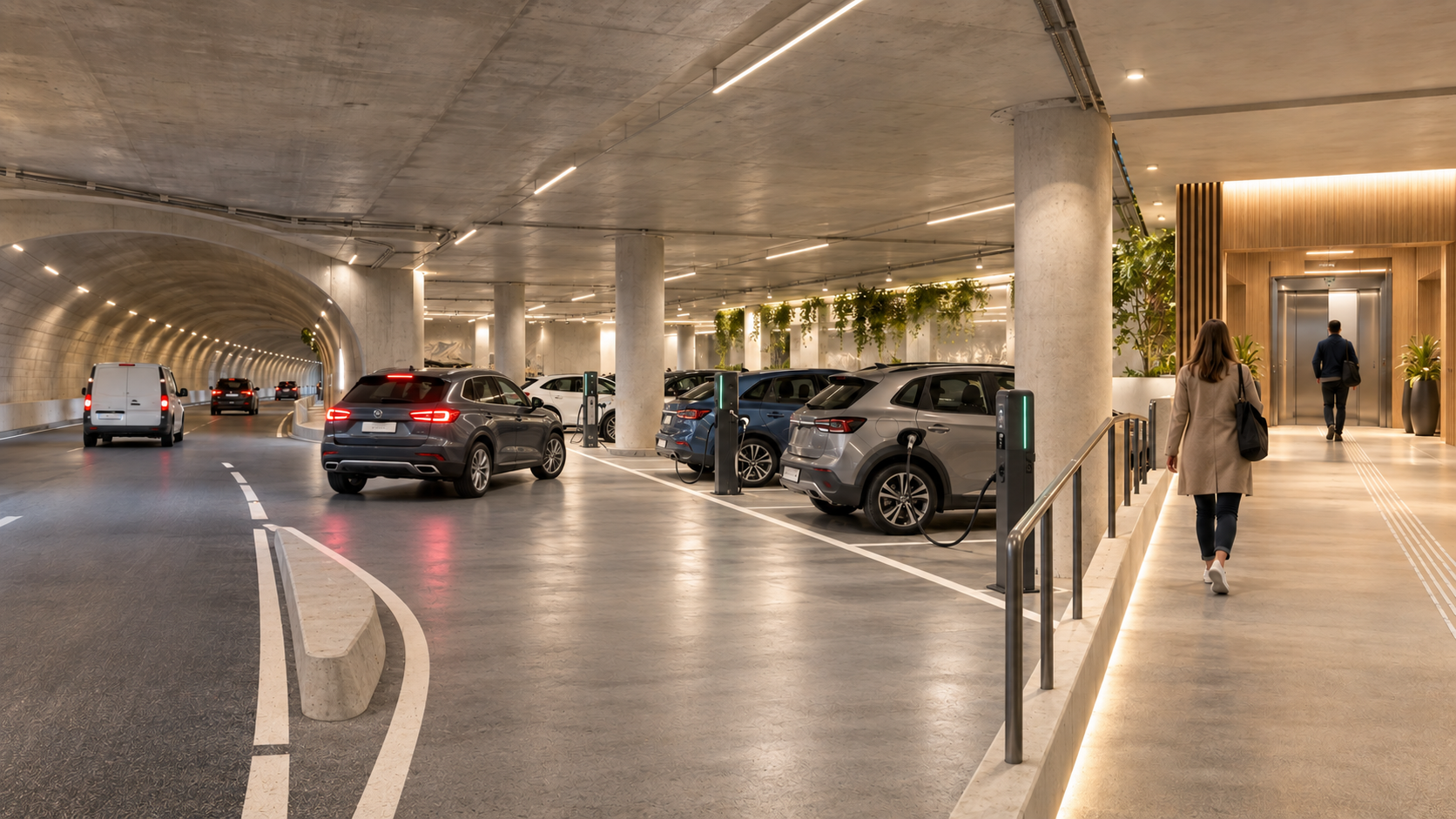
A connection at the Hauptbahnhof would give this network another purpose. Passengers arriving by train could walk to an underground mobility hub, collect a reserved shared or rental car, or step into a taxi and continue directly onto the ring. Autonomous vehicles could join that service as the technology becomes practical. The railway would handle the long journey, with a car available for the onward leg where it makes sense. A single booking could cover both, with short, accessible connections for passengers and their luggage. That would make the station a useful meeting point between modes of transport whose advocates spend rather too much time arguing with one another.
Autonomous driving could also change where cars need to spend their idle hours. Once a vehicle can reliably collect you and park itself elsewhere, it has much less reason to occupy a space outside your flat all day for the privilege of watching your front door. It could drop you off, continue to an underground garage to wait or charge, and return when required. A shared vehicle could serve its next passenger instead. Streets would still need well-designed places to pick people up and set them down, including those who need extra time or assistance. But whole rows of residential parking could gradually give way to wider pavements, trees, cycle routes and public space. The mobility service would include managing where vehicles wait, so that empty cars do not simply circulate until somebody needs them.
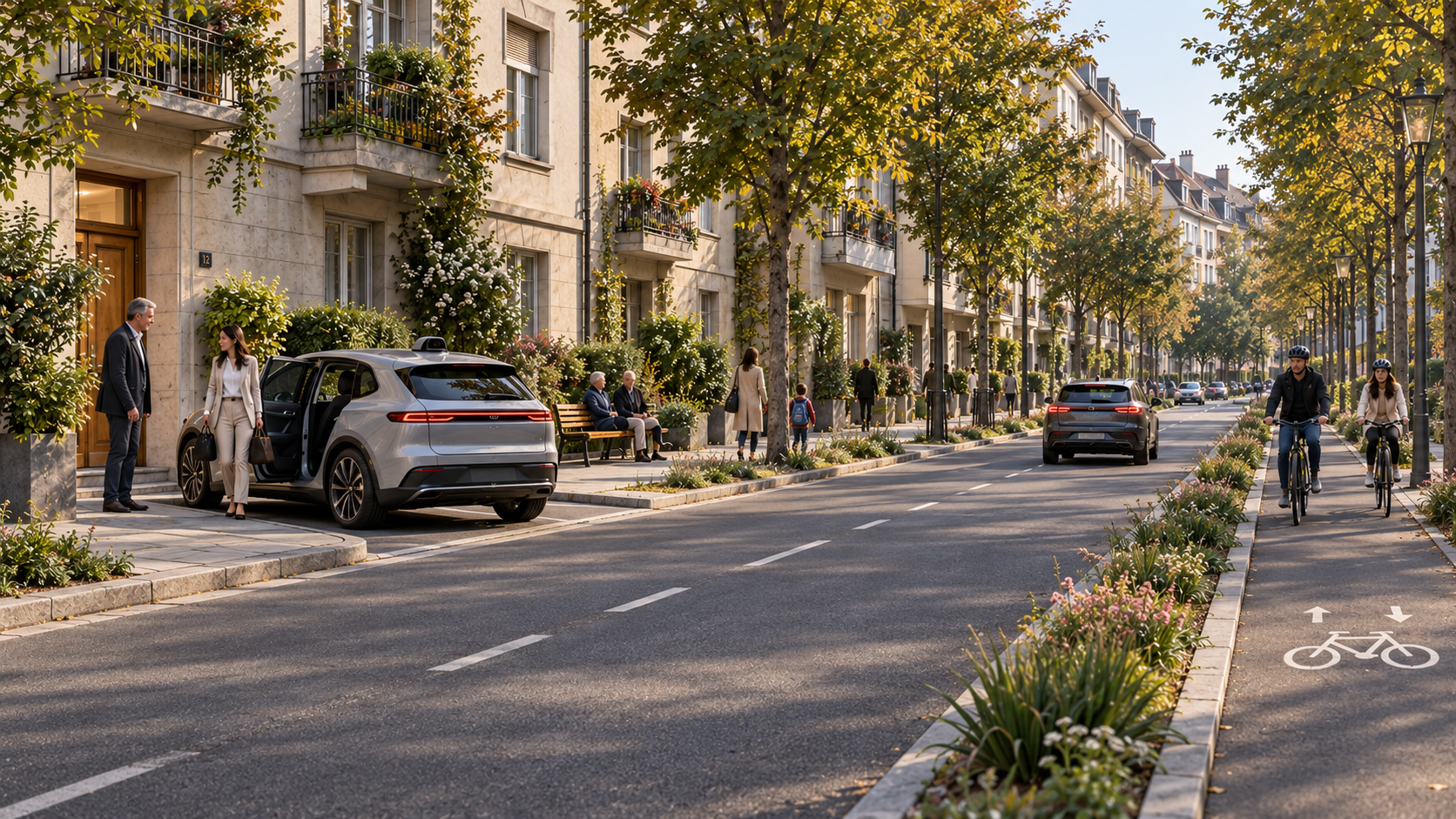
The bargain would be explicit. In return for moving appropriate traffic and parking underground, reclaim substantial space above it. Reduce road space where the new arrangement permits it and turn the land released from parking into places worth spending time in. As the need to keep a car immediately outside each home declines, that transformation could go further. The point of the investment would be to change the city above, with the transport network and the reclaimed streets planned as one project.
This is a direction to investigate, not an engineering drawing. A tunnel that merely transfers a queue to its exit would be an expensive disappointment. The connections, traffic effects, geology and costs would all need serious examination. But those are reasons to commission serious work, not reasons to confine the discussion permanently to the next set of bollards.
The price of thinking small
Zürich is a wealthy city. It should be capable of entertaining a transport vision before reducing it to whatever can be accommodated within the next modest streetscape adjustment. Infrastructure serves generations. The appropriate question is not simply what a proposal costs this year, but what kind of city it creates over the next thirty, fifty or eighty years. The current arrangement is not free either. Repeated alterations, lost time, persistent conflicts and valuable land devoted to storing stationary vehicles all have a cost, even when they do not appear together in one alarming headline.
The Gotthard offers a useful reminder of the timescales involved. Its first road tunnel opened in 1980 (total cost: CHF 686 million); the second tube is now budgeted at CHF 2.14 billion. It will allow the original to be renovated while the connection remains open, and subsequently provide separated directions of travel and an alternative during closures. Looking back, I would rather we had built both tubes together. That is a judgement about long-term usefulness, not a claim that comparing two nominal construction bills proves exactly how much we would have saved. ASTRA project details and costs.
We cannot assume that every ambitious project becomes a bargain with age. We can, however, stop assuming that postponement is prudent simply because its invoice arrives later. In thirty years, today’s apparently outrageous price may look rather less impressive beside three decades of use. The people benefiting from the investment may wonder what frightened us so much. The people still negotiating the same junction may have a different question.
The cycling study should prompt more than the usual contest over whether motorists, cyclists or planners deserve the blame. It should make Zürich examine where its transport system manufactures conflict, what behaviour it tolerates and whether its ambitions extend beyond reallocating the same contested metres. I am quite prepared to give up road space for a better city. I would simply like the city to demonstrate an ambition equal to the sacrifice.
The tunnel beneath the Hauptbahnhof shows that Zürich can think beyond the surface. It would be encouraging if that habit travelled further than the tunnel’s exits.
Just my five cents.
//Alex

