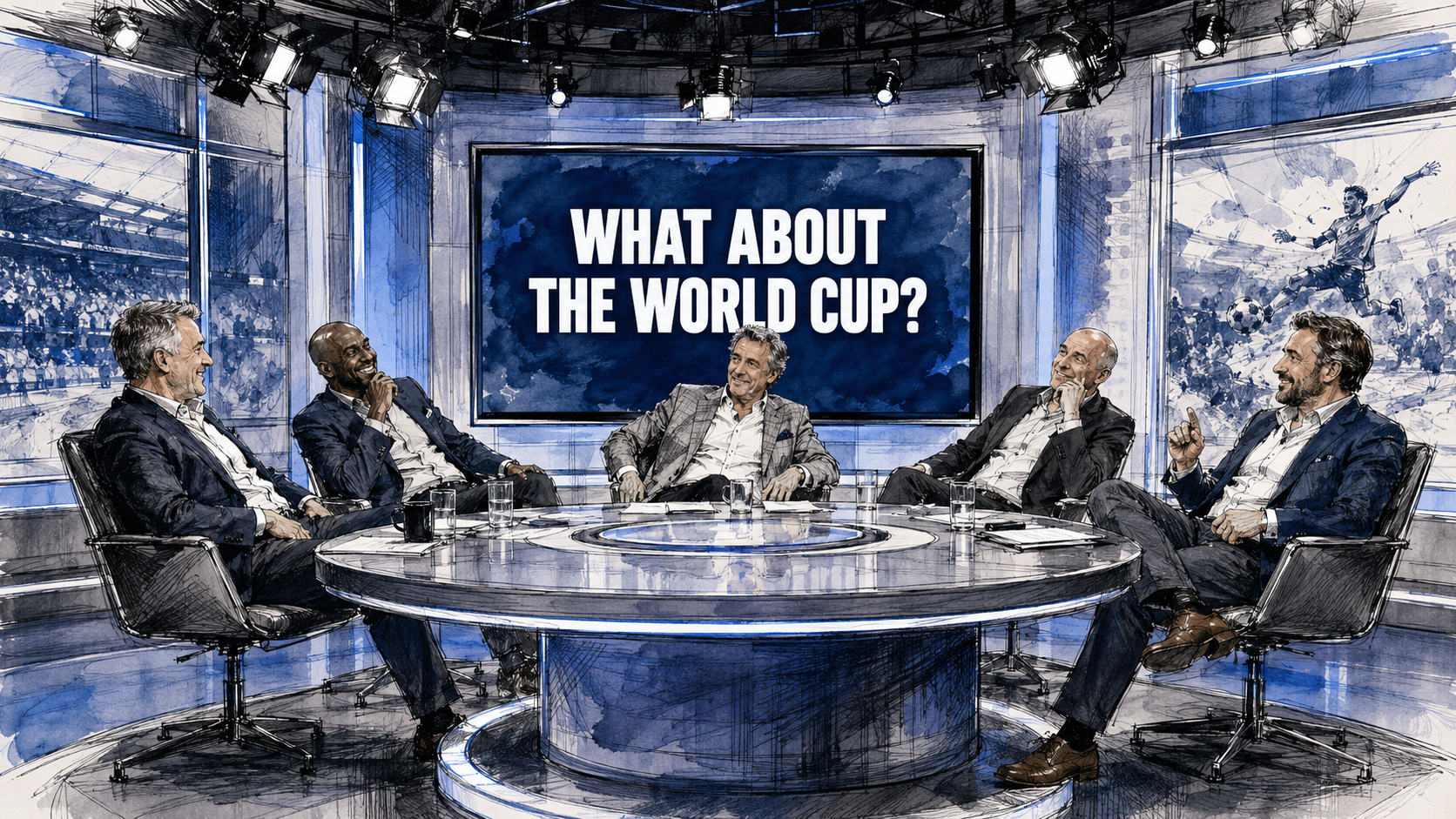
There is a strange little ritual developing around the FIFA World Cup 2026. Across European football media, players are being asked what they think about the situation in the United States, whether they have concerns, whether they would speak out, whether a boycott should even be discussed. The questions are asked because the issues are impossible to ignore. War, entry restrictions, security concerns, excluded supporters, grotesque ticket prices. The material is all there.
But then something revealing happens. The moment an answer might actually open the door to a serious discussion, the door is gently closed again. You can see it across the football talk-show circuit: the issue is touched just long enough to look serious before the familiar escape route appears. Football is sport, not politics. Players should focus on the game. Officials should deal with the topic. The question is asked, but the answer is not really wanted. Not if it forces the room to stay with the consequences. How convenient.
That formula is perfect for people who want to sound responsible without taking any real responsibility at all. It allows everybody in the studio, on the panel, or behind the microphone to acknowledge that there is, technically speaking, an issue, only to move it safely somewhere else. The players are told to concentrate on football. The political questions are handed to functionaries. And sports journalism gets to sit in the middle, nodding gravely, while pretending the matter somehow belongs to somebody else. That is far too cheap.
Because the first serious question here is not only what players are supposed to say. The first serious question is much simpler: what exactly is the role of sports journalists? Are they really supposed to step aside the moment a football issue becomes politically uncomfortable? Are they there only for tactics, line-ups, transfer gossip and dressing-room mood, while everything larger gets outsourced to politicians, federation officials, or generic current-affairs panels? That would be an absurd abdication of responsibility.
If you cover the biggest sport in the world, then you also have to cover the realities that shape it. And football is political, whether some people in television studios like that fact or not. This is not some marginal sport operating at the edge of public life. Football is the biggest sport on earth. The World Cup is its biggest tournament and one of the biggest media events on the planet. Billions watch it. Governments know that. Authoritarian states know that. FIFA certainly knows that.
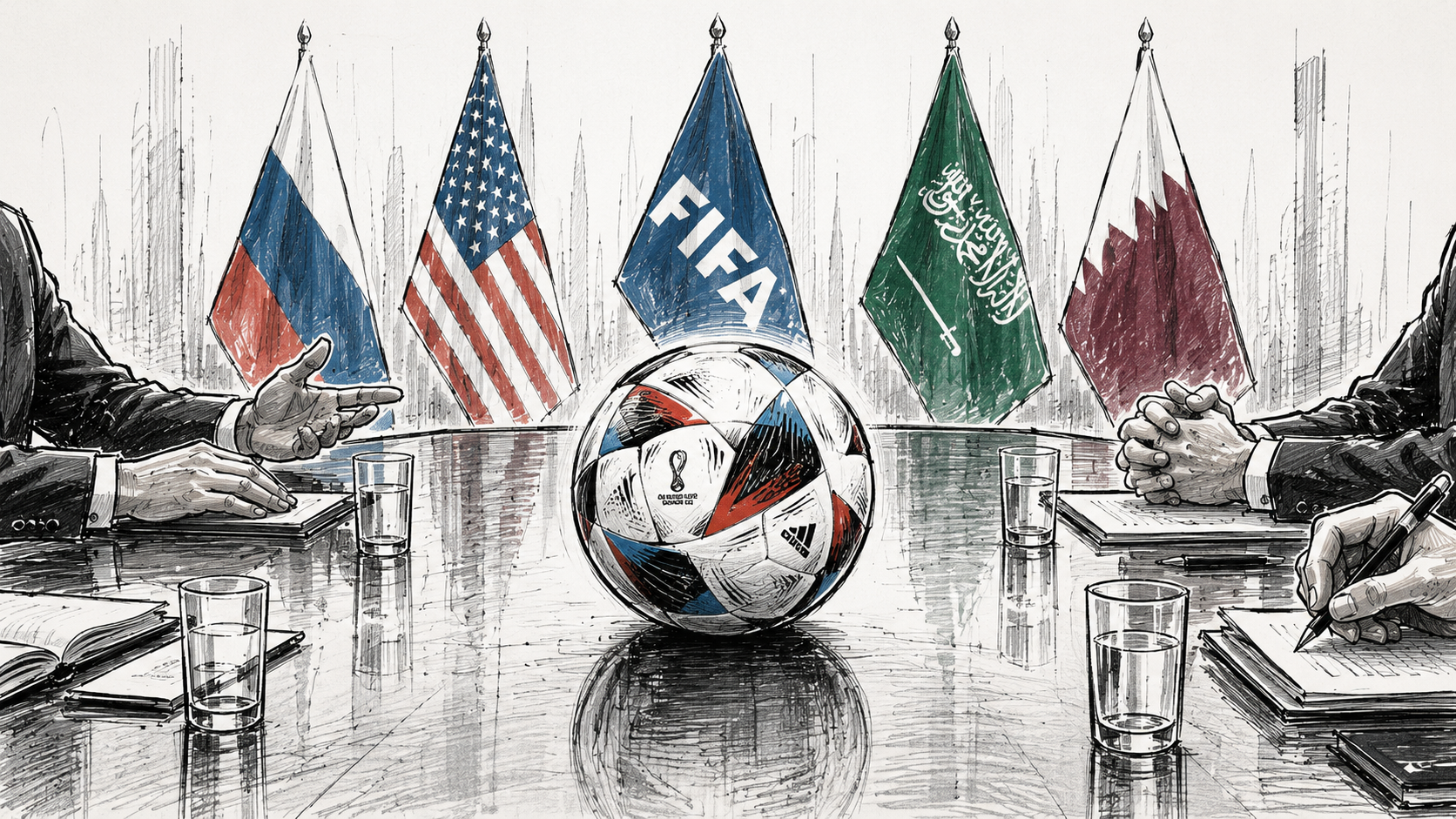
So let us stop kidding ourselves. Russia did not want the World Cup out of pure love for football. Qatar did not host it because of some great football romance. And Saudi Arabia is not investing heavily in global football because it suddenly fell in love with the beauty of the game. These are not acts of sporting innocence. They are exercises in power, prestige, and image management.
And that is exactly why the lazy phrase that football is sport, not politics is not just naive. It is dishonest. Politics is already embedded in football at the highest level. It enters through hosting decisions. It enters through the use of football as a global image machine. It enters through the conduct of FIFA itself. And it enters through the simple fact that the World Cup is now far too large, far too visible, and far too politically useful to be treated like some sealed-off sporting fairytale.
That alone should be enough to force a more serious discussion. But in the case of 2026, the issue goes even further, because the United States has itself become part of the problem. This is not a country that was passively dragged into some distant conflict. It joined Israel in launching the war against Iran, and Iran is a qualified participant nation.
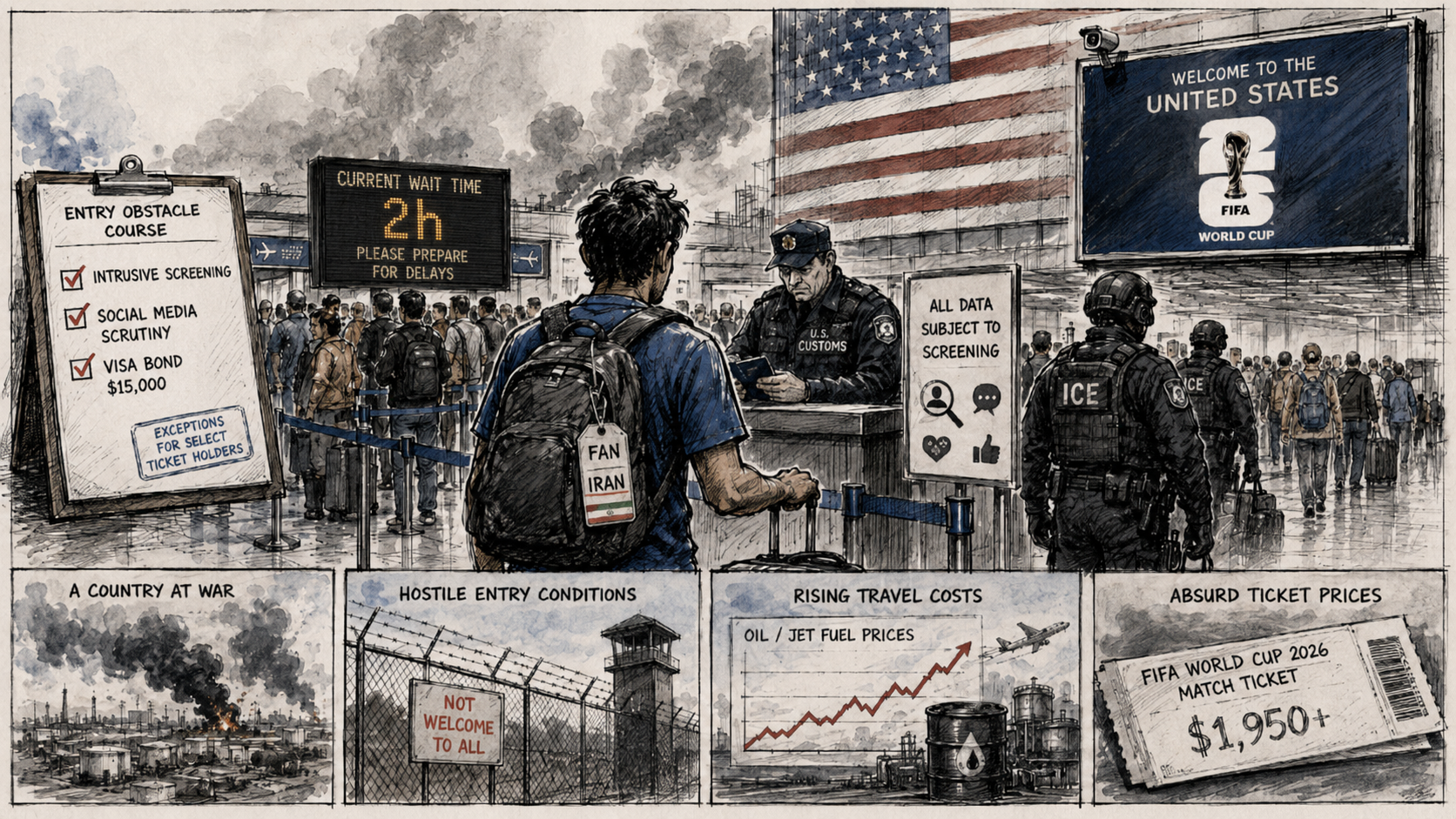
At the same time, it is turning entry for many supporters into an obstacle course of bans, intrusive screening, social-media scrutiny and a visa-bond regime so absurd that Washington has already had to carve out special exemptions for certain World Cup ticket holders. And even the loudly promoted FIFA PASS does not solve the basic problem. It merely adds another bureaucratic hoop for fans to jump through: register separately, hope for priority treatment, pay, wait, explain yourself, and still arrive without any guarantee that you will actually be allowed into the country. The final decision remains at the border. That is not hospitality. That is administrative roulette dressed up as tournament planning. For fans from some qualified nations, it is worse than that: entry is effectively barred outright.
Inside the country itself, even the basic image of order and welcome has already cracked once. During the spring funding crisis, unpaid TSA staff, hours-long queues and airport chaos became so severe that ICE agents were deployed to more than a dozen airports to help shore up operations. Not as a reassuring symbol of hospitality, but as the public face of an aggressive immigration apparatus associated with raids, fear and violent confrontations on American streets. Even if the immediate crisis eased after emergency payments, the image remains grotesque. Is that really what fans from around the world are supposed to accept as the setting for the biggest tournament on earth?
The host has broken its contract with the fans. We are neither welcome nor safe.
A World Cup host has an ethical duty to welcome the world. This looks increasingly like a country that is filtering it, policing it and shutting parts of it out. And even getting there becomes part of the absurdity. The war and the disruption around the Strait of Hormuz have pushed oil and jet-fuel prices sharply upward, making long-haul travel more expensive before fans have even reached the stadium. So supporters are invited to fly into a country at war, under hostile entry conditions, with rising travel costs. And that is before FIFA asks them to smile at the absurd ticket prices.
Beyond all of that lies an even darker point. A country actively engaged in war is not just politically compromised as a World Cup host. It also becomes a heightened security risk. The danger of terror, retaliation, or politically motivated violence is no longer some distant abstraction.
But let us return to the war itself, because that is where the moral absurdity becomes impossible to soften. The president of the host country is not merely presiding over a difficult geopolitical situation. He is using apocalyptic language against Iran. A World Cup host cannot threaten a participant nation in terms that sound like the wiping out of a civilisation and still expect the rest of the football world to treat this as background noise. Even if some of it is performance, pressure, or grotesque political theatre, the line has already been crossed. And if such threats were ever carried out, what exactly would sports journalism do then? Smile nervously, call it politics, and ask whether the players should perhaps say something?
And this is where the evasiveness of sports media becomes more than just intellectual laziness. It starts to look like self-protection. Sports media does not merely cover the World Cup. It feeds on it. The tournament means airtime, ratings, studio panels, advertising, access, travel, content and relevance. A damaged World Cup is bad for business. So the fans are politely downgraded to scenery. Their costs, their queues, their entry problems, their security concerns and their insulting ticket prices become inconvenient details around the product. They are still useful when they sing, wave flags and fill the camera frame. Less so when they start looking like the people being asked to carry the bill and the risk. Yet this time, many fans seem to understand the transaction perfectly. They are not merely complaining. They are emotionally withdrawing. Even people who have travelled to tournaments for decades are looking at this World Cup and saying, in effect: Fuck It. If the host makes entry uncertain, safety questionable and travel punishing, then the old contract between tournament and supporter has been broken.
That is precisely the reality sports journalism cannot brush past with a few nervous sentences before retreating into safe clichés. Once you accept what this tournament has become, the question changes completely. It is no longer just about whether a player might be asked an awkward question in a press conference. It is about whether sports media is willing to describe the tournament honestly at all. Too often, it is not.
Of course players should be allowed to speak. They are not decorative figures expected to perform, smile, and keep quiet. They are public figures, highly paid representatives of the sport, and often ambassadors of their countries. They do not live under a rock. Some may be affected directly, others indirectly, through family ties, personal convictions, travel concerns, or simply because they can see perfectly well what kind of tournament this is becoming. So yes, it is legitimate to ask whether they have a view.
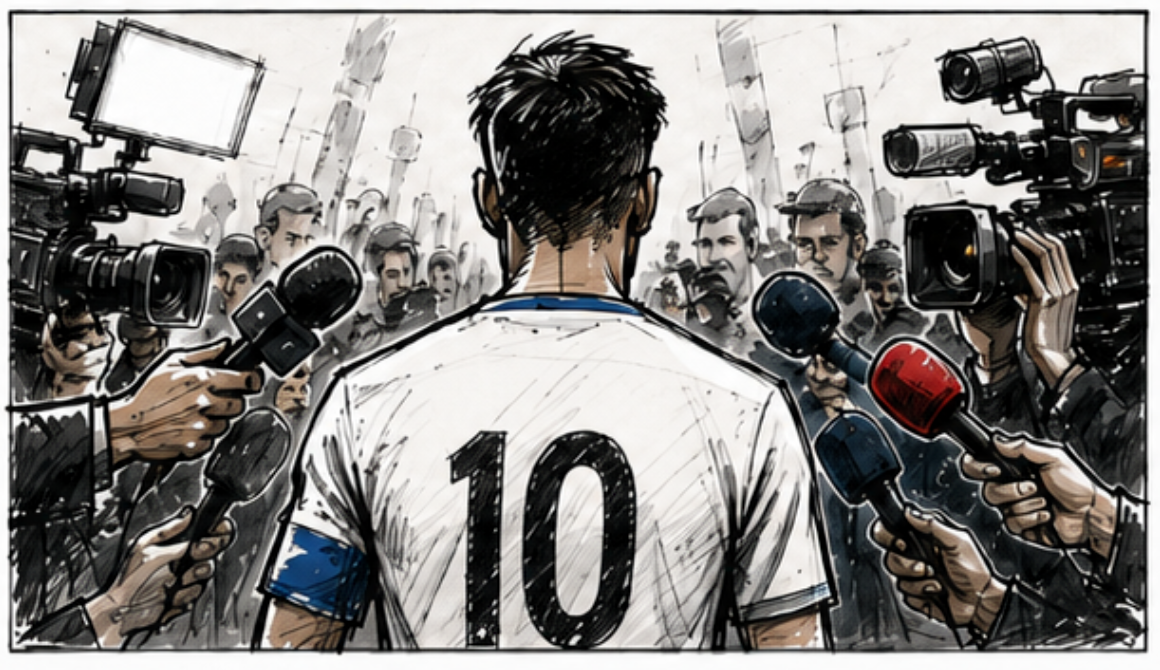
But players are not the problem, and they should not be used as cover. The real disgrace is how eagerly sports journalism tries to dump the burden on them while keeping its own hands clean. If sports media wants to raise the subject, it should also have the backbone, and frankly the balls, to follow it through. Instead, too much weak sports coverage does what it always does: it flirts with seriousness, then runs back to safety the moment the discussion threatens to become real. That is not journalism. It is a Mogelpackung, a beautifully German word for misleading packaging.
That is the real problem. Not that the subject is mentioned, but that it is instantly defused. A World Cup shaped by war, exclusion, screening, legal uncertainty, contempt for supporters, scandalous ticket prices, and a media economy invested in the product cannot be handled with a few nervous phrases and a quick attempt to dump the burden on the players. Sports journalism does not get to dodge that.

And that is why so much of it feels increasingly fraudulent: it wants the appearance of seriousness without the courage that seriousness requires. And when the tournament finally arrives and everyone wonders why the atmosphere in some stadiums feels strangely flat, they should not act surprised. The real fans stayed away. Not because they stopped loving football, but because the tournament stopped treating them as if they mattered. And sports journalism was too timid to put real pressure where it belonged: on the organisers, the federations, and the institutions that managed to fail at the simplest obligation of a World Cup: making the world feel welcome.
As always, just my five cents.
//Alex

