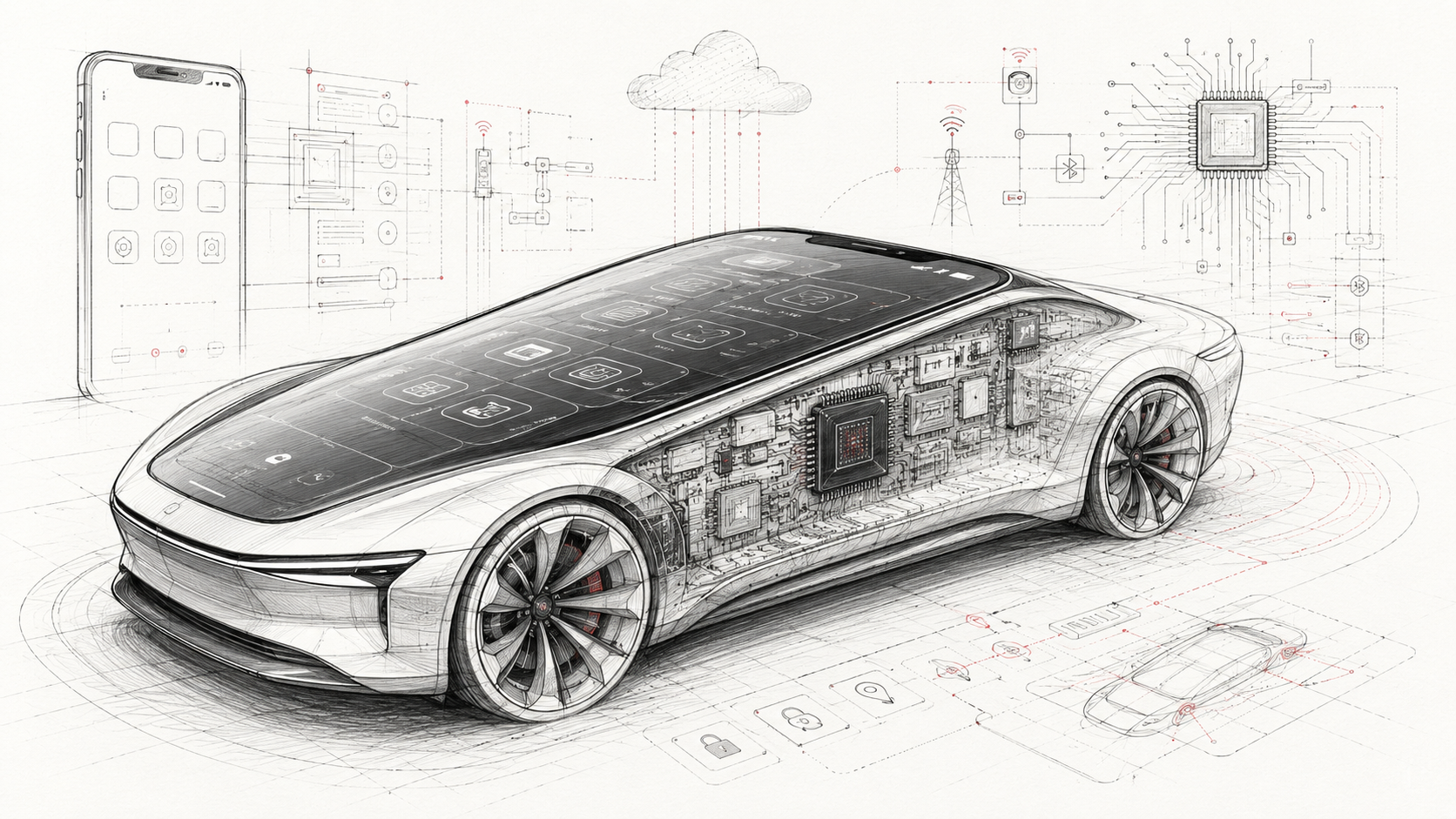
There was a time when an expensive car could grow old with a certain dignity. Paint could be polished, leather could be treated, engines could be rebuilt, suspension could be refreshed, and even a tired interior could be returned to something close to its original purpose. The machine aged, but it did not necessarily become ridiculous. A well-kept Porsche, Mercedes, BMW, Lexus or Jaguar could still make sense after twenty years because the essential value of the car was physical, mechanical and emotional. It lived in metal, engineering, proportion, tactility and the strange confidence of a product built to last longer than a fashion cycle.
That world is disappearing, and not only because of electrification. The deeper problem is computerisation. Modern cars are becoming rolling software platforms, full of screens, processors, sensors, connectivity modules, driver-assistance systems, battery controllers, infotainment stacks, cameras, cloud services, mobile apps and update mechanisms. This is not inherently bad. Much of it is necessary. Regulation, safety expectations, emissions management, electric drivetrains, diagnostics, navigation, cybersecurity and driver assistance all require software. The nostalgic fantasy of the purely mechanical car is charming, but increasingly irrelevant for any manufacturer that wants to sell a legal, competitive and useful vehicle in the modern world. The problem is not that cars have become digital. The problem is that they have become digital in a way that makes them age like consumer electronics.
Nobody wants to use a five-year-old smartphone as a primary device if there is a serious alternative. The battery is tired, the processor feels slow, the camera is dated, the operating system is near the end of support, the apps have moved on and the whole thing carries the faint sadness of once-expensive technology that has become ordinary. This is acceptable in a phone. Annoying, perhaps, but economically survivable. It is much harder to accept inside a car sold for 100,000, 150,000 or 250,000+.
That is the contradiction now facing the premium car industry. Manufacturers still speak the language of permanence, heritage, craftsmanship and long-term value while building digital systems that can feel old before the first finance contract has fully digested itself. If a premium car is to remain a premium object, it cannot be designed like a sealed electronic device with wheels. It has to be built for digital continuity.
Software Does Not Age Like Steel
Steel rusts, leather cracks, rubber hardens and paint fades. These are visible forms of ageing, but they are also familiar ones. We know how to deal with them. We can repair, replace, restore or preserve. Mechanical ageing has a vocabulary and a craft around it.
Software ages differently. It becomes unsupported. It loses compatibility. Its maps become stale, its interface looks dated, its hardware becomes too slow, its connectivity modules lose relevance, its security assumptions expire, and its update path quietly ends. It may still function, but it no longer belongs to the present. It becomes a fossil with a touchscreen.
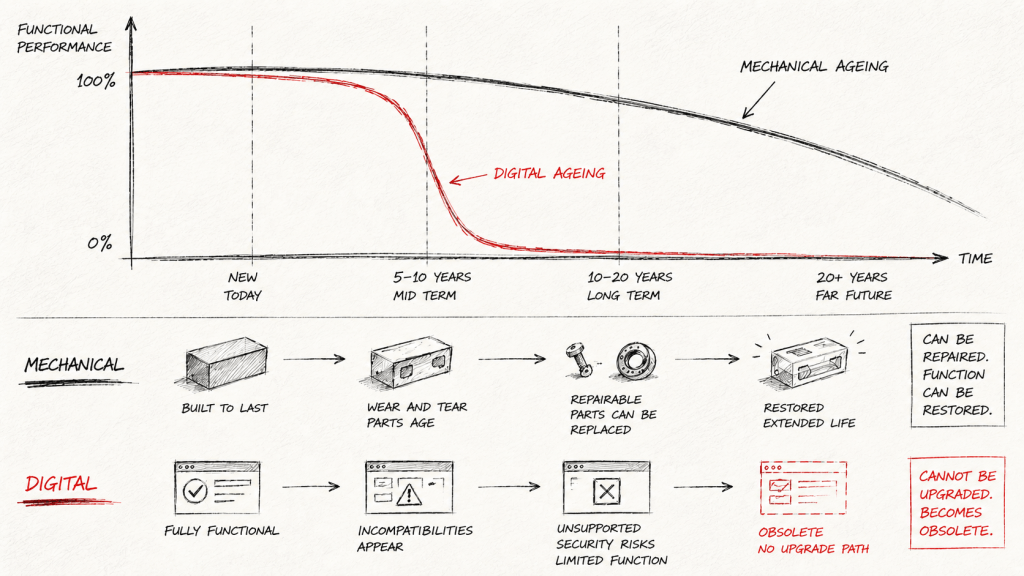
This matters because the digital layer is no longer decorative. It is not merely a radio, a navigation unit or a luxury convenience. It increasingly defines the user experience, the maintenance model, the feature set, the safety systems, the energy management and the perceived modernity of the car. A mechanically excellent vehicle can now be made to feel obsolete by a slow infotainment system, a dated display, an unsupported app, an ageing driver-assistance computer or a software platform abandoned by the manufacturer. That is not a small inconvenience. It is a direct attack on the idea of premium.
A budget car may reasonably live with compromise. If someone buys an inexpensive vehicle, the expectation is practical mobility, not digital immortality. A car in the 20,000 to 30,000 range may have a limited digital life because the investment is smaller and the bargain is clearer. A mainstream electric vehicle around 40,000 or 50,000 should offer better support and may reasonably aim for a useful software life of perhaps ten years. Tesla has shown that this is possible far better than most traditional manufacturers, even if Tesla itself does not solve the deeper issue of hardware permanence.
But a premium car is different. At 100,000 and above, the promise changes. The customer is no longer buying only transport. He is buying duration, substance, refinement, engineering and the right to expect that the car will not become digitally embarrassing while the bodywork is still in its prime. If a manufacturer wants to charge permanent-object money, it cannot deliver temporary-device architecture.
The Theatre of Over-the-Air Updates
The industry has discovered over-the-air updates and now often speaks about them as if the problem were solved. It is not. An update channel is not a software culture. A download mechanism is not digital competence.
Many traditional manufacturers now advertise OTA capability as proof of modernity. In practice, the experience can be thin: rare updates, unclear release notes, small interface changes, a bug fix here, a menu adjustment there, perhaps a feature that should have worked at delivery. Then the next model year arrives, the next hardware revision appears, the next platform is announced, and the owner of a relatively new car discovers that meaningful progress has moved elsewhere.
This is where the old industry reveals itself. It has learned the language of software without always adopting the discipline behind it. True software development is not the occasional update after a committee has survived itself. It is architecture, cadence, testing, rollback strategy, security, backward compatibility, observability, modularity and long-term support. It is not a feature in a brochure. It is a culture.
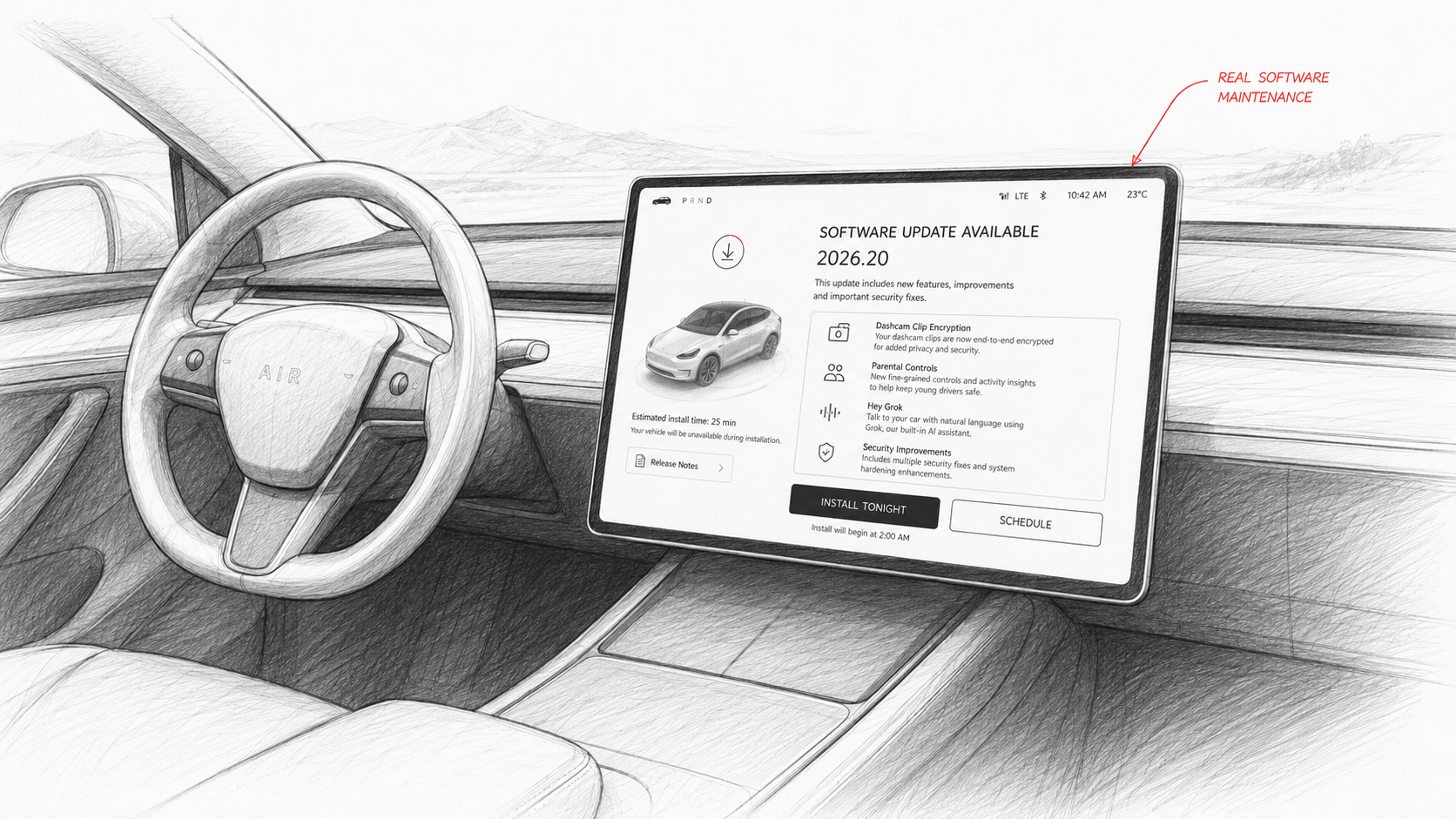
Tesla deserves credit here, even if it should not be treated as the final answer. Tesla has shown that a car can improve meaningfully after delivery. Features can mature, interfaces can change, driver-assistance functions can evolve, energy management can improve and the vehicle can remain alive in a way most traditional cars do not. Tesla has not abolished digital ageing. Its cars still have fixed computers, fixed cameras, fixed displays, fixed connectivity assumptions and fixed internal architectures. At some point, even a Tesla hits the hardware ceiling.
But Tesla has destroyed the excuse. Once a manufacturer has demonstrated that cars can improve after delivery, the traditional industry can no longer pretend that software stagnation is normal. It is not normal. It is organisational.
The Talent Problem
There is another uncomfortable point the industry rarely admits. Software excellence is a talent game, and the traditional car industry is not naturally positioned to win it.
A legacy manufacturer can attract excellent mechanical engineers, manufacturing specialists, safety experts, materials people, aerodynamicists, battery engineers and chassis developers. That is its natural habitat. It knows how to build physical products at scale, how to manage supply chains, how to crash-test structures, how to tune ride and handling, how to assemble complex machines and how to turn industrial competence into brand emotion.
But does the absolute top tier of global software talent dream of spending its life inside the infotainment department of a traditional carmaker, negotiating with procurement, supplier contracts, model-year cycles and corporate committees? Some do, certainly. But as a system, the traditional manufacturers are competing for software talent against cloud companies, AI labs, cybersecurity firms, platform companies, open-source ecosystems, infrastructure providers and startups that actually behave like software organisations.
That matters. Modern software is global. The best developers, security researchers, platform architects, AI engineers and systems specialists are distributed across countries, companies, universities, open projects and technical communities. They gather around ecosystems, tools, reputations and hard problems. They do not all sit obediently inside the closed software department of one car manufacturer.
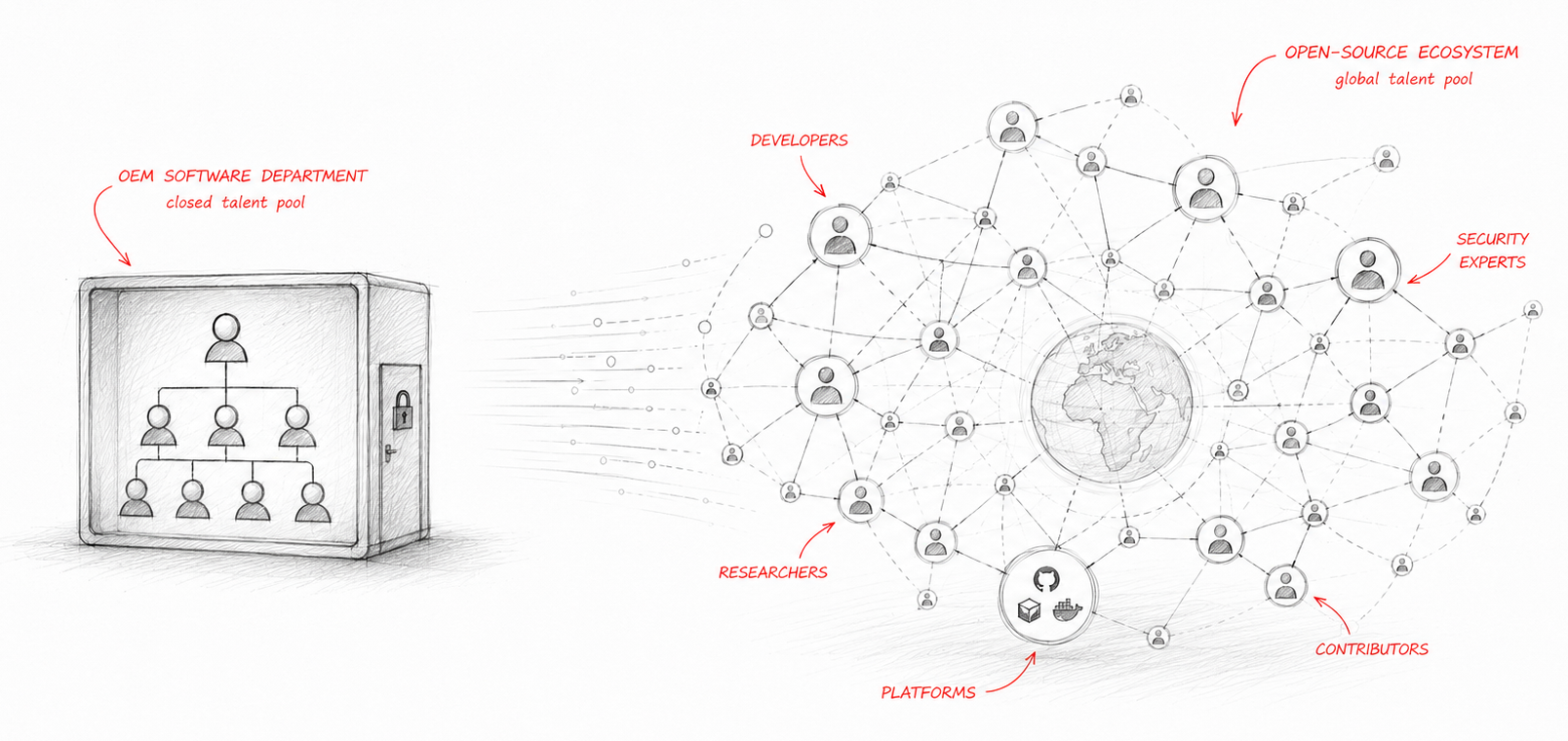
This is why open source matters. Its power is not only that the code is visible. Its power is that it can attract the largest talent pool available to the industry. It exposes weaknesses, invites review, accelerates improvement and creates foundations that outlive individual vendors. The modern software world has learned this repeatedly. Cloud infrastructure, containers, DevOps, large-scale distributed systems and much of the modern internet are built on open-source foundations and Linux-shaped infrastructure, not because open source is romantic, but because shared foundations work.
The car industry should pay attention. Projects such as Eclipse SDV already show that an open, shared software foundation for software-defined vehicles is not a fantasy. It is an emerging industrial necessity. The point is not that every carmaker should give up differentiation. The point is that every carmaker should stop wasting energy on isolated digital foundations that will age badly, fragment quickly and depend on the limited software culture of a single organisation.
If the vehicle is becoming a software-defined platform, then the computer part should not remain trapped inside the limited competence, budget and priorities of each manufacturer. The future will not be won by the brand with the most heritage. It will be won by the architecture with access to the deepest talent pool.
Closed Does Not Mean Secure
The usual objection is security. The industry will say that vehicle software cannot be open because cars are safety-critical machines. This sounds serious, and parts of it are true. Nobody should download steering logic from an app store. Nobody should install brake software because it has five stars and a pleasing icon. A car is not a toy, and pretending otherwise would be idiotic.
But the conclusion does not follow. Closed does not mean secure. It means closed.
Modern cars are already full of attack surfaces: diagnostic interfaces, control units, mobile apps, wireless connectivity, keyless entry systems, infotainment stacks, cloud services, update mechanisms and supplier software. The idea that all this is safe because it is proprietary is one of the more comfortable illusions of the industry. The existence of UNECE regulations for vehicle cybersecurity and software-update management should already tell us that closed automotive software is not magically safe. Security by obscurity is not security. It is delayed embarrassment.
There are already enough tools, adapters and grey-market devices that can manipulate vehicle software, unlock functions, change coding, alter configurations or interfere with settings manufacturers would prefer to describe as protected. The closed model has not produced a pristine digital fortress. It has often produced opaque systems whose weaknesses become visible only when someone outside the official structure finds them.
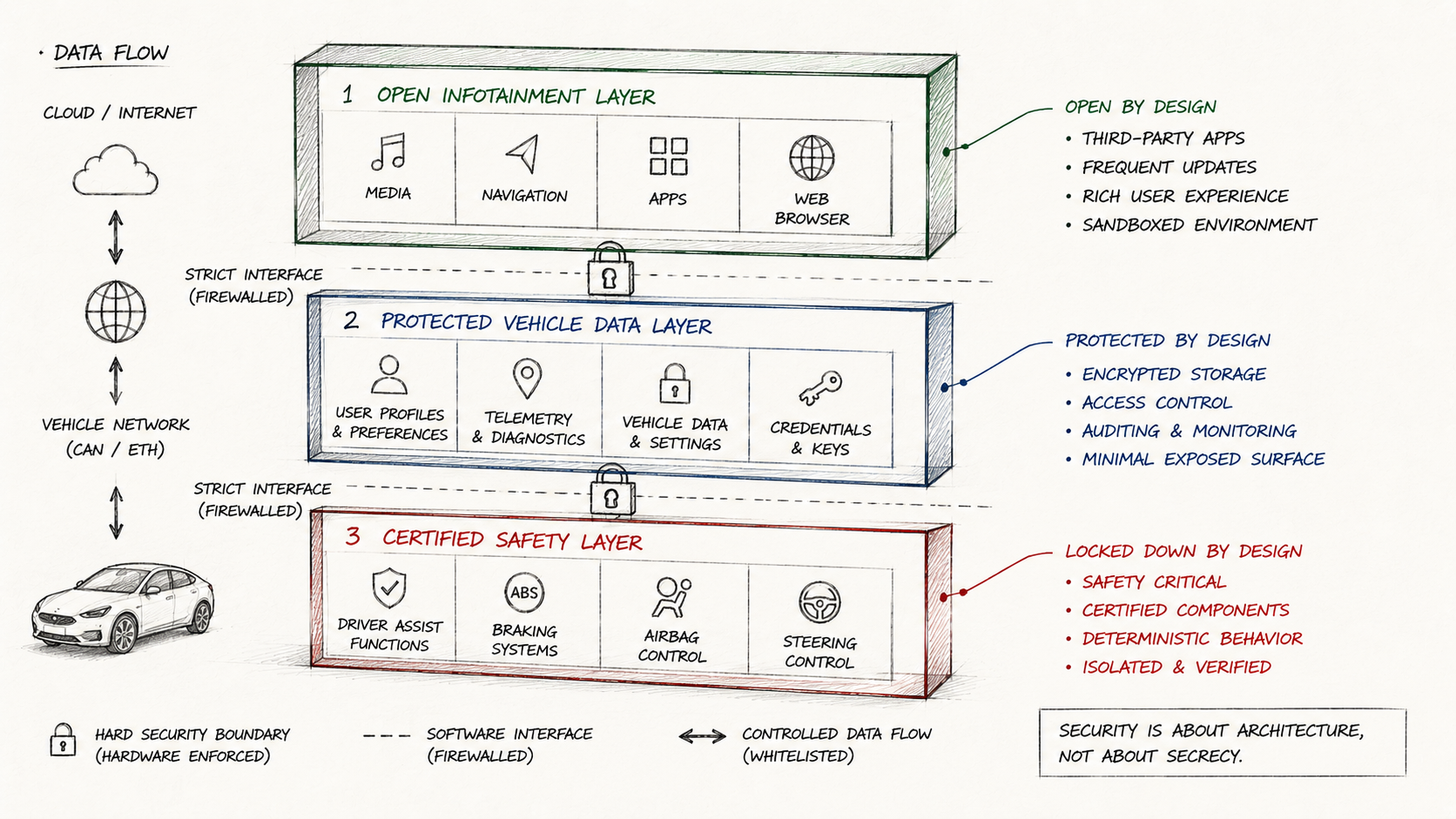
A serious open-source Car OS would not mean open chaos. It would mean layered openness. Infotainment, apps, media services, navigation options, charging tools, personalisation and non-critical user interfaces can be open, extensible and competitive. The vehicle data layer should be standardised, well documented and properly protected. Safety-critical functions such as braking, steering, stability control, airbags, battery safety and autonomous-driving control must remain certified, signed, audited and restricted.
That is not an argument against open source. It is an argument against stupidity. A well-governed open core can be more transparent, more inspectable, more resilient and more sustainable than a sealed proprietary stack maintained by a manufacturer that has already moved on to the next platform. The distinction is not between open danger and closed safety. It is between professional architecture and branded opacity.
The Upgradeable Premium Car
If premium manufacturers want to survive the digital age as more than luxury trim suppliers, they need a new product philosophy. The car should be designed as a durable physical platform with replaceable digital layers. The vehicle should outlive its first computer.
This requires more than software updates. It requires hardware-aware longevity.
The first principle is separation. The durable vehicle layer should include the structure, chassis, suspension, steering hardware, braking hardware, battery integration, electric motors, crash systems, climate hardware, seating, body and essential physical controls. This is where traditional manufacturers still have deep competence. They should build the machine, and they should build it beautifully.
The second principle is a stable safety layer. Critical real-time systems should remain conservative, certified and strongly controlled. Nobody benefits from fashionable experimentation in airbag logic or brake control. These systems need long support cycles, clear responsibility, auditability and strict software integrity.
The third principle is a standardised vehicle data and service layer. Vehicle signals, diagnostics, permissions, software update logic, logging and health monitoring should be based on open standards wherever possible. This is where the industry must stop behaving like every manufacturer deserves its own little digital kingdom. Standards and platforms such as AUTOSAR Adaptive and COVESA’s Vehicle Signal Specification point in the right direction: modern vehicle software needs services, APIs and a common language for vehicle data, not a private dialect for every brand. Shared foundations do not destroy differentiation. They prevent waste.
The fourth principle is modular infotainment. The cockpit computer should be replaceable because infotainment ages quickly. Navigation, media, connectivity, voice assistants, smartphone integration, app support and interface rendering should not condemn an otherwise excellent car to digital old age. A premium car should have a serviceable cockpit module, a replaceable connectivity module and displays designed for long-term availability or standardised replacement.
The fifth principle is a separate autonomy compute module. Infotainment and autonomous driving should not be treated as one computer. They have different lifecycles, different risks and different certification requirements. A future premium vehicle should have an upgradeable AI compute slot, perhaps using whatever high-performance platform becomes dominant at the time, whether from NVIDIA or another supplier. But this module must be certified against the vehicle’s sensors, actuators, braking architecture, steering architecture and software release. It should be upgradeable, but not casual.
The sixth principle is long-term commitment. A premium manufacturer should publish support periods for software, security, displays, compute modules and connectivity. Not vague lifestyle language. Not “continuous improvement” as a decorative phrase. Actual commitments. Fifteen years of security support. Twenty years of module availability. Certified upgrade paths. Documented interfaces. Repairable digital components. A premium price should buy a premium lifespan.
The Dashboard Must Become Serviceable
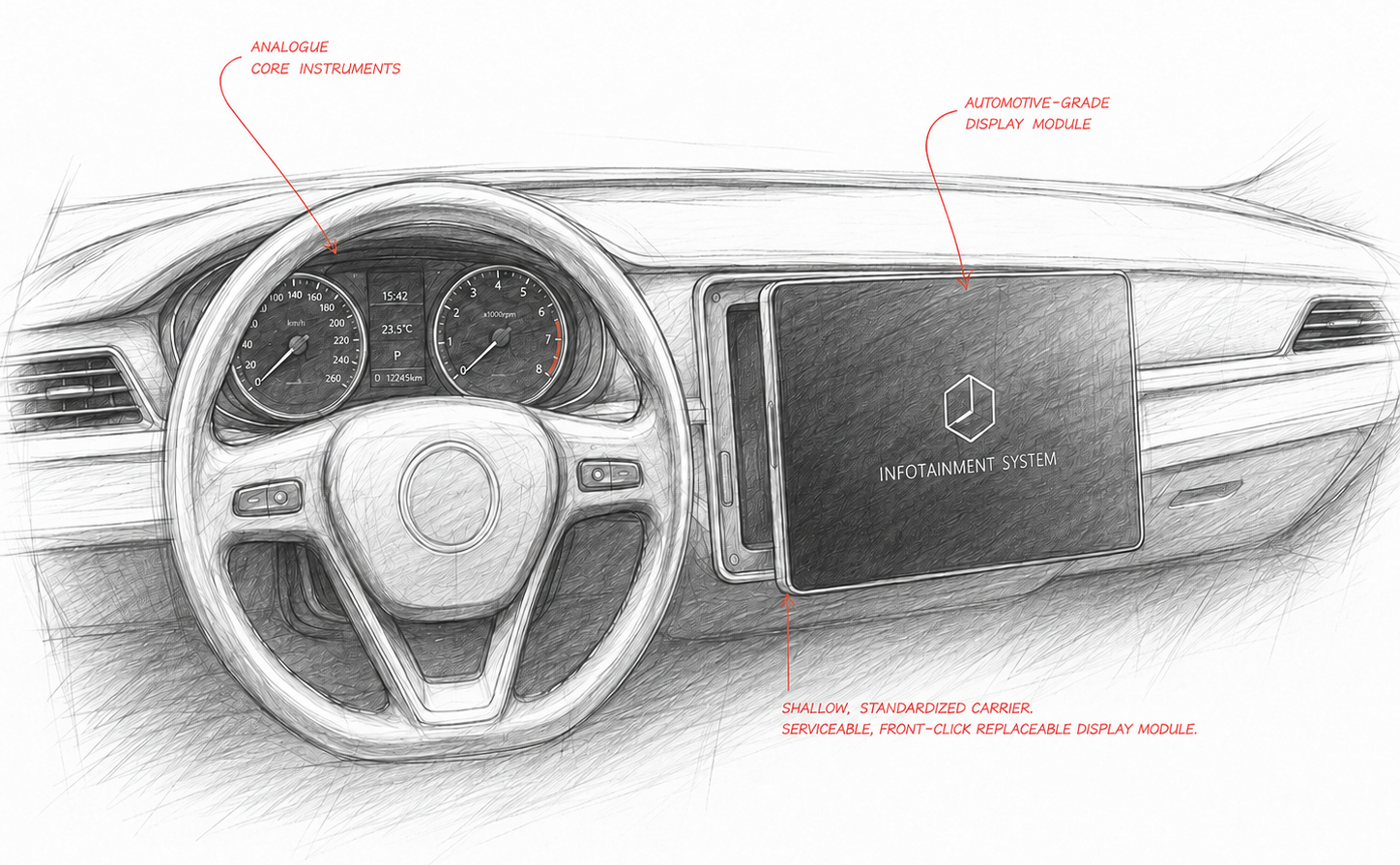
A truly durable premium car should also rethink the visible hardware. This starts with the instruments. I want a proper analogue speedometer. I want a proper analogue rev counter, or its electric equivalent where that makes sense. Not because analogue instruments are nostalgic theatre, but because essential driving information should not depend entirely on one large ageing screen, one supplier panel, one software skin or one discontinued display unit. The basic act of driving should remain readable even when the fashionable digital layer has become old.
This does not mean rejecting displays. That would be childish nostalgia. Modern cars need screens for navigation, media, driver assistance, charging, vehicle settings and increasingly complex information. But those displays should be designed as replaceable modules, not as permanent architectural hostages. A premium manufacturer should not glue the digital face of the car into the dashboard as if it were building a disposable tablet with a leather steering wheel attached.
The right answer is not necessarily a consumer tablet from an electronics shop. A car needs automotive-grade display modules: heat resistant, cold resistant, vibration resistant, sunlight readable, crash safe, electrically robust and certified for the environment in which a vehicle actually lives. But these modules should follow standardised sizes, connectors, mounting frames and communication interfaces. They should click into place securely, be recognised by the car, receive their software profile and work. If the display ages, fails or becomes technically outdated, it should be replaced like a component, not excavated like an archaeological site.
This is also where the economics matter. Serviceability is not real if it only exists in a brochure. A replaceable display that costs 5,000 dollars in parts, requires five days at a dealer and another 5,000 dollars of labour is not serviceable. It is hostage-taking with a parts catalogue. In a premium car, an automotive-grade display module may cost more than a consumer tablet. Fine. Make it 500 dollars. Make it 1,000 dollars. But the principle must be clear: the screen should be replaceable at a rational cost and within a rational amount of time.
The physical interface should be designed accordingly. A locked frame, a standardised carrier, a robust connector, proper thermal contact, tamper protection and software authentication are all possible. This is not beyond the capability of an industry that can build retractable door handles, active suspension and panoramic glass roofs that tint themselves for dramatic effect. The problem is not engineering difficulty. The problem is that manufacturers have rarely been forced to treat digital components as long-term service parts rather than expensive design gestures.
A lasting premium car should therefore have two faces. The first is the durable driving face: analogue or semi-analogue core instruments, physical controls where they matter, and essential information that remains available for decades. The second is the replaceable digital face: automotive-grade display modules, upgradeable cockpit compute and standardised interfaces that allow the car to stay modern without pretending that a screen installed in 2026 will still feel contemporary in 2036.
This is what premium should mean in the digital age. Not the largest screen at launch. Not the most theatrical interface. Not another menu system designed by people who apparently believe climate control is more elegant when hidden three taps deep. Premium should mean that the car remains usable, repairable and visually dignified when its first generation of electronics has grown old.
The Compute Bay
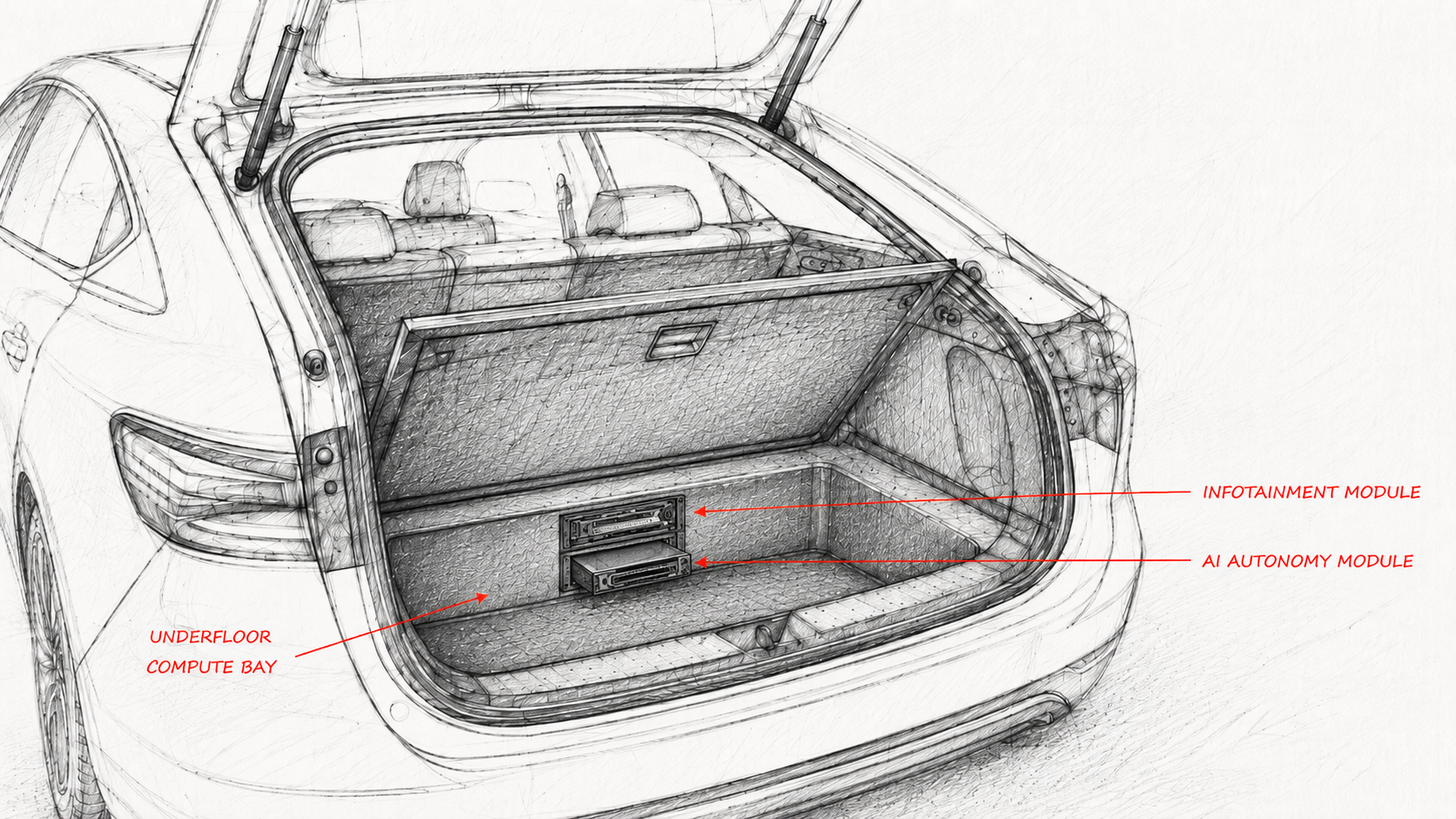
The most concrete expression of this idea would be a compute bay, probably located somewhere practical and serviceable such as the rear of the vehicle. Not a single sealed brain, but separate modules.
One module would handle infotainment and cockpit services. It could be replaced every five to seven years if necessary. A faster processor, newer wireless standards, better app support, improved maps, modern voice assistance and updated interface capability should not require buying a new car.
The second module would handle autonomous-driving and AI workloads. This would be more serious. It would require high-speed sensor inputs, thermal management, power headroom, secure boot, hardware identity, signed software, fallback behaviour and certification. It could not be swapped like a gaming graphics card. But it could still follow a defined upgrade path, allowing a premium vehicle to receive a more capable AI compute unit later in life if the sensors, actuators and regulatory approvals support it.
Such a system would require a simplified electrical and electronic architecture. The industry has already been moving from scattered control units toward more centralised, domain-based and zonal architectures. That direction is correct. A modular premium car would need standardised high-speed communication, clean abstraction layers, stable APIs and vehicle services that are not inseparably welded to one generation of hardware.
Upgradeability also has to be economically honest. A replaceable compute unit should not become a five-thousand-dollar theatre piece wrapped in proprietary workshop procedure. If the module costs more than roughly two thousand dollars, the concept starts to defeat itself. The whole point is to make the car’s digital core serviceable at a rational price, not to invent a new premium tax on obsolescence.
None of this is science fiction. It is difficult, expensive and politically inconvenient. That is different from impossible.
The Real Threat to Premium
The premium car industry often talks as if its greatest threats are regulation, electrification, China, software companies or changing consumer taste. Those are real pressures. But the more intimate threat is that premium itself becomes incoherent.
What does premium mean if the expensive object ages like a gadget? What does heritage mean if the digital layer is unsupported? What does craftsmanship mean when the cockpit feels obsolete after five years? What does engineering excellence mean when a car costing more than a house in some countries depends on a processor that cannot be upgraded?
Premium cannot simply mean more screens, more ambient light, more subscriptions, more digital theatre and more brand-managed vocabulary. That is not excellence. That is expensive disposability.

The rescue of the premium manufacturer may come from accepting a humbler truth: they should not own everything. They should build the durable machine. They should define the brand experience, the physical quality, the safety architecture and the emotional character of the product. But the digital foundation should be open, modular, standardised and able to draw from the largest talent pool in the world.
That will offend the old instinct for control. Good. That instinct has produced too many closed systems, too many weak updates, too many abandoned platforms and too many cars whose software life is shorter than their paint warranty deserves.
The car of the future does not need to be less digital. It needs to be digitally honest. If it is a computer on wheels, then design it like a serious computer platform: modular, serviceable, secure, upgradeable and built on foundations that can survive longer than one product cycle.
The lasting premium car will not be the one with the largest screen at launch. It will be the one that is still worth owning when its first computer has become old.
Like always. Just my five cents.
//Alex

