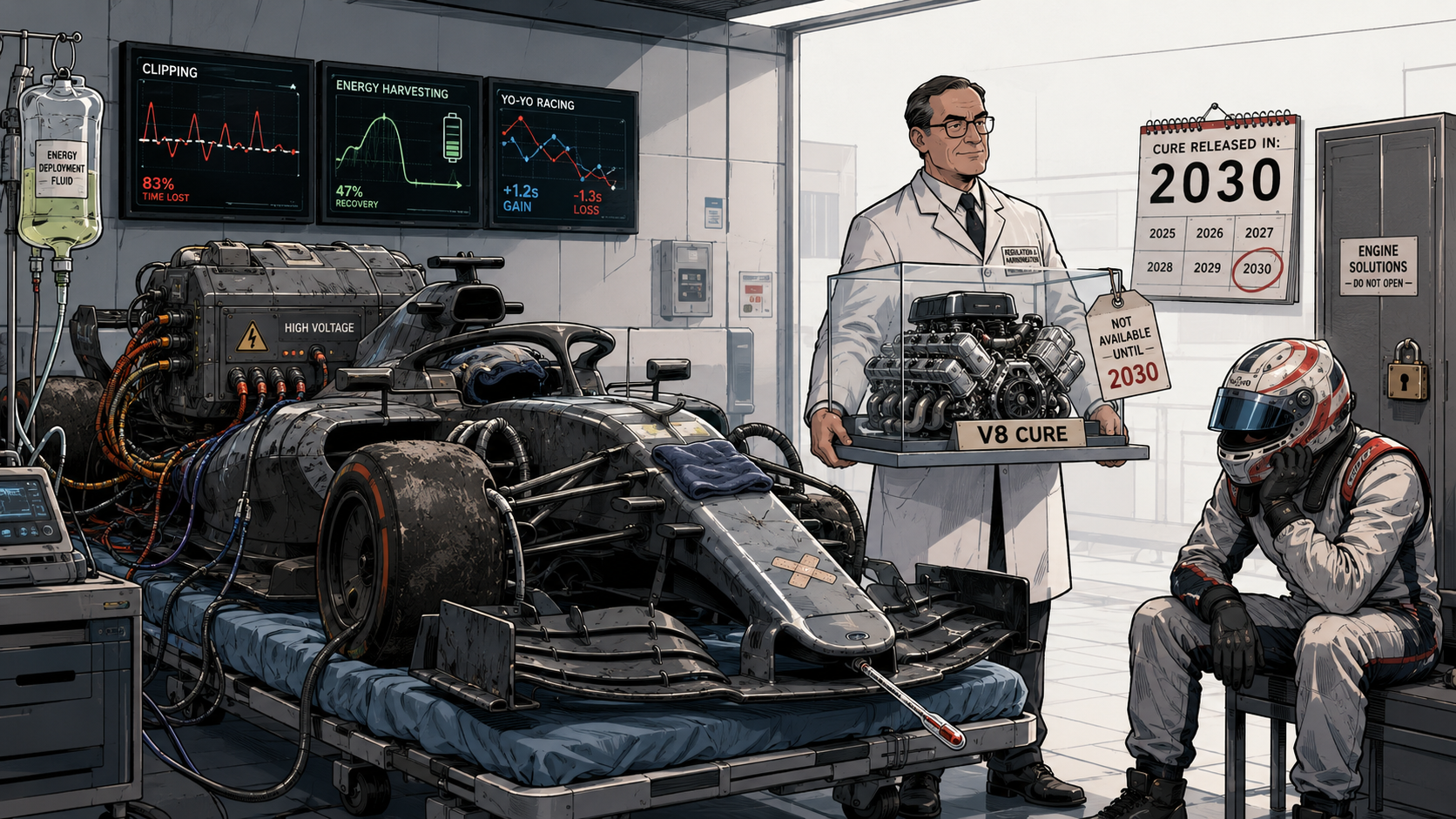
There are few pleasures in life more petty, but also more satisfying, than watching reality arrive late to a conclusion you reached years ago.
Formula 1 has now entered that phase. The FIA president has openly talked about bringing back V8 engines by 2031 at the latest, possibly even by 2030 if the manufacturers cooperate. Less complexity, less weight, more sound and only minimal electric support. In other words, almost everything some of us have been asking for while being told that the future had to be heavier, quieter, more electrical, more managed and somehow more relevant because the right people had put the word sustainability near it.
I wrote it in 2024 when the 2026 regulations were announced: Formula 1 was going in the wrong direction. And I wrote it again when the 2026 season began and the sport looked less like Formula 1 and more like Formula Eco. So this latest V8 discussion does not feel like a surprise. It feels like confirmation: the sport has finally begun to retreat from the direction it defended for far too long.
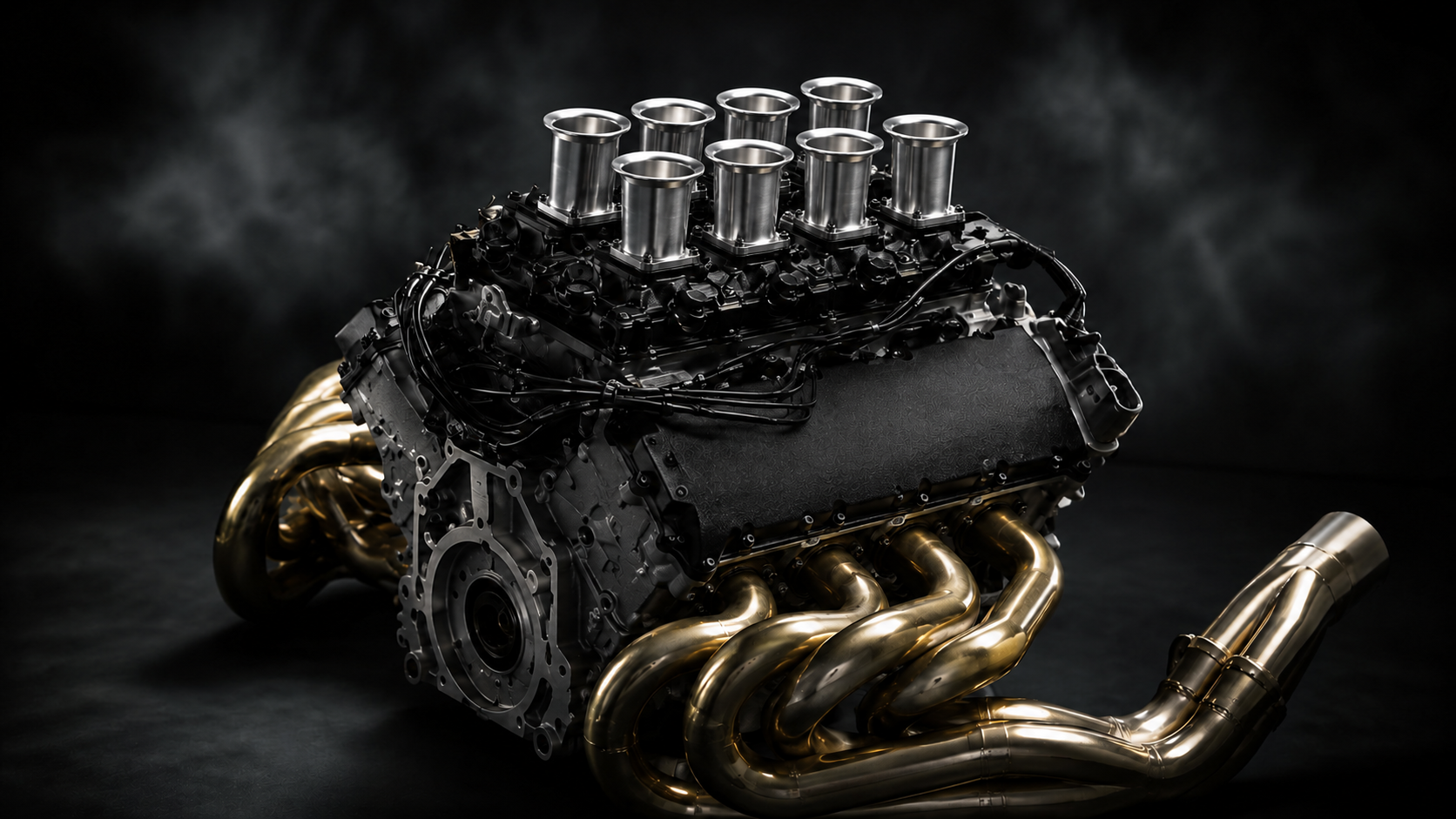
The important point is not that Formula 1 has discovered some perfect solution with the V8. Many fans would still prefer the return of the V10, and for good reason. If the argument is about sound, emotion and combustion character, the V10 remains the obvious reference. The V8 is likely the compromise. It is easier to justify to manufacturers and more aligned with markets where the V8 still has cultural weight. It may not be the dream answer for purists, but it would still be a significant step away from the over-electrified direction now causing so much discomfort.
The absurdity of the 2026 rules lies precisely here: when the electrical side becomes so dominant that it dictates the rhythm of the car, the driver is no longer simply fighting the limit. He is working around an energy model. That is where clipping and superclipping become so damaging. They are not just ugly technical terms for engineers to discuss in private. They attack the basic instinct of watching a racing car. A driver may be on full throttle, but the car does not necessarily deliver full power because the system needs to protect or recover electrical energy. The car is no longer responding purely to commitment. It is responding to battery state, deployment logic and regulatory compromise.
This changes the entire reading of a lap: the value of corner speed, the logic of deployment and even the meaning of an overtake. One car can close because the other has run out of electrical support or has entered a harvesting phase. A few moments later, the situation can reverse. On the timing screen there is action, but not all action is racing. If an overtake is created mainly because one car temporarily has the wrong energy state, then the spectacle may be moving, but it is not necessarily meaningful.
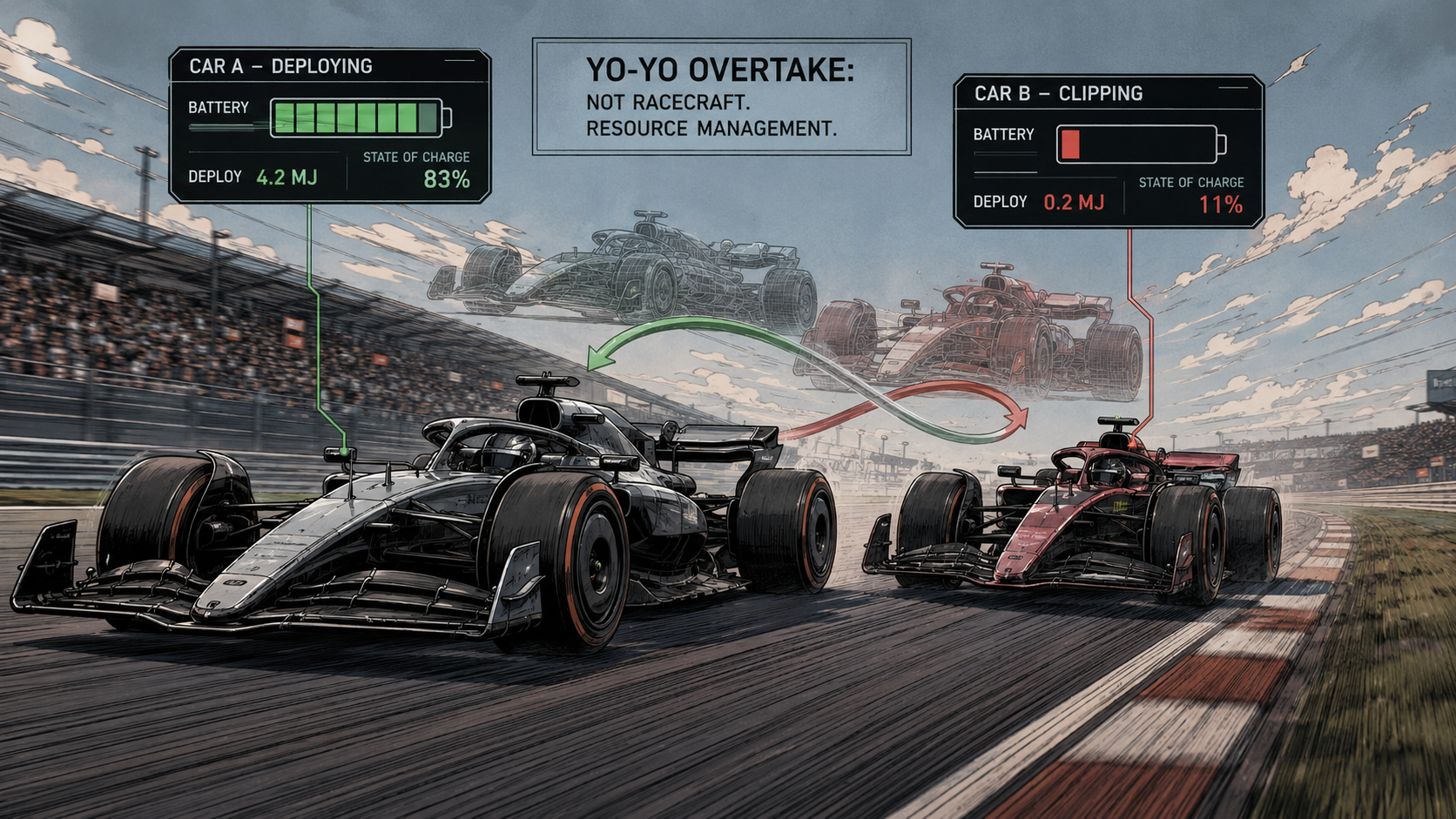
The so-called yo-yo effect is therefore not a small defect. It is a symptom of a deeper failure. Formula 1 is supposed to show the difference between drivers at the limit, not alternate between battery privileges. The best drivers should separate themselves through braking, corner entry, rotation, throttle control, judgement and nerve. Those are the places where talent becomes visible. Those are the moments where Max Verstappen, or any other exceptional driver, should look different from the merely competent.
Instead, the current concept risks flattening those differences. When going faster through a corner can punish you on the following straight, the entire logic of performance becomes warped. A racing car should reward commitment and precision. It should not ask the driver to compromise the most exciting parts of the lap because the energy strategy demands a different compromise.
The FIA has already tried to soften some of the worst effects with rule adjustments, but that only confirms the problem. You do not start correcting a healthy concept almost immediately. You correct it because the sport has seen enough to know that the direction is not working. And now, while the 2026 era has barely started, the governing body is already talking about the next philosophical reset.
Now there is even talk of adjusting the 2027 engine rules to a 60/40 split between combustion and electric power. That may sound like a correction, but it is really just another round of expensive tinkering. If Formula 1 simply reduces the electric contribution without properly replacing the missing power, it risks creating cars that feel embarrassingly underpowered for the category. And if the manufacturers now have to redesign stronger V6 engines anyway, then the obvious question becomes unavoidable: why waste resources on repairing the wrong concept? If you are going to build new engines, build the right ones. Go to the V8 directly, instead of spending more time and money polishing a compromised V6 formula that has already lost the argument.
That is the absurdity. Formula 1 seems to know where it needs to go, but it may take until 2030 or 2031 to get there. If the change comes in 2030, fans still have the rest of 2026 plus three full seasons to endure. That is not a small transitional inconvenience. That is several seasons of a flawed concept after the sport has already started preparing the correction. For traditional racing fans, this is hard to accept.

The return to V8 engines would not solve everything. The cars still need to become smaller and lighter. Aerodynamics still need to be controlled far more aggressively. Dirty air, oversized dimensions and artificial overtaking aids remain part of the same disease. But a simpler, louder combustion engine with only modest electrical support would at least move the sport back toward the right argument. It would admit that racing is not improved simply because the powertrain has become more complicated.
Max Verstappen may become the most visible symbol of this delay. Not because the sport depends on one driver, but because he represents exactly the kind of talent Formula 1 should be built to showcase: uncompromising, direct, instinctive and interested above all in driving faster than everyone else. If the correction only comes in 2030 or 2031, the sport is asking drivers like him to waste several more years inside a concept that dulls the very qualities that make them exceptional. That is not a small risk. Formula 1 may not only lose the patience of serious racing fans. It may also lose some of the drivers who still make the whole thing worth watching.
So yes, the V8 discussion is good news. But it is also an indictment. It confirms that the current concept was a wrong turn, and it confirms that the sport now knows it. The uncomfortable part is the waiting period. Formula 1 appears ready to admit the mistake, but not ready to spare us from watching it for several more years.
Racing fans have not been offered a solution. They have been offered a date somewhere in the distance, while the sport continues to run the very idea it now seems prepared to abandon.
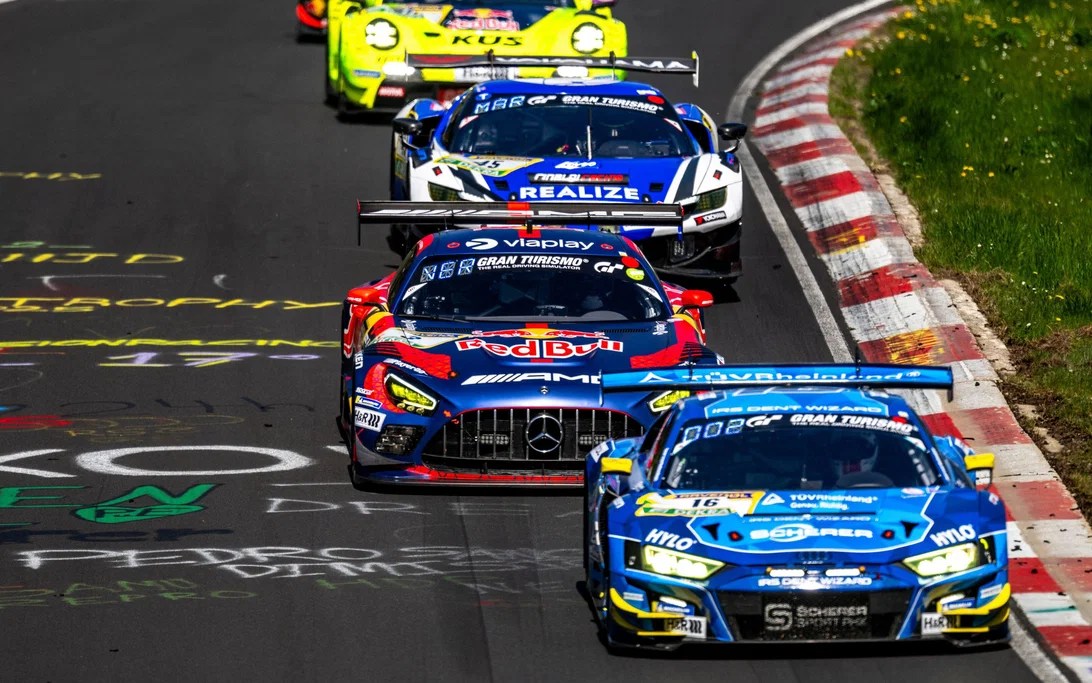
What remains is the exit ramp. Until Formula 1 corrects its mistake, serious racing fans may have to look elsewhere. GT endurance racing would be a good place to start: real cars, real drivers, real racing.
As always, just my five cents.
//Alex
Enjoy the topc? Here some more F1 related articles:
🏁 My F1 Series – The full Rant
- I gave Formula 1 another Chance. That was my Mistake.
- Shut Up, Max? Why F1 Media has become Part of the Problem
- Formula 1 is dead. Long live Formula Eco!
- It’s not just the Monaco Circuit, Dummy — It’s the Tanks we call F1 Cars
- The 2026 F1 Regulations: You’re doing it wrong!
- Papaya Paradox: How McLaren’s own Rules undermined Oscar Piastri’s Championship Run
- F1: The Movie – Driven by Ego, Powered by Bullshit

