
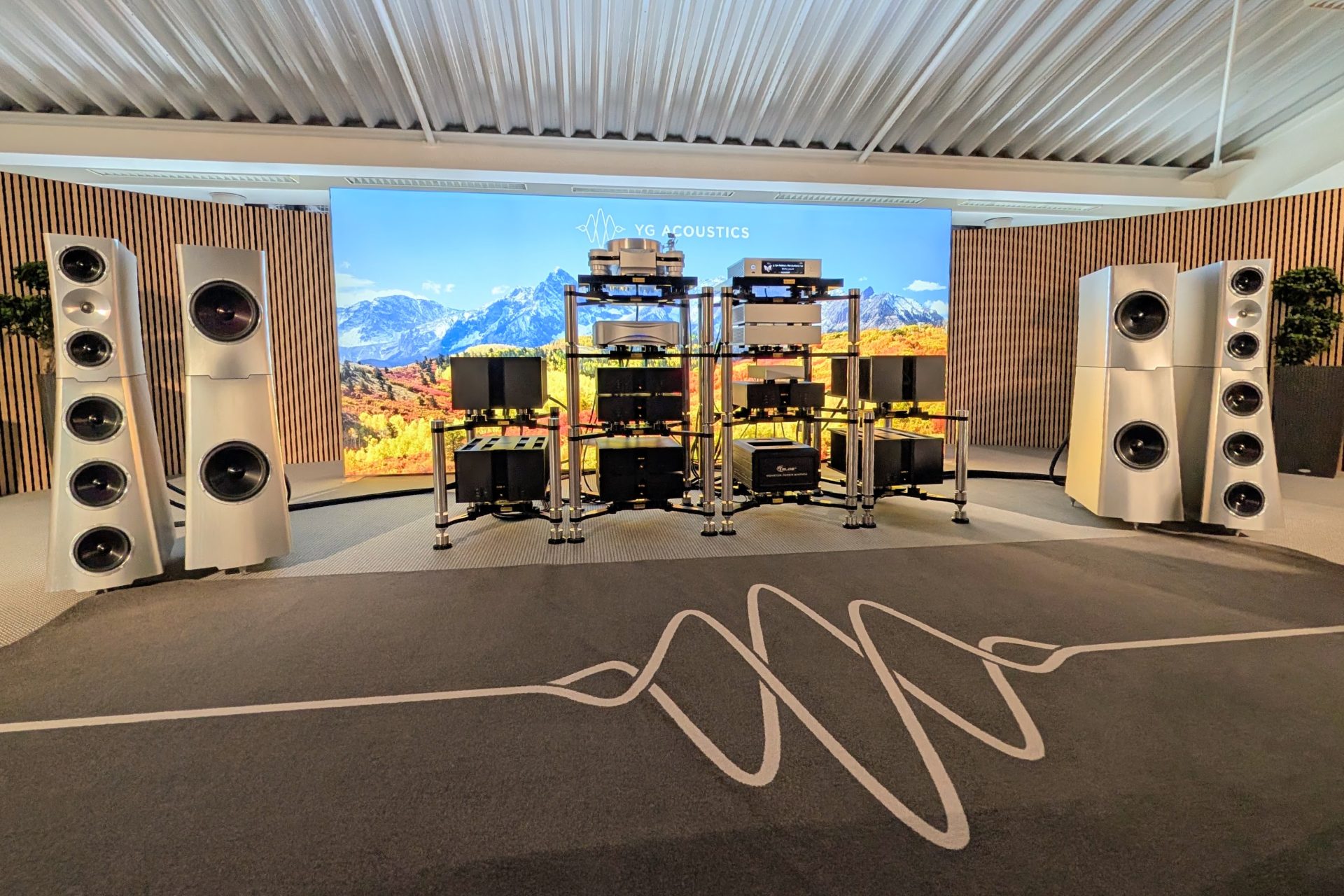
I just returned from the High End Munich 2025 — the world’s largest trade show for high-end audio — and let me tell you: it was a breathtaking and slightly overwhelming experience: Room after room of shiny components, eye-watering price tags, and audio so lifelike you feel like Miles Davis is smoking a cigarette in your living room. It’s a wonderland… and a jungle.
Events like this are thrilling if you’re deep into the hobby. But they also remind me just how confusing and intimidating HiFi can be for newcomers. People who just love music, who aren’t interested in snake oil or audiophile jargon, simply want a system that sounds better. They’re not looking to mortgage the house for a pair of golden speaker cables. They want better sound than their Bluetooth box, but without a PhD in electrical engineering.
They often ask me: Where do I start? What matters most? How do I avoid wasting money?
So here’s a practical, entertaining guide. A sanity-saving companion for anyone who wants to dive into HiFi without drowning in jargon or bank debt.
🎧 Why You Should Trust Me (at least a little…)
For the past 30 years, I’ve been immersed in the world of HiFi, home theater, and multi-channel audio. I’m tech-obsessed, curious, and hands-on. I experiment. I visit trade shows and demo rooms. I read reviews (with a grain of salt), talk to engineers and regularly exchange thoughts with a crew of equally audio-obsessed friends, and, perhaps most importantly, I’ve built my own dream system from scratch (you can read about it here).
I don’t sell gear. I don’t have a horse in the race. I’m just someone who cares deeply about good sound, and helping others find it. What I do have is experience, hard-won perspective to avoid the most common HiFi pitfalls.
🔍 Start With the Right Questions
Before you buy anything, take a breath. Pour a coffee. And think.
A good HiFi system is not one-size-fits-all. It depends on you: your space, your habits, your taste, your expectations. To help you begin, here’s a list of questions I always ask friends before making any recommendation:
- What’s my budget? How much are you willing to spend? Then ask: Could I stretch it if it really makes a difference?
- New or used? Used can be great, but check warranties and condition.
- Will it be used for TV sound too? HDMI eARC is becoming common but still rare in ultra-high-end gear.
- Stereo or multichannel? For pure music lovers: stereo often wins. For movie fans: consider multichannel, but carefully (more on that below).
- Room size and layout? This is huge. A small concrete loft with glass walls needs very different gear than a carpeted music room with bookshelves.
- Ease of use vs. ultimate quality? Who else will use the system? Simplicity may matter more than you think.
- Aesthetics: How much do looks matter? Are there preferred colors or materials? Where will you place the components? These are the compatibility questions for the boss in the house: Your wife 😅
- Speaker space: Do you have space for two full-size speakers? What dimensions, shapes, or colors are acceptable?
- Rack space for electronics: How big can they be? How far from the speakers will they sit?
- Music preferences: Jazz, classical, electronic, rock, hip hop—all benefit from different system strengths.
- Playback sources: Do you listen to Vinyl? CDs? Streaming? Your own File Library?
- Streaming habits: Which service? Shared family plans? Integration with other devices?
- How do you listen? Want the same playlist in your car? (Yes, the car matters!)
💡 Pro Tip: Some of these answers may feel unrelated to sound, but they’re crucial to choosing components that will truly fit your life.
⚠️ Important Notes
HDMI eARC and high-end gear: While HDMI eARC has made its way into many modern systems, the absolute top-tier gear often avoids HDMI altogether, partly due to concerns about electrical noise introduced by HDMI chipsets. In those systems, each function (TV sound, streaming, DAC, amplifier) typically has its own dedicated component, and price is usually no object.
Multichannel vs. Stereo: A common trap is expecting a multichannel receiver to perform like a high-end stereo amplifier. Truth is, even a budget stereo amp will often sound better in 2-channel mode than a much more expensive AV receiver. If stereo sound quality is your priority, separate the two worlds. How can this be done? Look here.
Space constraints: If you lack space for speakers or components, you might need to go with a soundbar or a wireless all-in-one solution. That’s fine! Just don’t try to force a full rack into a tiny shelf or a massive speaker in a small room.
Music style matters: Some components and speaker brands cater better to specific genres. For example, if you love orchestral music, you might look for brands known for openness and scale. If you love electronic music, punch and bass control become more critical.
💰 The Myth of the Perfect System – And the Role of Budget
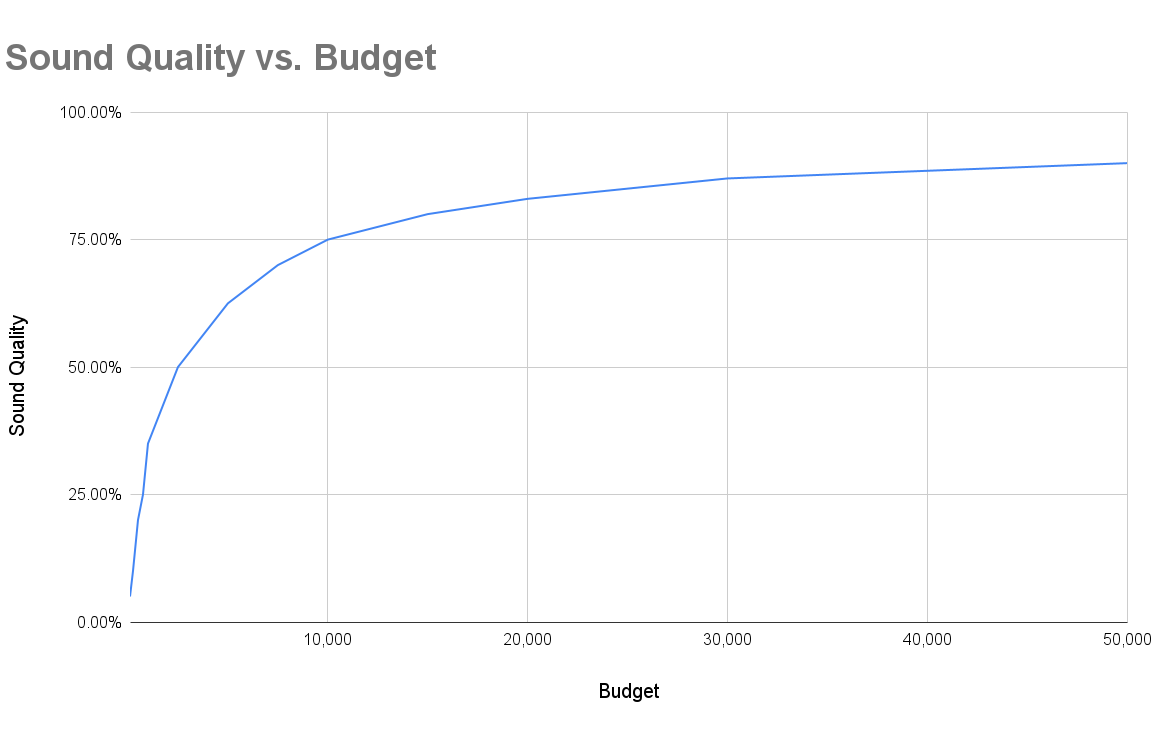
Let’s be real. Everyone wants 100%. The truth? That doesn’t exist. There’s always a trade-off. More money can buy better sound, but the return on investment isn’t linear. The higher you climb, the smaller the gains. It’s called diminishing returns. Here’s how it works:
At the beginning, every Dollar counts. A $1,000 system will sound way better than a $100 Bluetooth speaker. But jump from $5,000 to $10,000? The improvement may be subtle. Go from $50,000 to $100,000? You might be chasing the tiniest sonic detail.
So, is a million-dollar system “worth it”? That depends on who you are. If your garage holds 25 Ferraris, why not get the Rolls-Royce of HiFi, too? But for the rest of us, the sweet spot lies somewhere between smart investment and sane restraint.
To illustrate this, I’ve created a graph showing how sound quality typically scales with budget. You’ll clearly see where the curve starts to flatten — and where it’s time to say “good enough.”
🧠 What Really Matters for Great Sound?
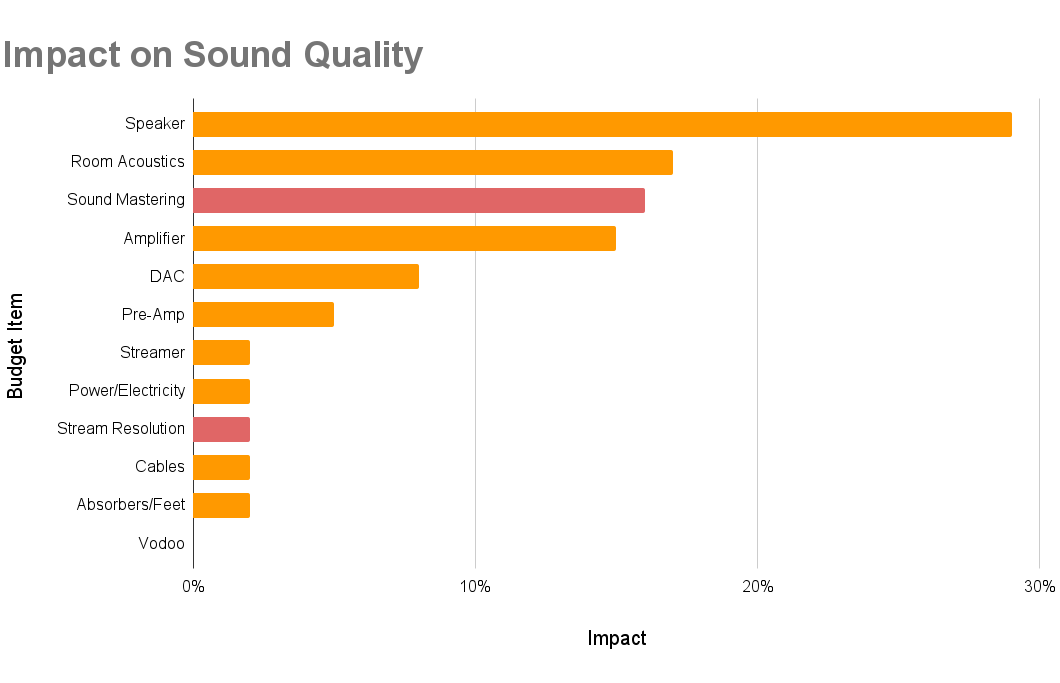
Now that we’ve got the budget elephant out of the room, let’s talk about what actually matters. I’ve compiled a chart showing the factors that impact sound quality — ranked by importance.
Some surprises?
- Room acoustics: Hugely underrated. Even the best system will sound like mud in a bad room.
- Sound mastering: You can’t fix a bad recording. A great system will actually reveal just how bad it is. Shit in = Shit out. 💩
- Cables, stream resolution, power conditioning? Small gains. Nice, but only after the big stuff is right.
🎯 A reminder: You can’t control mastering or streaming resolution. That’s the artist’s call. So don’t budget for it — just be aware. Sadly, many albums are poorly produced. It’s not your system’s fault.
🎚️ Room Correction Systems – Helpful, but not Magic
Modern HiFi systems increasingly offer automatic room correction, known as room EQ. These tools use microphones and DSP (digital signal processing) to measure your room and correct peaks and dips in the frequency response. Sounds great, right?
Well…. Yes and No. 🫤
They can definitely help. But they are not miracle workers. A poor room full of bare walls, large windows, and boomy bass traps won’t magically become an acoustic wonderland just because you ran an auto-calibration.
Room correction can fine-tune, not fix. Think of it as the icing, not the cake. Real improvement comes from physical changes: rugs, curtains, bookshelves, panels, speaker placement. Combine both, and now you’re cooking. Don’t fall for the illusion that room EQ alone can save a poorly designed setup. It’s a tool, not a cheat code. What to learn more? Have a look on this video here.
💡 Pro Tip: Even though room acoustics have a massive impact, you don’t need to throw your entire wallet at them. Around 10% of your total HiFi budget can go a long way, especially if you make smart choices with soft furnishings or DIY acoustic panels. For extreme setups or dedicated music rooms, hiring a professional can absolutely make sense — but even then, the 10% rule is usually enough.
💸 How to Spend Smart: Budget Distribution
Now that you understand what matters, how should you split your budget?
Glad you asked. I’ve developed a pie chart showing how to smartly allocate your HiFi budget.
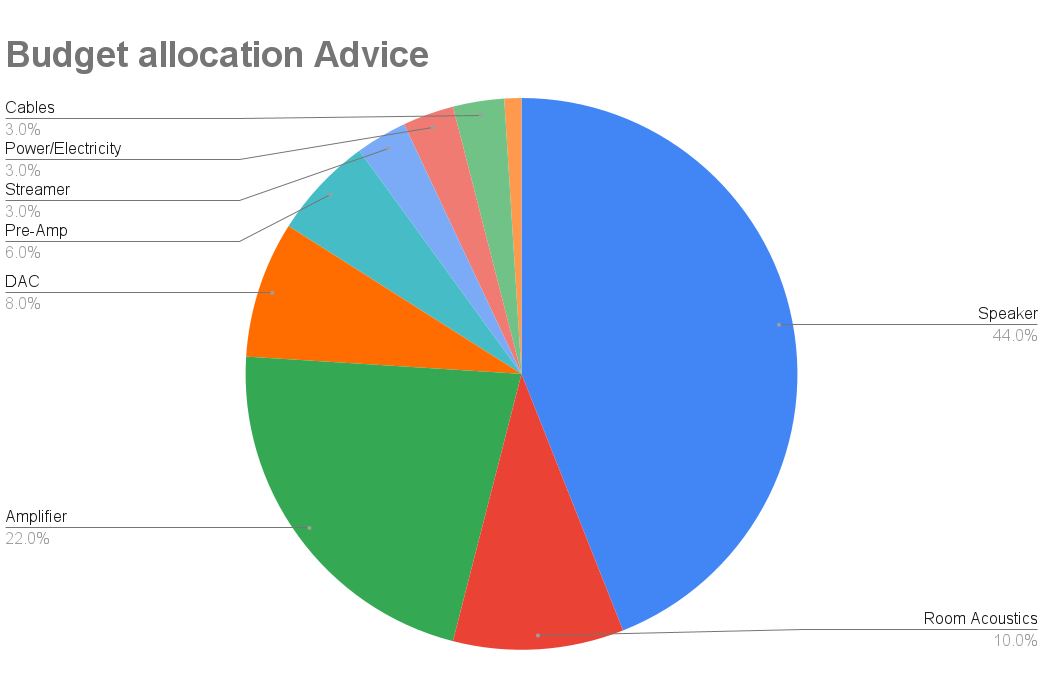
It’s not gospel — but it’s a great starting point. Spend the most on speakers, followed by amplification and acoustics. Overall, all the electronics together are slightly less influential than the loudspeaker. Don’t overspend on tiny gains like high-end cables until the core is rock solid.
🎯 A quick note on vinyl: You might notice that I haven’t included a dedicated line for analog sources like turntables. That’s not an oversight, just a personal bias. While vinyl remains beloved by many enthusiasts for its tactile charm and warm sound, it’s not a core part of my own setup. That said, if you’re into vinyl or plan to be, you can roughly align its budget share with that of a DAC/Streamer combo: Think of the turntable and phono stage together as the analog equivalent of your digital front-end. So yes, vinyl can be part of the equation — but it doesn’t have to be.
🧩 When to Go “Separate”
This is key: Each function in a HiFi system has a “critical spending threshold”
Below it, adding it separately makes no sense and it may sound worse than the integrated solution. But if you pass that threshold, separates can deliver magic. That’s why I’ve built a table showing when it’s time to split things up and how much to spend on each.
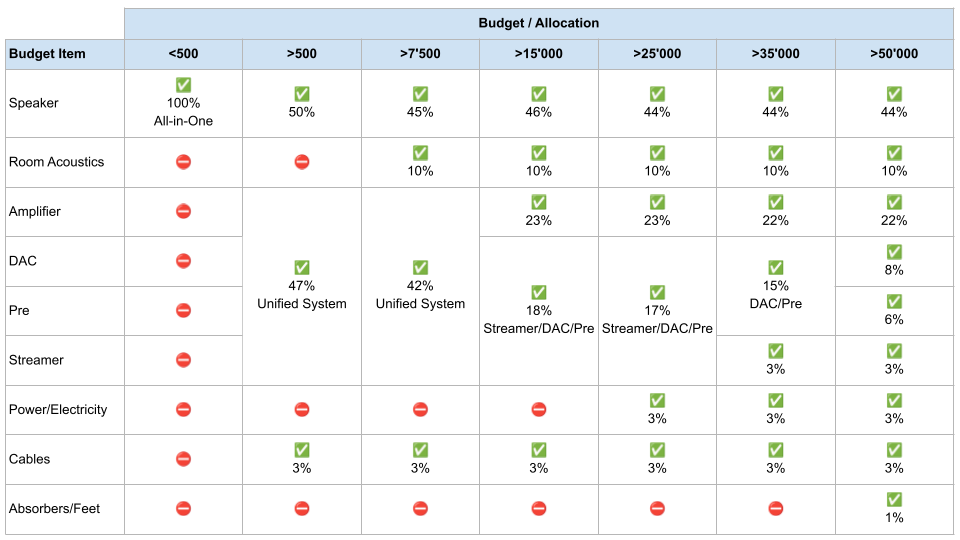
Low budget? Go all-in-one. Mid-tier? Consider splitting DAC and Amp. High-end? Go full separates. But always do so intelligently.
🔄 System Architectures: The Overlap Is Real
People often think: “Separates = Better.” But it’s not that simple.
There are stunning integrated systems (like active speakers with built-in DSP and streaming) that outperform clunky separates. Likewise, a wireless system can sometimes sound better in a tricky room than a “purist” setup.
So I created a bubble chart to show how these overlap:
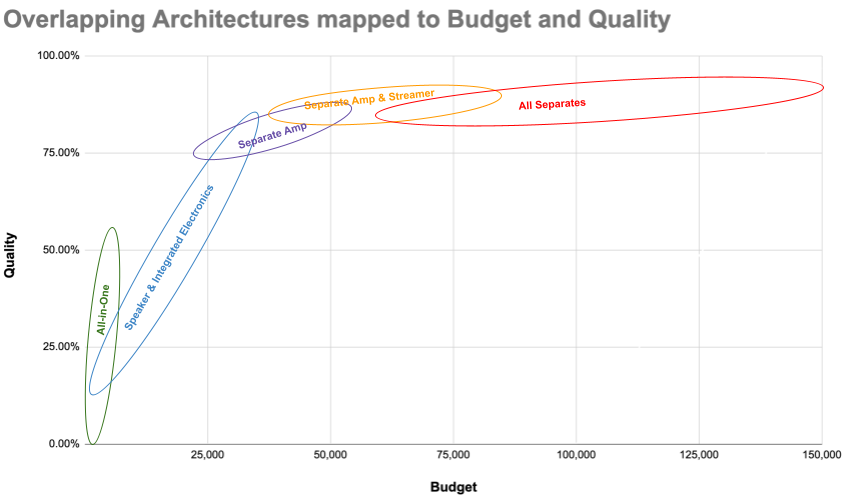
Don’t get stuck in dogma. A great system is one that works for you: In your room, for your music, in your life. Your goal isn’t to build what looks audiophile, it’s to build what sounds great for you.
🏠 The Most Important Test: At Home
Let’s end with something crucial.
Never buy a system based solely on reviews, specs, or dealer demos, or because it looks great on a pedestal in Munich. They are useful starting points — but they don’t replace listening in your own space. Room acoustics matter. Furniture matters. Your ears matter.
And most importantly: Just because two components are expensive doesn’t mean they’ll sound good together.
This is one of the most common mistakes, even among seasoned enthusiasts. You might pair a $10,000 amplifier with a $15,000 pair of speakers and still end up disappointed. Why? Because synergy matters. Components have different sonic signatures, electrical characteristics, and gain structures — and not all of them complement each other. Sometimes, a humble amp with a certain speaker will sound infinitely more alive and musical than an ultra-high-end mismatch.
💡 Pro Tip: Don’t assume price will fix your problem. It won’t. A system is more than the sum of its parts — it’s how those parts interact.
That’s why testing in your own environment is so vital. Many good dealers offer in-home trials. Use them. Try things out. Swap components. Trust your ears, not the price tag. And please: Respect the dealer’s time. If someone lets you borrow $25,000 worth of gear to test, don’t use that knowledge just to score a discount elsewhere. Fair play, folks. HiFi is a relationship business.
🎶 Final Words
Building the perfect HiFi system is a journey: part logic, part passion, part trial and error, part therapy. There’s no single right answer — but there are smart steps you can follow to avoid common traps. Don’t let perfection get in the way of joy. Start with your needs, not trends.
Ask the right questions. Focus on the fundamentals. Test in your environment. And don’t lose sight of the real goal: To enjoy the music you love in a way that moves you.
Happy listening and have fun on the journey!
//Alex
Enjoy the topc? Here is the complete HiFi Guide Series (in chronological order):
🎧 The Complete HiFi Guide Series
- 🎵 How to Build the Perfect HiFi System (Without Losing Your Mind) – (you are here)
- 🎧 HiFi on a Budget for Dummies
- 🔵 HiFi on a Budget: The Blue Pill
- 🔴 HiFi on a Budget: The Red Pill
 alexreusch
3 comments