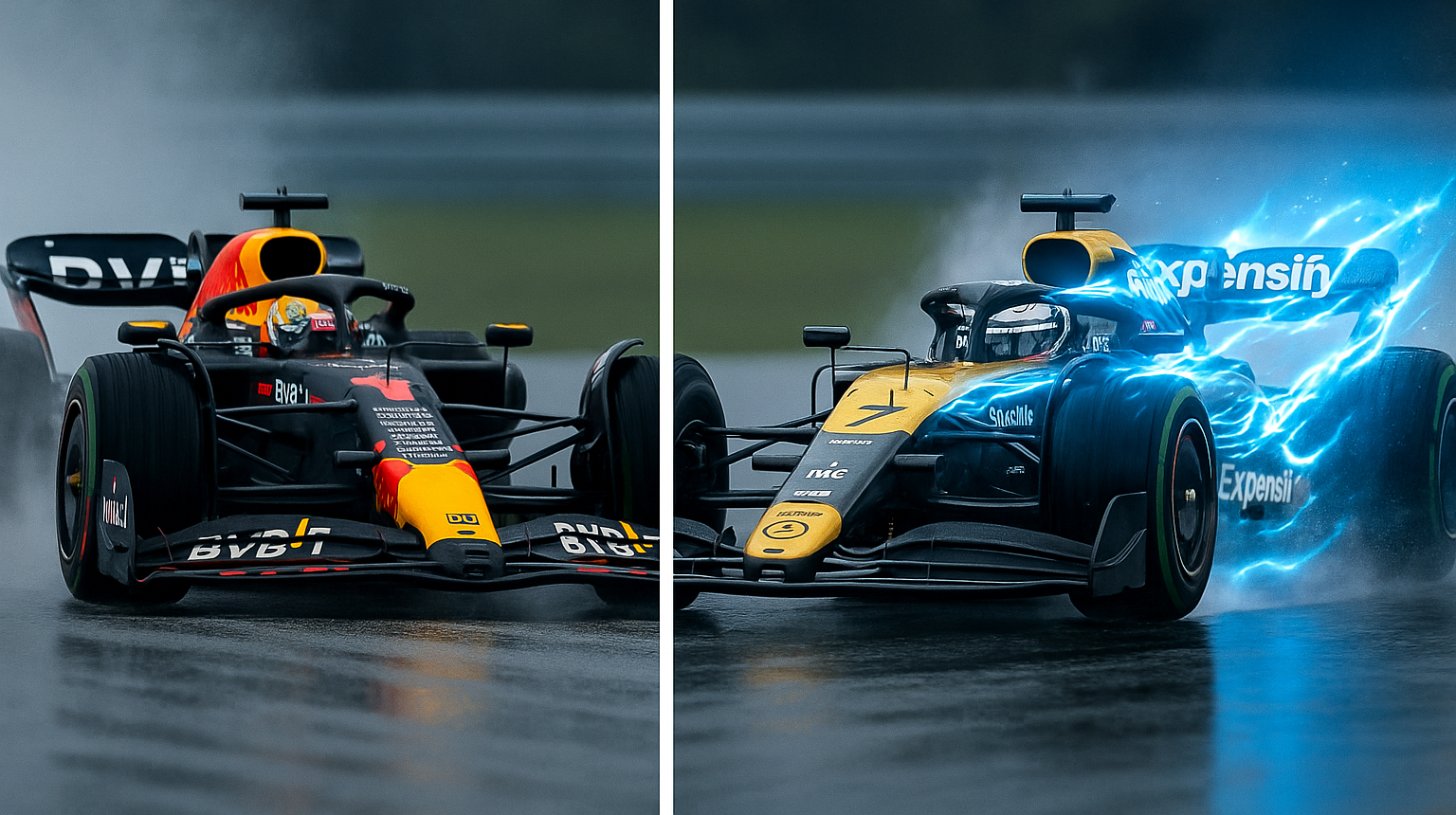
A Life in the Fast Lane
I grew up with Formula 1.
At five or six years old, I watched my first races: Alan Jones, World Champion 1980. Since then, I’ve followed every champion, every rule change, every technical evolution: Keke, Nelson, Nikki’s comeback, Prost, Senna, Mansell, Häkkinen, Schumacher, Alonso, Vettel, Hamilton, Verstappen… I’ve been there for all of them. To say that real F1 isn’t dramatic and funny is simply an understatement.
I read aerodynamic blogs, watch every YouTube tech breakdown, every race analysis. And I study the details. In short: I love this sport. And that’s exactly why this movie hit me so hard.
Hollywood Promises Realism – and Delivers Fantasy
F1 – The Movie, starring Brad Pitt and Javier Bardem, produced by Lewis Hamilton, was marketed as an authentic racing epic. What we actually get is a cinematic car crash, somewhere between Fast & Furious, Days of Thunder, and Saturday morning cartoons.
From the very first minutes, you know: this isn’t a movie about Formula 1. It’s a movie about what Hollywood thinks Formula 1 is. The dialogue is painfully stiff, the emotions plastic. And everything — absolutely everything — is explained to the audience. Overexplaining a movie. I love it, not.
The Kindergarten Commentary
The stadium announcer commentates as if talking to preschoolers. Every movement, every steering input, every DRS activation is shouted in real time, like a football commentator narrating every pass and tackle.
And then, for extra cringe, the crowd supposedly hears live team radio — unfiltered, broadcast over loudspeakers. In reality? Impossible. Team radio is delayed and selectively aired on TV. Spectators at the circuit don’t hear any of that.
It all feels like someone confused the FIA rulebook with a children’s audiobook.
The Start-Button Joke
Right from the opening sequence, you know what kind of nonsense you’re in for. Brad Pitt’s character “Sonny Hayes” stalls on the formation lap — on purpose. He pretends the car won’t start, just to gain a “strategic advantage.” Of course, the entire radio exchange is broadcast live through the track speakers (because that’s totally how Formula 1 works). Cue the enthusiastic announcer explaining it to the audience as if to toddlers:
“What first looked like a setback might turn into a huge advantage!”
Pure cringe. Utterly embarrassing. 🫣
According to the film’s logic, Pitt now has warmer tires because he had to catch up and therefore could drive faster. What a joke! The entire point of the formation lap is to heat the tires. Nobody drives “leisurely” at the front; they all fight to get their tires into the optimal window through braking, weaving, and throttle bursts.
The idea that a driver starting seconds later would have better tire temps is complete nonsense. And the way the movie treats it as a genius tactical move just proves how far removed it is from actual racing logic.
Then, as always, he rockets past half the grid within a few corners because, of course… “warm tires.” A car that qualified dead last now storms through the field like it’s Need for Speed. This level of stupidity deserves a podium of its own.
When DRS Becomes a Magic Button
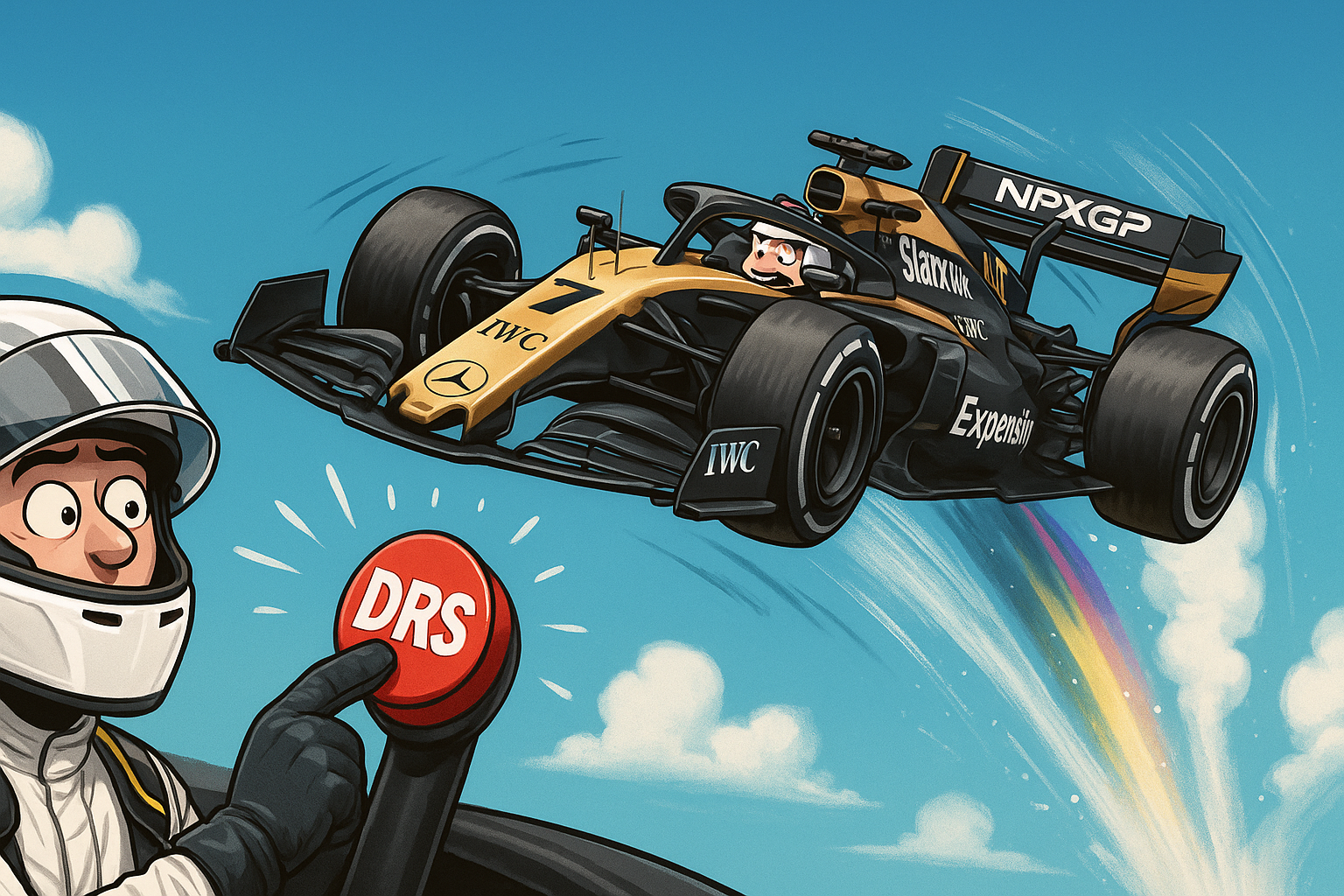
The Drag Reduction System (DRS) is portrayed as a miracle weapon: press a button, and boom! Instant overtake.
In reality, DRS is a useful but limited tool that only works under perfect conditions: You must be right behind another car, within one second, and it only works in one or two designated zones per circuit. It’s not a “press and pass” button. But in the movie? Click, and suddenly he’s flying by.
If only real life were that simple! The real drama in F1 lies exactly in the precision it takes to make that move work.
Crashes Without Consequences
Even more absurd are the race scenes where Brad Pitt deliberately causes crashes — multiple times — to trigger a Safety Car. He runs over curbs, scrapes walls, nudges other cars, and somehow his car survives untouched. Apparently, these machines are made of titanium and blessed by the gods. Sure, quick nose change in the pits and off we go. Hilarious.
In real Formula 1, that would earn a penalty. Ten seconds, a stop-and-go, or in extreme cases, a black flag. In the movie, it’s simply “part of the strategy.” Recklessness as a tactic — You only see that in bad video games. (Although, to be fair, Mario Kart is still cool.)
Slicks in the Rain. Physics? Never Heard of It!
Then comes the scene that makes every fan scream at the screen: Drivers stay out on slicks in pouring rain. Not by mistake, on purpose. And they keep racing, at full speed.
In reality, that’s suicide on four wheels. Slicks have no tread, nothing to disperse water. Even on a damp track, they lose grip. In the wet, you’re spinning out within two corners. No professional driver would ever stay out on slicks in heavy rain, certainly not at race pace.
But in the movie, it’s portrayed as a tactical masterstroke. They stay out and pull away… Apparently rain tires are just a fashion choice. In real F1, that would end in a spin, a Safety Car, or — best case — a scenic detour through the grass.
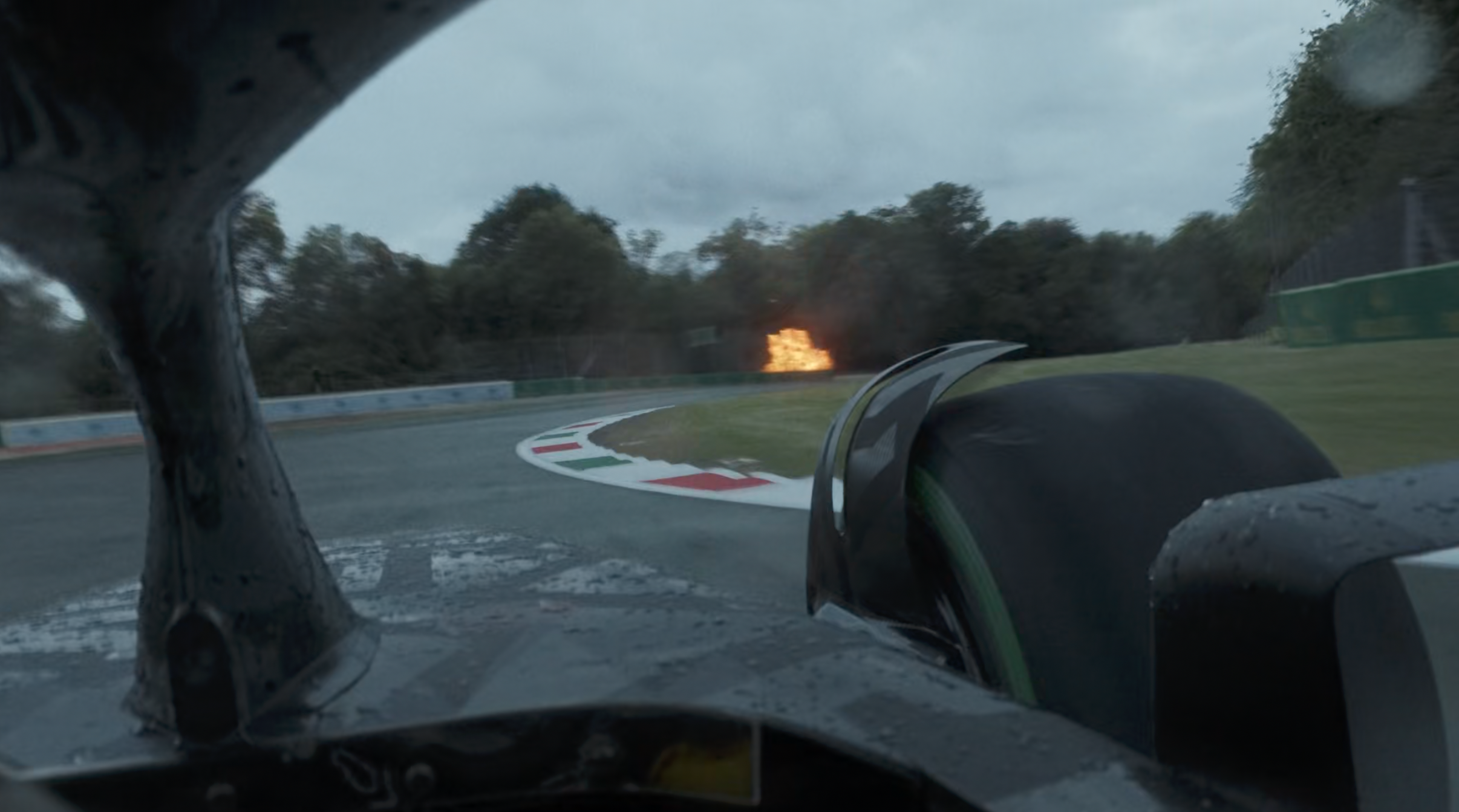
And then, halfway through, comes the so-called “big moment”: The young hotshot teammate, desperate for glory, tries to overtake Verstappen (yes, that Verstappen) for the win, loses control, goes straight on, flips spectacularly through the air, and explodes in a glorious ball of Hollywood fire. At that point, I couldn’t take it anymore. I burst out laughing… 😂
The Fairy Tale of the Miracle Team
Halfway through the season, the fictional team is on life support: Zero points, totally hopeless.
We barely see any qualifying sessions, but it’s clear: they start at the back. The car is slow, the setup terrible, no pace anywhere. And then, suddenly, they’re fighting for podiums. A backmarker car that’s been garbage all season is magically competitive. Sure.
Even getting within DRS range (one second behind the car ahead) would be unrealistic with a car that poorly balanced. But overtaking half the grid? Forget it. In the movie, they slice through the field as if they found the Mario Kart turbo mushroom.
In the real world, to achieve that you’d need a new concept, a new chassis, a miracle, or at least a regulation change (which doesn’t happen mid-season). But here, all it takes is a little motivation, a wrench, some “computer magic,” and a heroic soundtrack.
The “Magic Car” and the Laws of Physics
The biggest technical joke in the film is the so-called car that can follow another without being affected by dirty air. Anyone who knows aerodynamics knows this is the holy grail of modern Formula 1, and it’s been unsolved for twenty years.
The FIA has rewritten the rulebook multiple times to reduce “dirty air” — the turbulence from the leading car that robs the follower of downforce. Teams still struggle with it every season. You can’t just “design it away.”
And then comes Brad Pitt, a.k.a. Sonny Hayes, with one of the most laughable lines ever written: He tells his chief aerodynamicist, naturally a brilliant young woman who can apparently defy physics, to build him a car that’s “ready for combat.” 🤦 A car that can follow others without being disturbed by their wake.
Excuse me? That’s not strategy, that’s science fiction. The problem lies with the leading car, not the one behind. You can’t just order a “combat-ready” car and magically neutralize fluid dynamics.
The Myth of the “Turbulence-Absorbing” Sidepod
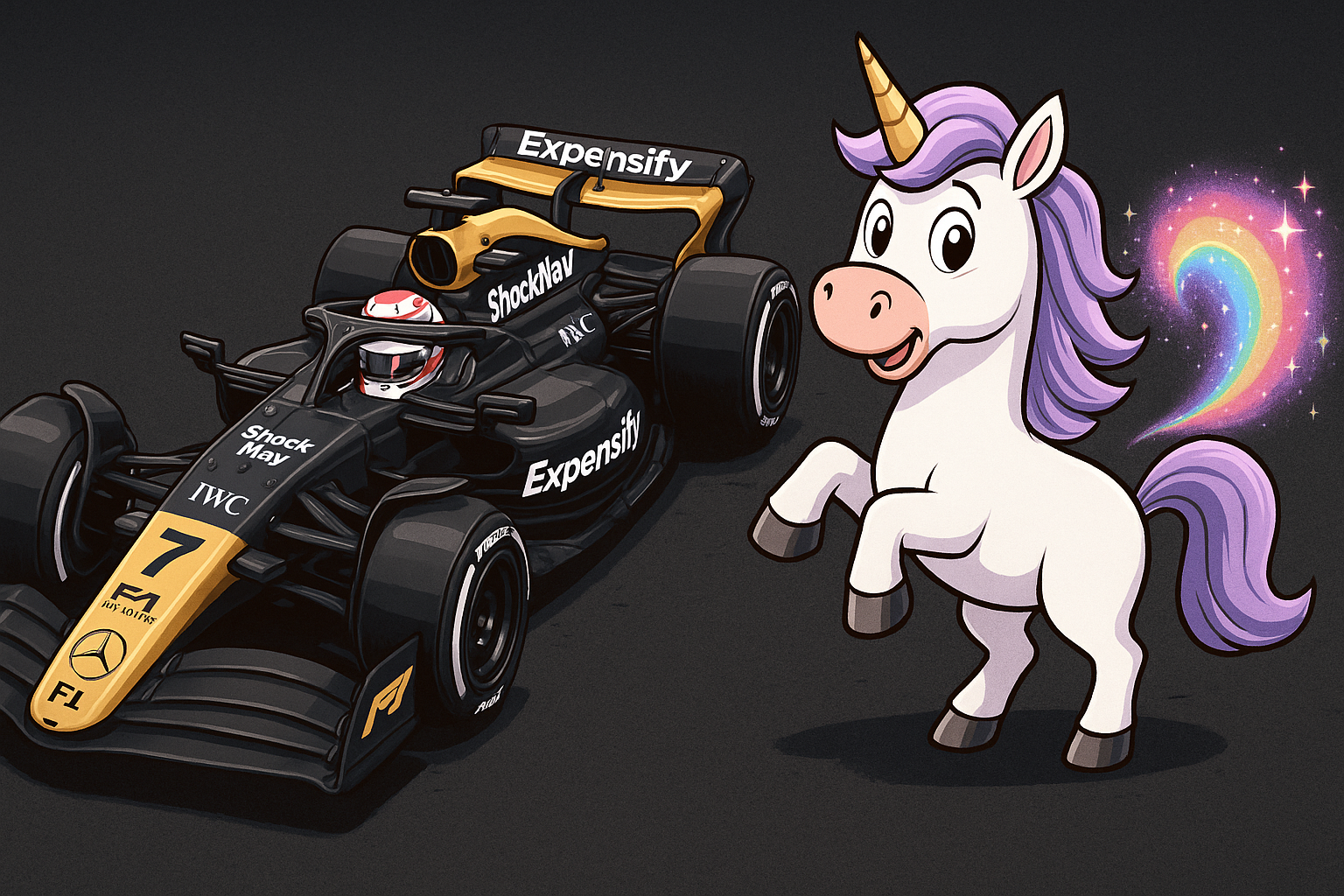
The movie tries to explain its miracle car with a bit of pseudo-science: The engineers supposedly designed a few carbon “airflow deflectors” along the side of the car to improve the underbody airflow, allowing the car to follow others more closely. Sounds clever. It’s nonsense.
Yes, in real life, Formula 1 cars use small carbon elements — bargeboards, flow diverters, and turning vanes, to guide air efficiently around the chassis and feed the floor. But these only optimize clean airflow around the car’s own structure. They can’t magically fix or “smooth out” the turbulent wake created by the car in front. That’s like trying to stop a hurricane with a paper fan.
That disturbed air — the so-called dirty air — is chaotic and unpredictable, constantly changing direction and pressure. Once it hits, it ruins the downforce under your floor. You can’t just bolt on a few carbon plates and pretend physics doesn’t apply. If such a system really worked, every team on the grid would already be using it. To do anything like that, you’d need active aerodynamics with sensors, real-time feedback, and morphing geometry, which is banned in Formula 1 and challenging even in aerospace. The idea of a passive “turbulence-eating sidepod” is so absurd it’s almost funny.
Hollywood clearly picked up on real aerodynamic jargon, stripped away the complexity, and turned it into another miracle fix: A few panels, a montage, and voilà: A car that beats turbulence itself.
And as if that weren’t enough, the movie completely ignores the sport’s actual regulations: Since 2021, Formula 1 has operated under a strict budget cap limiting annual team spending. You can’t just throw unlimited money at a problem or develop revolutionary parts overnight. Wind-tunnel and CFD simulation hours are also capped. The worse your team’s results, the more time you get, but even then, we’re talking about a few weeks of testing. Over the course of a whole season! A brand-new aerodynamic concept appearing mid-season, especially near the end of the year? Absolutely impossible.
In short: A sidepod that “absorbs turbulence” and gets built overnight is about as realistic as a spoiler made of Vibranium. But hey, it’s the combat update! Hahaha!!!
The Comeback of the 60-Year-Old Wonder Driver
And then there’s Brad Pitt himself, a.k.a. Sonny Hayes, supposedly a former racing prodigy who once battled with Senna and the greats of his era. After a crash, he vanishes from Formula 1, spends decades racing off-road somewhere in the desert, surfing, and contemplating life. And suddenly… Boom! He’s back.
The movie even shows flashback scenes with a yellow Formula 1 car carrying Camel sponsorship, unmistakably the Lotus livery used from 1987 to 1990. Since Senna himself drove that yellow Lotus until the end of 1987 before moving to McLaren in 1988, and the flashbacks show him in his McLaren MP4/5B with the number 27, that places the timeline to the 1990 season. At that time, the average F1 driver was around 27 to 28 years old, with the youngest rookies typically in their mid 20s. Never 17 or 18 like today. So, even if we assume Sonny Hayes was a young talent then, say 23 or 24, that would make him roughly 58 to 59 years old today.
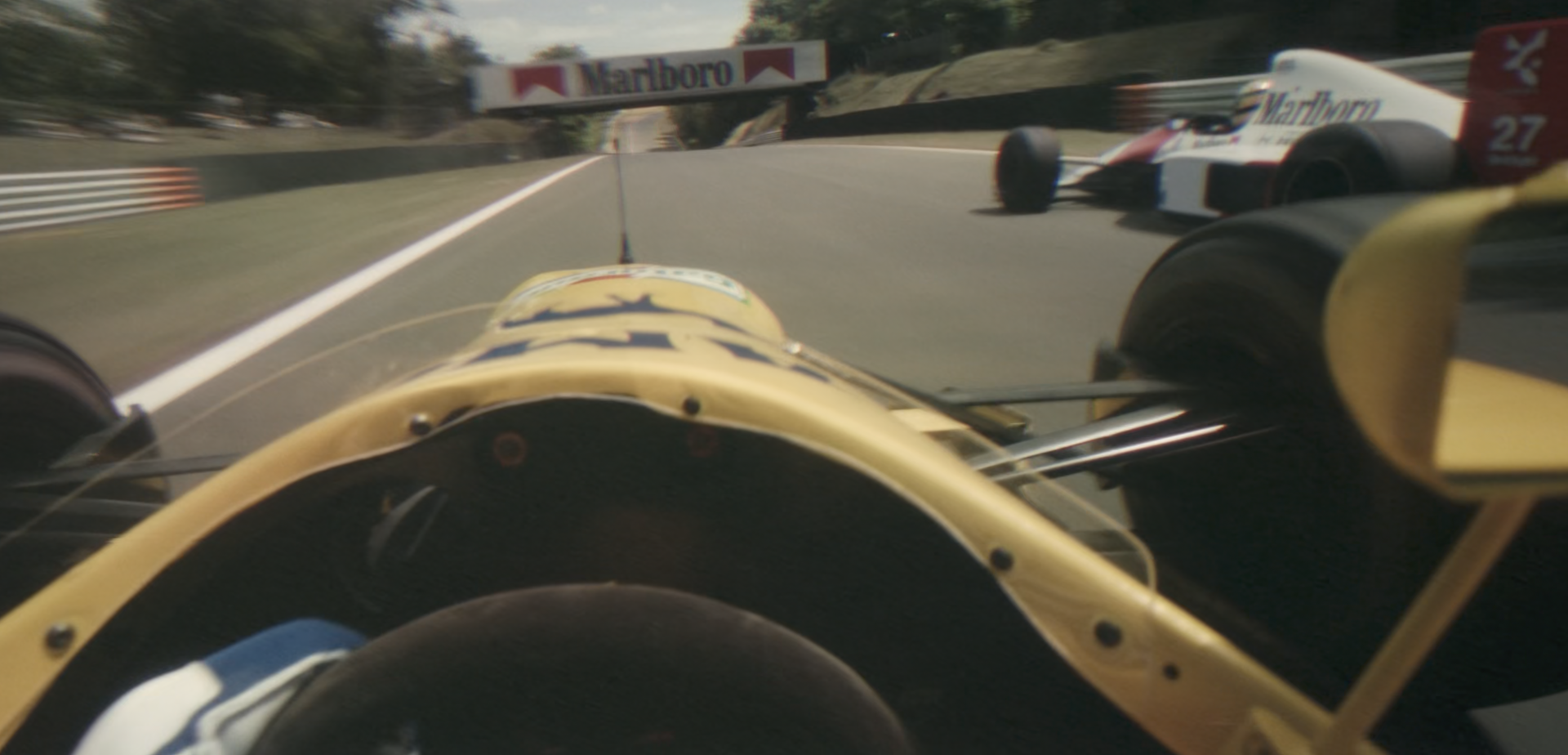
At nearly sixty, he jumps straight into a modern F1 car that has evolved over thirty years, carbon brakes, hybrid engines, energy recovery systems, steering wheels with more buttons than a spaceship. But of course: No problem for Sonny Hayes. Endurance isn’t necessary the problem with age, but reaction time is. And that’s something you simply lose over time. Sonny’s reaction time? Like a 25-year-old. His fitness? Superhuman. After two laps, he’s right there, fighting with the best.
So yes, 60-year-old rookie going wheel-to-wheel with the young guns of F1. Sure. Because modern Formula 1 cars are so easy to drive. Anyone who’s seen a documentary about G-forces or driver reflexes knows this is pure science fiction. But Hollywood loves that story: The aging lion returns, proves everyone wrong, beats the kids. Without question: A total joke.
Realistic? Not even close.
Entertaining? Maybe, if you don’t have motor oil in your veins.
Final Lap: Powered by Bullshit
I get it: Movies exaggerate. But F1 – The Movie doesn’t exaggerate; it abandons reality entirely.
Produced by Lewis Hamilton, of all people. Seriously, what was he smoking? This isn’t a film about Formula 1. It’s about Hollywood’s version of Formula 1: All drama, zero authenticity.
For real fans, it’s unbearable: Too much pathos, not enough F1. If you truly love Formula 1, do yourself a favor and skip it.
Because F1 – The Movie isn’t Driven by Passion.
It’s Powered by Bullshit.
 alexreusch